By Lin Wan, Foreign-Trade Lead at KKCN, Jingdezhen
A glaze looks like a color you can pick from a chart, and most buyers approach it that way. They send a photo of a celadon cup or a Jun bowl and ask for the same color on their range. What they get back depends less on the recipe than on the kiln: how thick the glaze went on, where the piece sat in the firing, and how much oxygen reached it at the moment the glaze melted. Chinese porcelain glazes are a recipe and a firing together, and some of them are meant to come out a little different every time.
That is the single most useful thing to understand before choosing one. Some glazes are stable: fired with care, they repeat closely enough to be matched against a measured tolerance, load after load and year after year. Others are reactive: the variation is the reason people buy them, and no factory in China or anywhere else can make two pieces identical. Neither kind is better. They suit different ways of selling, and many disappointments I’ve seen in ten years of export work came from choosing a reactive glaze for a range that needed to match, or from treating natural variation as a defect.
This guide is written from the export desk of a porcelain factory in Jingdezhen that fires every glaze it sells, Ru, Ge, Jun and Tang Sancai included. It covers what a glaze is and what the kiln does to it, the main glaze families a buyer will meet, how each behaves in daily use, and how to approve and reorder one. Historical and technical points from outside sources are listed at the end.
What a glaze is, and what the kiln does to it
A glaze is a thin layer of glass fused onto clay. It goes onto the dried or once-fired body as a liquid suspension of ground minerals, by dipping, pouring or spraying, and in the kiln it melts and bonds with the surface. On porcelain, the glaze and the body mature together at very high heat. Our four natural-gas shuttle kilns in Jingdezhen fire porcelain at 1,280–1,330 °C, most often at about 1,300 °C (2,370 °F), over a full cycle of 22 to 28 hours. At that heat the body vitrifies, meaning its particles fuse into a dense, glassy mass, while the glaze melts into a smooth skin over it.
Vitrification is what separates porcelain from other ceramics in use. Canada’s border agency, in its guidance on classifying ceramics, defines porcelain and china as almost completely vitrified, with water absorption of 0.5 percent or less and translucency through 4 mm of body, and puts typical porcelain firing at 1,200–1,400 °C. Earthenware, by contrast, absorbs more than 3 percent and is fired at around 1,000–1,150 °C. That difference is why a high-fired porcelain cup doesn’t take up tea or water through a chip, and why a low-fired piece needs more care.
The air in the kiln matters as much as the heat. In a reduction firing, the kiln team cuts the oxygen while the glaze is melting, and the flame pulls oxygen out of the metal oxides in the glaze. Iron that would fire amber or brown in plenty of air fires green or blue instead; copper that would turn green fires red. Our kilns hold reduction for two to four hours at the top of the firing and then cool in stages, which relieves stress in the body. Our Kiln Firing page explains how a load is set, heated, reduced and cooled, and Craftsmanship & Production shows where firing sits among the other stages of the work.
Stable or reactive: sort the glaze before you choose it
Before choosing a glaze for a range, decide which kind of glaze you are buying. The table below sorts the families buyers ask us about by how closely they repeat, and what that means for approving them.
| Glaze family | How predictable | What varies | How to approve it |
|---|---|---|---|
| Clear glaze on white porcelain | Very stable | Slight warmth of the white | Against a white reference piece |
| Solid monochromes, gloss or matte | Stable | Tone with thickness | Measured tolerance on fired tiles |
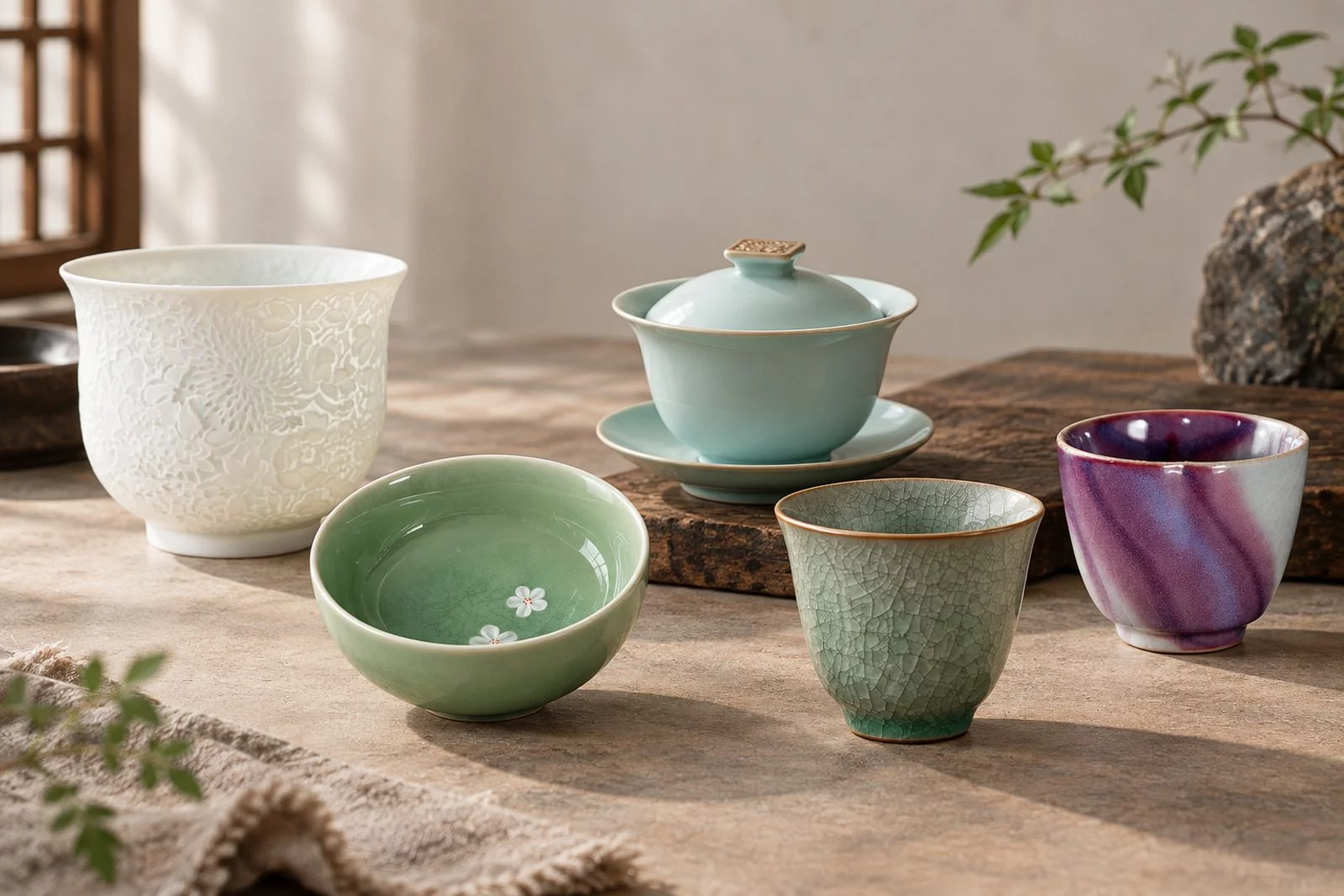
| Celadon | Mostly stable | Depth of green where the glaze pools | Lightest and darkest accepted tones on fired pieces |
| Ru | Moderately stable | Blue to gray-green, density of fine crackle | A fired range, not one piece |
| Ge crackle | Reactive in pattern | Size and color of the crackle web | A range of crackle density |
| Jun | Reactive | Where purple and blue appear and how much | Individual pieces, or a written range of what is acceptable |
| Crystalline | Reactive | Size and placement of the crystals | Individual pieces, or a written range |
| Wood-fired | Highly reactive | Ash deposits, flashing, luster | Each piece on its own |
For stable glazes, a number is possible and worth having. In our guide to custom porcelain product development, we explain how we match a brand color in a solid glaze to within ΔE00 2.5, measured with a spectrophotometer and approved on fired gradient tiles that show a lighter, a target and a darker version. For reactive glazes, a number would be dishonest. What a buyer approves instead is a range: several fired pieces that show the lightest, darkest, plainest and most dramatic results that will be accepted, with that range written into the order.
In our kilns, solid matte glazes, plain celadon and standard white porcelain repeat most closely from one firing to the next. Jun, crystalline glazes and heavy crackle vary most, because they respond so strongly to the kiln atmosphere. Yields tell the same story. A typical firing of standard white porcelain gives us 90 to 94 percent first-quality pieces, celadon 82 to 88 percent, and a controlled gas-fired Jun glaze 60 to 72 percent (KKCN production and sales records, 2025–2026). The pieces that don’t make it are part of what a reactive glaze costs.
Celadon: green from iron, deepened where it pools
Celadon is a glaze colored by a small amount of iron and fired in reduction. It is the classic Chinese green, and its character comes from thickness. Where the glaze pools, in a carved line, at the foot or inside a bowl, it turns deeper; where it thins over a rim or an edge, it turns pale. That’s why celadon and carving have gone together for a thousand years: the pattern appears in the glaze itself.
For a buyer, celadon sits on the stable side of the line, with one condition. A celadon range repeats closely if the form, the glaze thickness and the firing stay the same, but a change of shape changes the color, because the glaze pools differently. A tea cup and a dinner plate in the same celadon will not look identical, and they shouldn’t be expected to. Our plum blossom celadon tea cup and celadon dinner service use related glazes on very different forms. Living Oriental, a German home brand with stores in Munich, Berlin and Frankfurt, has reordered celadon vases and white tea sets from us every year for six years, which is the kind of steady repeat a well-controlled celadon can support.
The body under the glaze changes the green too. Our guide to celadon on porcelain or stoneware explains how the body shifts the color. The Celadon Legacy Series collects our celadon and Song-glaze ranges in one place.
Ru, Ge and Jun: the Song glazes
Three glazes from the Song dynasty account for a large share of what buyers ask us to make, and each behaves differently. We make and fire all three in our own Jingdezhen kilns.
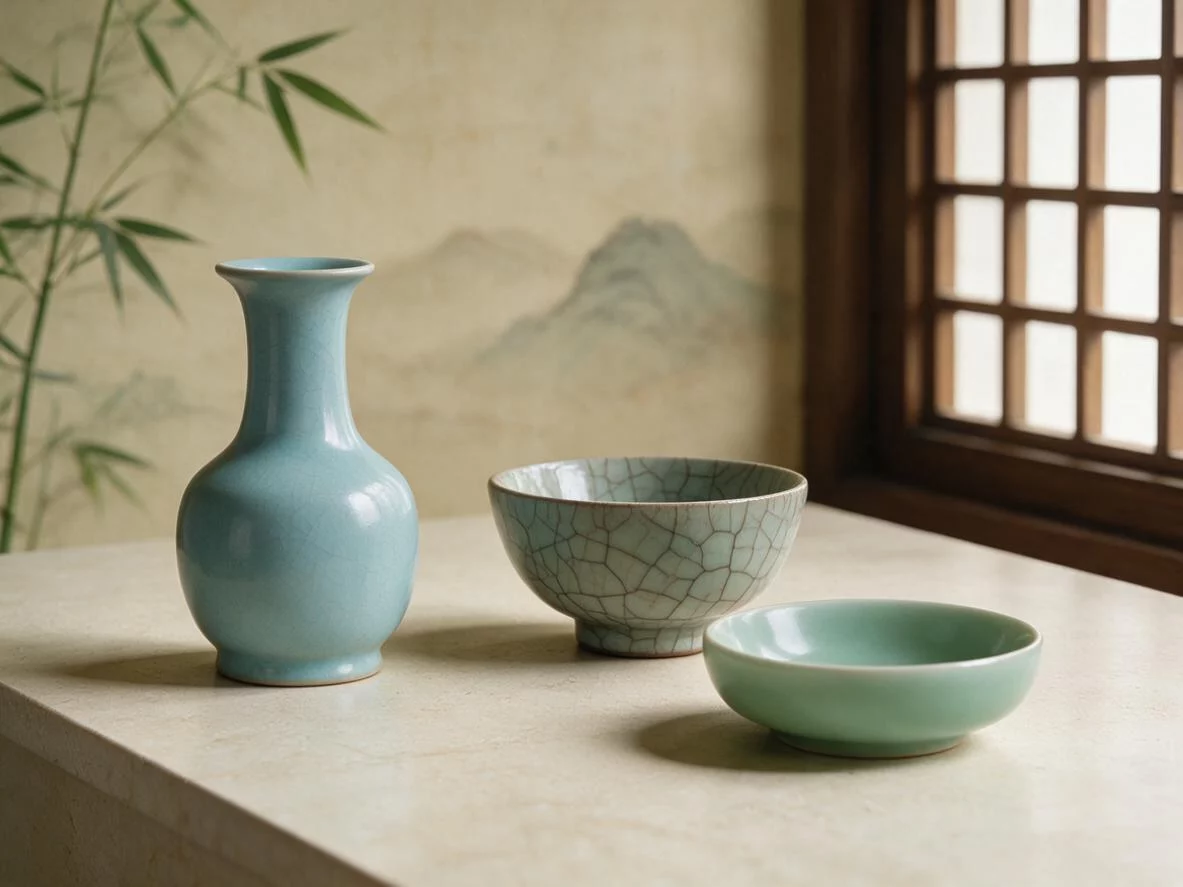
Ru is the quietest of them. The British Museum dates its Ru pieces to the Northern Song, about 1086–1125, and describes a thick blue-gray glaze with fine crackle and three small spur marks on the base, left by the supports the piece stood on in the kiln. A good Ru glaze has a soft, waxy surface rather than a bright shine, and its color sits between sky blue and pale gray-green. It is moderately stable: the tone and the fineness of the crackle vary within a recognizable range. Our Ru ware tea set is a typical use, and our Ru Ware page explains how to read the glaze.
Ge is defined by its crackle: a web of lines that forms in the glaze as the piece cools, because the glaze shrinks more than the body under it. The lines can be wide or fine, dark or golden, set in a gray or cream glaze. The crackle is in the glaze, not the body, so a Ge cup is not cracked, though it behaves differently in use, as the next section explains. Our Ge ware crackle tea cup shows a typical web, and our Ge Ware page covers the variations.
Jun is the most dramatic and the least predictable. Its blue glaze runs thick and opalescent, and copper in the glaze fires into purples and crimsons that drift through it wherever the glaze gathers or thins. No two pieces come out of the kiln the same, even side by side on one shelf. Our Jun ware meiping vase and Jun purple swirl cup show how differently the color can fall on two forms, and our Jun Ware page explains why.
Crackle in daily use
Crackle needs a word of its own, because it is the glaze buyers most often worry about after the goods arrive. A crackle glaze is crazed on purpose: the glaze is formulated to contract more than the body as it cools, so it breaks into a web of fine lines. Unintended crazing on an ordinary glaze, the kind ASTM C554 checks for with a thermal shock test, is a fault. Intended crackle on a Ge glaze is the decoration. The difference is whether the buyer chose it and approved it.
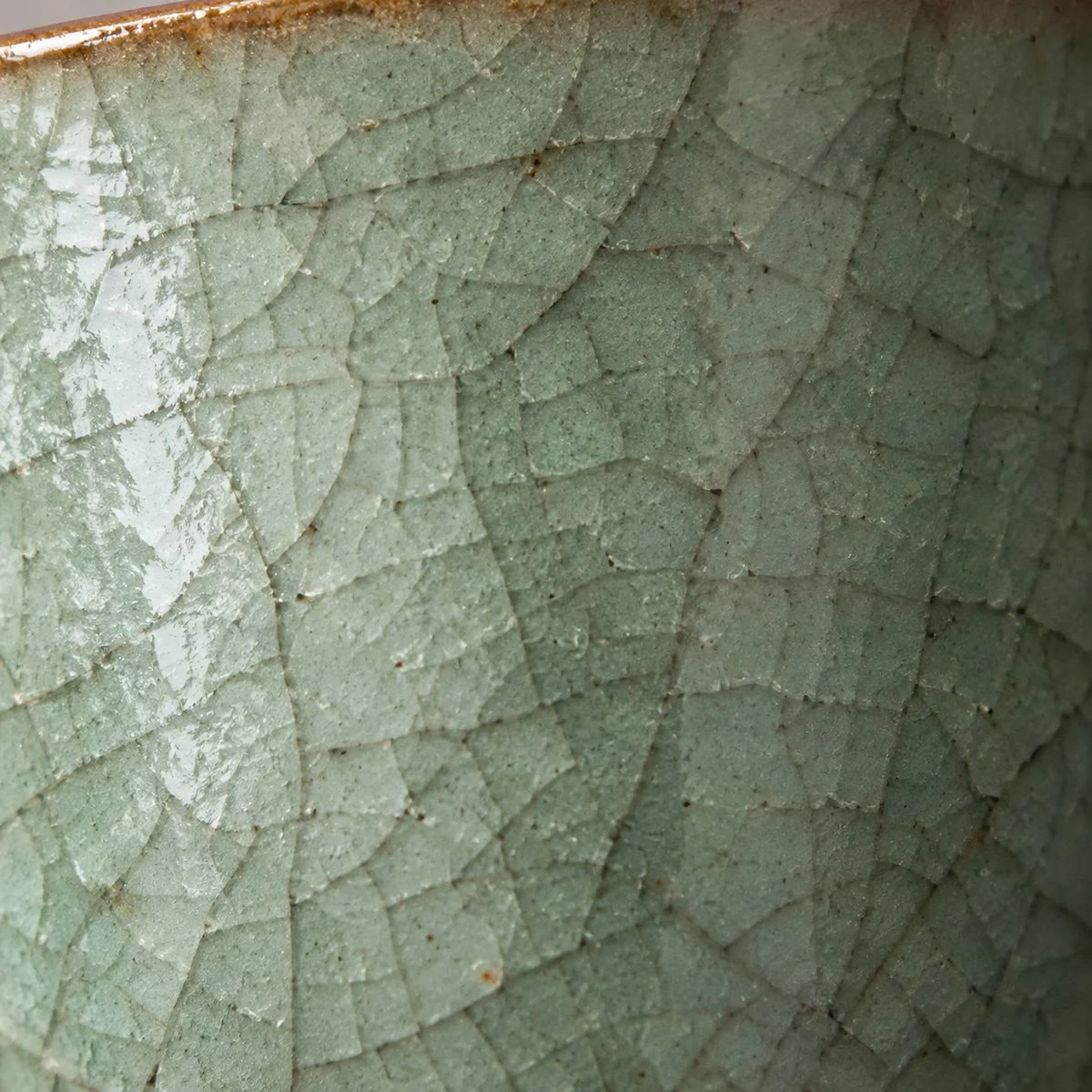
In use, the lines take up color. Tea, coffee and wine work into them over time, and a crackle tea cup gradually darkens, which many tea drinkers value and some customers mistake for dirt. We don’t pre-stain or ink the lines before shipping. The fine lines develop after firing and darken gradually with use, from tea, oils and everyday dust, and our care copy tells customers so. A seller should say the same in the listing and on the care card, in plain words: the lines will darken with tea, and this is expected. Strong bleach and long soaking aren’t kind to crackle, and hand washing suits it best.
The same logic applies to inspection, and our Quality Control page puts it in one line: a Ge crackle passes, and the same line on a plate fails. A crack-like line on a plain white plate is a fault in the glaze, and we pull it.
Selling a glaze where every piece differs
Jun, strong crackle and wood-fired glazes can sell very well, but only if the way they are sold matches what they are. The problem is rarely the glaze. It’s a product page with one photograph and a customer who expects to receive that exact piece.
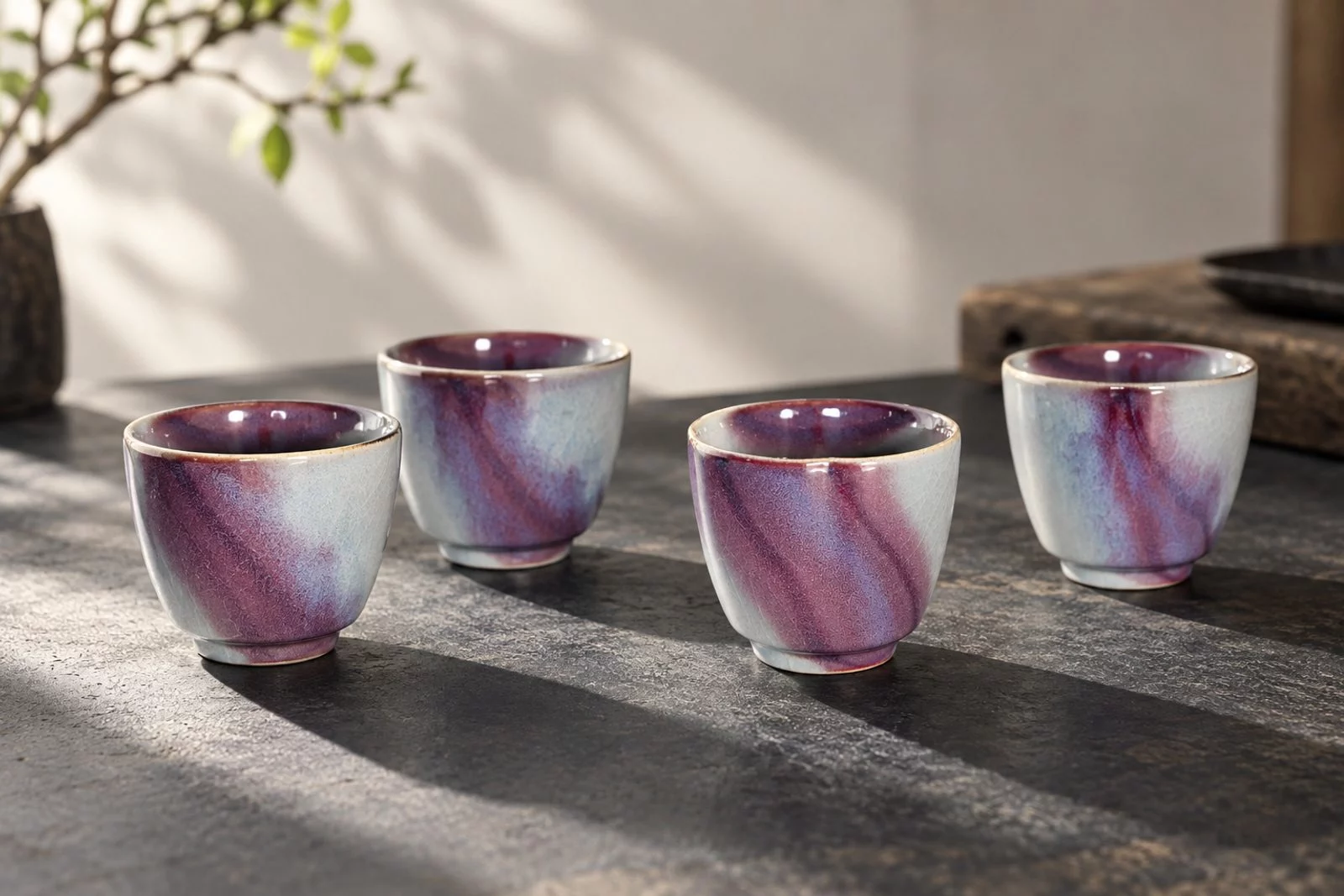
There are a few approaches that work. A retailer selling online can photograph each piece individually and sell it as itself, which suits higher-priced vases and collector pieces. For cups and smaller pieces sold in quantity, the listing can show three or four pieces side by side and say clearly that each one differs and the one shipped will not match the photograph exactly. In a shop, the variation becomes a reason to browse, and customers often enjoy choosing their own piece. Sets are the hardest case. We match sets by tone when they’re packed, but a Jun tea set will always show variation from cup to cup, and the buyer should approve that range before production.
Our work with Art Space Milano, a Milan art space and interior studio, sits at the far end of this: 30 one-of-a-kind commissions in exclusive kiln-transformation glazes, each quoted and approved as a single piece.
A reactive glaze can still be developed into a line, with enough control. A European gallery client preparing a limited tea ware line for an exhibition in Milan needed a very specific muted ash-blue reactive glaze. The first test firings swung between gray and pale lavender, because reactive glazes respond sharply to where a piece sits in the kiln. Our glaze lab adjusted the feldspar and flux ratios, fired a gradient set of test tiles, and gave the line a fixed zone in the kiln stack for every batch. With the recipe and firing profile documented, the ash-blue glaze became one of the gallery’s signature lines and has carried through its later seasonal releases. Reactive glazes never become identical, but that kind of control brings them inside a range that can be sold as a line.
White, monochrome, matte and glossy
At the other end of the scale from Jun sits the plain white piece: a white porcelain body under a clear glaze, fired once. It is the most predictable glaze there is, and also the most revealing, because a clear glaze hides nothing. The rim, the foot and the evenness of the white all show. Our White Porcelain page explains what to look for. Monochromes, single solid colors over the whole piece, sit close to white for stability, and they are the right choice for a range that has to match across many forms and reorders.
Finish is a separate choice from color. A glossy glaze is fully melted and smooth, easy to clean and forgiving of fingerprints. A matte glaze has a soft, low-sheen surface that many modern ranges prefer, and it feels quieter on the table. In daily use, a matte surface does show gray marks from metal cutlery, and ours are no exception. These are metal deposits left on the surface rather than deep scratches, and they can usually be lifted with a paste of baking soda or a non-abrasive ceramic cleanser. Steel wool and harsh scrubbers should stay away from matte pieces, and felt dividers in storage stop them marking each other. For hospitality and premium home retail we developed a matte glaze line formulated for low metal marking and steady dishwasher performance; it is the glaze on the matte tea sets Living Oriental reorders. Even so, gloss remains the easier choice for dinner plates that see heavy cutlery every day.
High-fired and low-fired: use or display
Not every glazed ceramic is fired at porcelain temperatures, and the difference decides what a piece is for. Tang Sancai, the amber, green and cream glaze on Tang-style horses and camels, is a low-fired glaze on an earthenware body. The Metropolitan Museum of Art describes the original Sancai as brilliantly colored lead glazes in green, amber and white, widely used on funerary goods, with their peak in the late seventh and first half of the eighth century. They were made to be seen, not used.
Our Sancai pieces, such as the Silk Road Tang Sancai horse and the Chang’an Tang Sancai horse, are made in our own Jingdezhen workshops and sold as display pieces, which is what they are. A low-fired body is more porous and softer than porcelain, and its glaze is not suited to food or drink. Our Tang Sancai page shows the range. As a rule, a piece meant for daily use at the table is better in a high-fired glaze, because a vitrified body and glaze stand up to washing and chips, though it still needs a test report that covers that piece for the market it is sold in; if it is for a shelf, a lobby or a gallery, low-fired glazes open up colors that high firing can’t give.
Wood firing: what the kiln adds and what it costs
Wood firing is the oldest way of firing Jingdezhen porcelain and the least predictable. For collectible pieces, pieces are fired in a traditional pine-wood kiln in Jingdezhen at about 1,300 °C, in strong reduction, for 50 to 60 hours without a break. Pine ash settles on the pieces as they fire and melts into the glaze, giving a velvety, creamy luster that a gas kiln doesn’t produce, and the flame leaves each piece marked a little differently.
The cost is in the losses. Only 30 to 40 percent of a wood-fired load comes out good enough to sell, so the survivors carry the cost of the rest, and the price reflects that. Wood-fired porcelain suits collector markets and high-end retail, where each piece is sold as itself. It does not suit a matched set or a range that needs to reorder. We offer wood-fired tea ware at a premium of 60 to 110 percent over an equivalent gas-fired piece, with a starting minimum of 150 pieces per shape. The premium covers the longer firing, the fuel and the lower yield.
Flaws, character and the line between them
Every glaze has its own faults, and the hardest part of approving a reactive glaze is agreeing where character ends and a fault begins. The common faults are well defined. Pinholes are tiny holes where gas escaped through the glaze late in the firing. Crawling leaves bare patches where the glaze pulled back from the body. Blisters are bubbles in the glaze surface. Warping, cracks and pieces fused to the kiln shelf are faults of the firing. When we open a kiln, our team checks for each of these, compares the color against the approved sample under the same light, and taps each piece for a clear ring, which a hidden crack dulls.
Character is different, and it is specific to the glaze. A run of glaze gathered at the foot of a Jun vase is part of the glaze. The same run on a white plate is a fault. A dark crackle line belongs on Ge and doesn’t belong anywhere else. That is why we agree four classes with each buyer before production: what is fixed, what is configurable, what is accepted as natural variation, and what is a defect. Our Quality & Approval page sets out those classes, and our Final Selection page shows how every piece is sorted against them.
Matching a glaze on a reorder
A glaze reorder is only as good as the record behind it. For every order, we keep the approved sample at our headquarters and record the glaze, its application thickness, the firing curve and the atmosphere in the order’s craft file. A reorder is fired to the same record and judged against the same signed range. For stable glazes, that brings the second order very close to the first. For reactive ones, it keeps the second order inside the same range, which is the realistic promise.
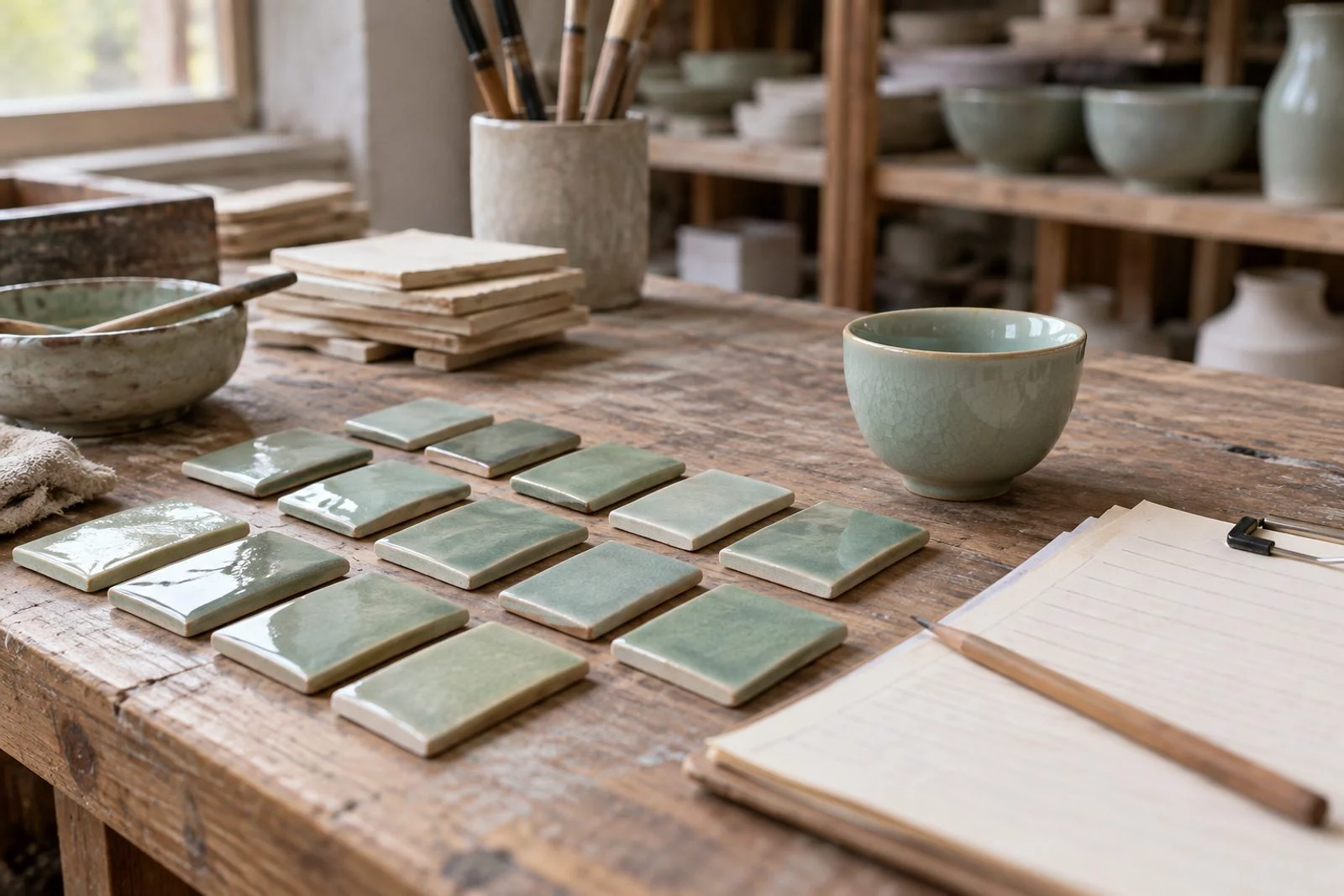
Two things help a buyer here. First, keep the approved piece or a fired tile on your side too, so both ends compare against the same object. Second, if you are developing a new glaze color, allow time: a new glaze or a new form takes 15 to 30 business days to sample with us, because each round needs a full firing. Glazes intended for food or drink also need testing, and that depends on the specific glaze and the market. Our report on white and celadon tea ware (SGS-CER-2026-0112) is listed with the others on our Quality Control page, and our guide to ceramic tableware compliance explains how to match reports to pieces. For our crackle, Ru and Jun tea ware, compliance and thermal shock reports are available on request.
The short version
Choose the kind of glaze before you choose the color. A stable glaze, such as white, a monochrome or most celadons, can be matched across forms and years against a measured tolerance. A reactive glaze, such as Jun, crackle or a wood-fired surface, has to be sold piece by piece, with the variation written into the listing. Approve every glaze on fired pieces that show its range, agree where character ends and a defect begins, and keep the record for the reorder. For decoration painted under or over the glaze, see our guide to Chinese porcelain decoration techniques.
To see how we fire each glaze, and what you can specify for a glaze-led piece, start from our Kiln Firing page.
Sources
- Canada Border Services Agency, Memorandum D10-14-67 (porcelain and earthenware definitions)
- British Museum, Ru ware A_PDF-A-26
- The Metropolitan Museum of Art, Tang sancai, object 39524
- ISO 6486-1, ceramic ware in contact with food: release of lead and cadmium (test method)
- ASTM C738, lead and cadmium extracted from glazed ceramic surfaces (test method)
All read October 2026. Test reports for KKCN products are available on request.
Lin Wan leads foreign trade at KKCN in Jingdezhen, coordinating buyers’ requirements, samples, orders and after-sales across Europe, North America, the Middle East and Southeast Asia. Ten years in ceramic export, working in English and Chinese.