
KKCN ceramic logo
Request a Quote

Craft & Materials 05

Porcelain Glaze and Firing Guides

Some glazes come out of the kiln the same every time; others never repeat. Knowing which is which before you order decides how you approve a sample and what you tell your customers.
Clear on whiteCeladonRuGe crackleJunMonochromeWood-fired
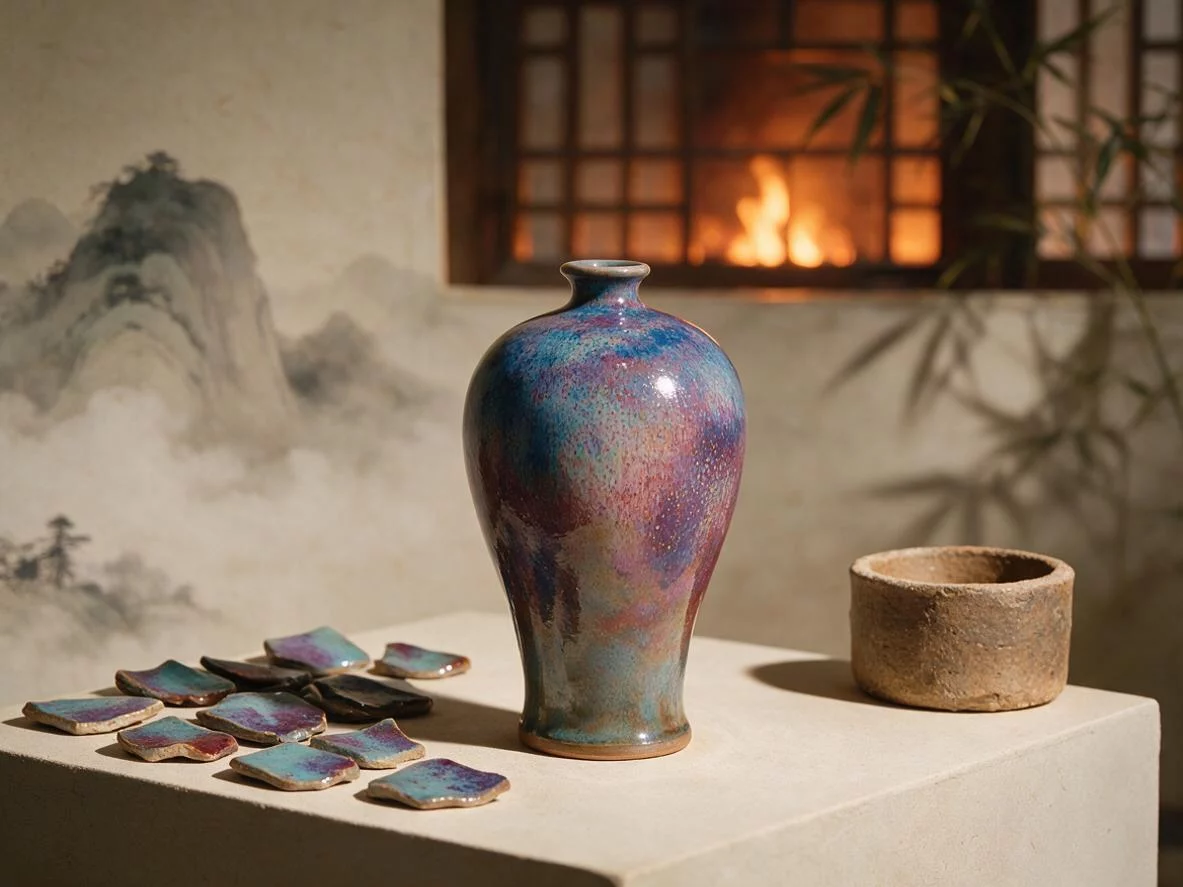
Jun-glazed vase beside glaze test tiles

The basics

How glaze and kiln decide the color

A porcelain glaze is only half finished when it goes into the kiln. Our four natural-gas shuttle kilns fire at 1,280–1,330 °C over a 22–28 hour cycle, held within ±10 °C across the chamber, and for most glazes the oxygen is cut back near the top of the firing. That reduction is what turns iron in a celadon glaze green and copper in a Jun glaze purple or red.

For a buyer, glazes fall into two groups. Stable glazes, such as plain celadon, Ru and solid colors, repeat closely enough to hold to ΔE00 2.5 within a batch. Reactive glazes, such as Jun, crackle and anything left to run, move in the kiln, so you approve a range on fired tiles rather than a single swatch.

A small part of our range is still fired in a pine-wood kiln, at about 1,300 °C for 50–60 hours, for collectible pieces in strong reduction. Wood firing is slower and less predictable than gas, and it starts at 150 pieces per shape.

Does it repeat on a reorder?

Sorted from the most predictable glaze to the least. Know where yours sits before you sign a sample.

GlazeRepeats on reorderPredictabilityHow to approve it
Clear glaze on white porcelainYesApprove against: A white reference piece
Solid monochromes, gloss or matteYesApprove against: Fired tiles with a measured tolerance
CeladonCloseApprove against: The lightest and darkest accepted tones
RuCloseApprove against: A fired range, not one piece
Ge crackleClose in color, never in patternApprove against: A range of crackle density
JunNever exactlyApprove against: Individual pieces or a written range
Wood-firedNeverApprove against: Each piece on its own

Library

All glaze and firing guides

All guides
Glazes & Firing

Chinese Porcelain Glazes: A Buyer’s Guide to Celadon, Crackle, Jun and Firing

How celadon, Ru, Ge, Jun, monochrome and wood-fired glazes behave, which ones repeat on a reorder, and how to choose, approve and sell them.
Read article →
Glazes & Firing

Celadon on Porcelain or Stoneware: How the Body Changes the Green

One celadon glaze reads clear and cool on white porcelain and deeper on a darker stoneware body. This guide matches each body to tea service, tableware or display, and shows what to fix in the specification.
Read article →

Questions

What buyers ask us

Short answers here; the guides above go further.

How hot are your kilns?

High firing runs at 1,280–1,320 °C, typically about 1,300 °C. Overglaze enamels get a second firing at about 780–850 °C.

Is crackle glaze a flaw?

No. Crackle forms when the glaze shrinks more than the body as it cools. It's part of Ge and some Ru pieces, and it can take on tea stain over time.

How do I sell a range where every piece differs?

Show the range, not one piece, in photos and on the card, and say on the listing that each piece is unique.

What is reduction firing?

Firing with the oxygen in the kiln cut back at high temperature. The flame then pulls oxygen out of the metals in the glaze, which is how iron turns celadon green and copper turns red or purple. The same glaze fired with plenty of air comes out yellowish or green-gray.

What is the minimum for wood-fired porcelain?

150 pieces per shape. Each firing runs for 50–60 hours at about 1,300 °C, and the results vary more than in a gas kiln, so the range is approved on fired samples first.

See how we fire

Four natural-gas kilns in Jingdezhen, firing at about 1,300 °C.