
By Lin Wan, Foreign-Trade Lead at KKCN, Jingdezhen
When a regulator, a retailer’s compliance team or an unhappy customer asks whether a porcelain cup is safe and as described, the question goes to the importer. The evidence, though, sits with the factory: the glaze recipe, the firing record, the test reports, the approved sample, the inspection results. Ceramic tableware compliance is mostly the work of getting that evidence from one desk to the other, matched to the right pieces, before anyone asks for it.
This guide is written for importers, brand QA staff and retail compliance teams buying porcelain from China. It treats compliance as three layers that build on each other. The legal layer comes first: deciding whether a piece is tableware at all, then meeting the lead and cadmium rules of each market it will be sold in, with the right declaration. The claims layer comes second: saying only what a test supports, about dishwashers, microwaves, boiling water and chips. The acceptance layer comes last: an approved sample, written tolerances and an inspection that can tell a defect from the natural variation of handmade porcelain. Most disputes I’ve seen in ten years of export work happen in the second and third layers, not the first.
Every regulation and limit below is quoted from its source as of October 2026, with the sources listed at the end of this guide. Rules change, and a few are changing now, so check the current text before you rely on a number. Where I describe KKCN’s own practice, I say so.
Who answers for compliance
The first thing to settle is whose name is on the line, because that decides who has to hold the documents.
In the United States, the importer of record answers for the goods at the border, and the FDA’s guidance on lead and cadmium in ceramic ware is the basis on which it decides whether to detain them. In the European Union, Directive 84/500/EEC on ceramic articles intended to come into contact with food was amended in 2005 to require a written declaration of compliance for ceramic articles not yet in contact with food, and to make the manufacturer or the importer into the EU provide the supporting analysis to national authorities on request. In plain terms, an EU importer needs the declaration in hand and the test results behind it within reach. We issue a declaration of compliance for tested daily-use tableware (EU-FC-DOC-20260122-019), and the reports behind it are listed on our Quality Control page.
California’s Proposition 65 spreads responsibility differently. According to California’s Office of Environmental Health Hazard Assessment, the primary duty to warn falls on manufacturers, producers, packagers, importers, suppliers and distributors, and it moves to a retailer in specific cases, for example when the retailer sells the product under its own brand. Businesses with fewer than 10 employees are exempt by law, although contracts with larger buyers often bring the obligation back. Online sellers have to show the warning before purchase, on the product page or through a clearly linked signal word, and with the delivered product.
The practical point is that compliance is easiest when the importer and the factory agree, in writing and before production, which documents come with each product. A ceramic factory in China that has shipped to your market before should be able to name them without looking them up.
First decide: is it tableware or decoration?
The single most important compliance decision for porcelain is made before any test: is this piece for food and drink, or for display?
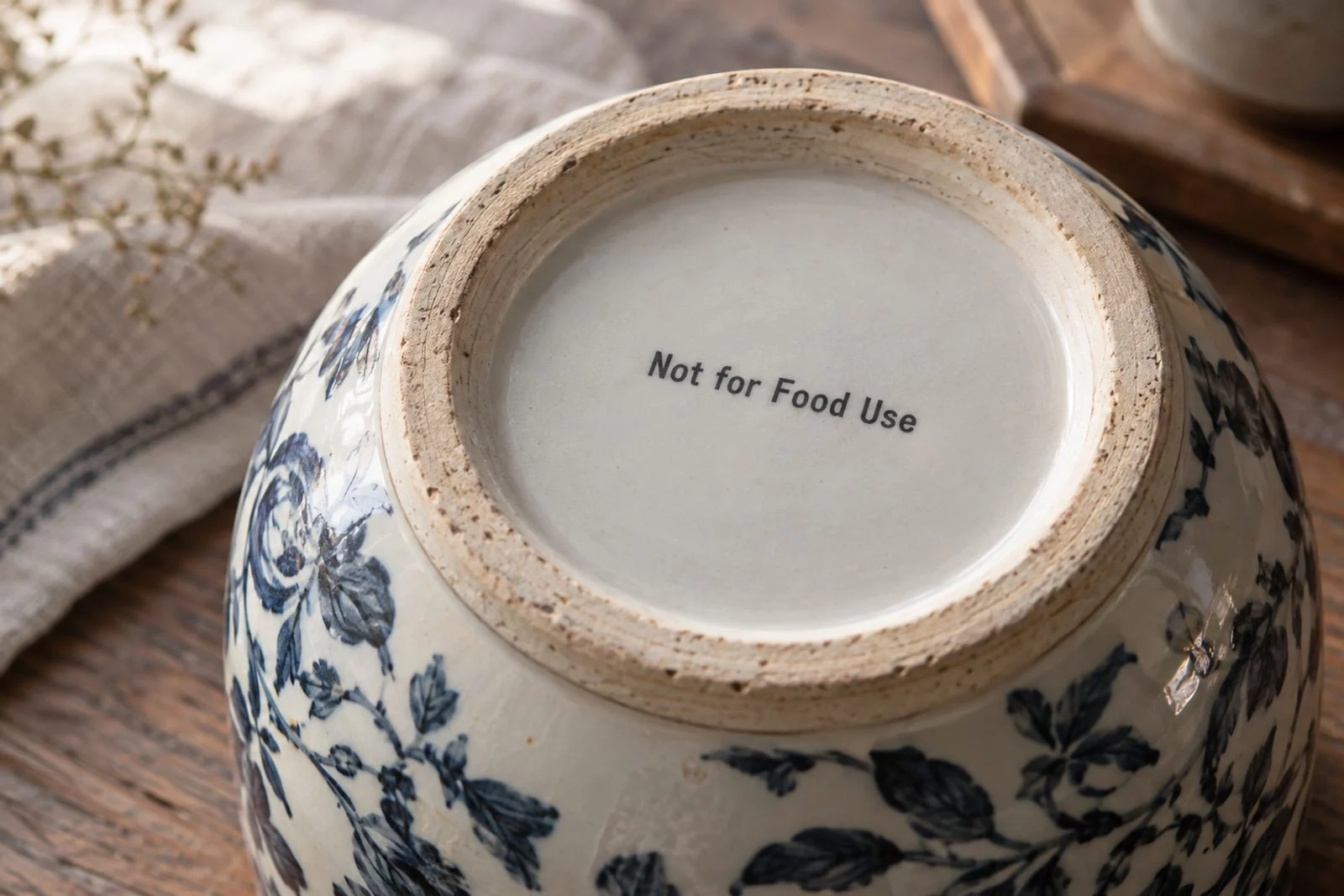
The question matters because porcelain blurs the line. A blue and white covered jar, a painted plate on a stand, a famille rose cup in a display cabinet: each looks like something you could eat or drink from. Regulators know this. In the US, 21 CFR 109.16 sets out how ornamental and decorative ceramic ware that could be mistaken for tableware has to be marked if it is not meant for food use. It requires a conspicuous stick-on label on a surface shoppers can see and a permanent statement molded or fired onto the exterior of the base, in letters at least 3.2 mm (0.125 inch) high where space allows and never smaller than 1.6 mm, using one of the statements the regulation sets out, such as “Not for Food Use—Food Consumed from this Vessel May be Harmful.” The alternative is a hole bored through the surface that would otherwise hold food.
That has real consequences for how you buy. If a piece will be sold for display in the US, the permanent mark has to be fired onto the base at the factory, so it belongs in the purchase order, not in a sticker added in your warehouse. Some overglaze enamel, metallic and reactive-glaze pieces are sold for display for exactly that reason: they haven’t been tested for food contact. At KKCN, display pieces are sold for display and described that way on our product pages, and any piece styled like tableware but meant only for display carries one of the regulation’s statements fired onto the exterior of its base when it ships to the US: “Not for Food Use. May Poison Food” where the foot ring is small, or “Not for Food Use—Food Consumed from this Vessel May be Harmful” where there is room, in letters 3.2 mm high where the base allows and never smaller than 1.6 mm. The stick-on label carries the same statement, so agree with us whether it ships on the piece or goes on in your warehouse before sale.
If a piece is tableware, everything in the next section applies to it. If it is decoration, mark it as such and keep it out of any food-related wording, on the box, the card and the listing. The worst position is the one in between: a decorative piece photographed with tea in it.
Lead and cadmium: the limits that apply where you sell
Glazes and enamels can contain lead and cadmium, and a glaze that is badly formulated or not fully fired can release small amounts into acidic food or drink. Every major market limits how much a piece may release, but each measures it differently, and the limits are tighter for pieces that hold liquid against the glaze for a long time.

| Market | Rule | What it limits (lead / cadmium) | What to note |
|---|---|---|---|
| United States | FDA CPG Sec. 545.450 (lead) and 545.400 (cadmium) | Lead: flatware 3.0 µg/mL (average of 6), small hollowware 2.0, large hollowware 1.0, cups and mugs 0.5, pitchers 0.5. Cadmium: flatware 0.5 (average of 6), small hollowware 0.5, large hollowware 0.25 | Cups and mugs have the strictest lead level; California adds Prop 65 |
| Canada | Glazed Ceramics and Glassware Regulations, SOR/2016-175 | Drinking vessels with exterior decoration within 20 mm of the rim: 4 mg/L lead, 0.4 mg/L cadmium in a rim test | The rim test applies on top of the limits for the food-contact surface |
| European Union | Directive 84/500/EEC | Flat (≤25 mm deep): 0.8 / 0.07 mg/dm². Other fillable: 4.0 / 0.3 mg/L. Cooking ware and storage over 3 L: 1.5 / 0.1 mg/L | Written declaration of compliance required; revision under way |
| Netherlands | National rule in force from May 29, 2026 | Flat: 6 / 4 µg/dm². Other fillable: 30 / 20 µg/L. Cooking and storage over 3 L: 10 / 7 µg/L | Far below the EU figures; sell-off allowed for compliant goods placed on the market before December 1, 2026 |
A few things in that table deserve a second look. The US categories depend on shape: in the FDA’s definitions, flatware is no deeper than 25 mm, small hollowware holds less than 1.1 liters, and a cup is judged more strictly than a bowl of the same size. Canada’s rim test exists because decoration on the outside of a cup sits exactly where the drinker’s lips go; it is the reason a logo band near the lip deserves its own test. And Europe is moving. The European Commission has been working on a revision of Directive 84/500/EEC since its 2019 impact assessment, aiming for significantly lower lead and cadmium limits and new limits for other metals, but as of October 2026 no new directive has been adopted. The Netherlands didn’t wait. Watch the units: the EU figures are in milligrams and the Dutch ones in micrograms, a thousand times smaller. Its 2026 limits for fillable articles are more than a hundred times lower than the EU figures for lead, and a range that passed comfortably under the directive may need to be retested to sell there. We have tested our core glazes against the new Dutch limits; a special or custom glaze still needs its own check for a Dutch project.
Matching the evidence to the piece
A test report proves that the samples described on it passed the stated test on the stated date. It doesn’t prove anything about a different glaze, a different decoration, or the same design fired a year later in a different kiln load. The most common compliance gap I see is not a failed test; it is a good report attached to the wrong product.
The result of a lead and cadmium test depends on four things, and a change in any of them can change the result. The glaze recipe is the first, including its colorants. The firing is the second: a glaze that has fully matured at high temperature holds its metals far more tightly than one that was underfired, which is one reason we fire our porcelain at 1,280 to 1,330 °C and check firing curves kiln by kiln. Decoration is the third, because overglaze enamels and decals are fused at much lower temperatures and sit on the surface. The body is the fourth, in a smaller way, through how it interacts with the glaze. So a report should describe the glaze, the decoration and ideally show a photo of the sample, and you should be able to point at each product in your range and say which report covers it.
Retesting follows the same logic. A new glaze color, a new enamel palette, a new decal supplier or a significant change to the kiln schedule all justify a new test. A fixed calendar, such as annually, catches drift. Our own rule combines the two. We start a new round of testing whenever we introduce a new glaze formulation, change the source of a glaze raw material, switch decal suppliers, change the firing temperature or kiln atmosphere, or revise the body recipe; for a material system that hasn’t changed, we retest every 12 months. Some buyers add their own checks on top: Living Oriental, for whom we’ve made white and celadon tea ware for six years, has a sample tested by SGS every quarter.
The decal trigger is in that list for a reason. A US importer’s third-party lab once found elevated cadmium release on a small batch of our overglaze tea ware during pre-shipment testing. The cause was a single batch of imported decal pigment that had slipped through our incoming material check. We quarantined the whole stock, recalled the decal roll, switched to a pre-vetted pigment supplier, reprinted the artwork and refired the goods, and the shipment cleared without a customs hold. Since then, every new decal batch is tested before it goes into production. The importer, for its part, tightened its own vendor checklist. Both changes came from treating a report as evidence about a specific batch of materials, not about a product name.
How to check lead and cadmium reports walks through a report line by line, including how to verify the report number with the lab.
What “lead-free dinnerware” actually means
Shoppers search for lead-free dinnerware far more often than for any test standard, so the phrase matters to anyone selling plates and cups. For ceramics in the United States it has no single legal definition. The FDA limits how much lead may leach from a piece, by shape, as the table above shows, and California’s Prop 65 adds its own, stricter warning level. “Lead-free” on a box is a marketing word, not a test result.
What a buyer can check is the leach test behind it:
- The method. ASTM C738 is the usual US method; ISO 6486 is the international one.
- What was tested. A decal or enamel band near the rim behaves differently from a plain glaze, so the report should cover the shape and decoration you are buying.
- The number. The measured result for each sample against the limit for that shape, with the lab’s name and the report date.
For our own lines, we give the result for the tested lines, with the report available on request, rather than a lead-free label. If your market expects the phrase on packaging, ask your compliance adviser first what evidence it needs there.
Claims you can make, and claims you shouldn’t
Lead and cadmium are the legal floor. Most product claims on porcelain go well beyond it, and they are where buyers are most exposed, because a claim on a box or a listing is a promise to every customer.
“Dishwasher safe” is the most common and the least defined. Porcelain itself rarely suffers in a dishwasher; decoration does. Overglaze enamel and metallic trim wear over repeated cycles, while underglaze decoration and decoration fired into the glaze hold up far better. There are standard methods for testing this: EN 12875 is the European series for resistance to mechanical dishwashing, with a separate rapid test for catering ware (EN 12875-5). A claim should name the test and the number of cycles, or it shouldn’t be made. Our hospitality range has been tested to EN 12875-5 by an independent accredited lab, and we share the reports privately once a project inquiry is open.
“Microwave safe” starts with metal. A piece with a gold, platinum or silver rim, a metallic decal or any luster is never microwave safe, and should be marked that way. Leaving metal out is the precondition, not the proof: we describe an underglaze or in-glaze piece without metal as microwave safe only when its glaze and decoration are covered by testing for that use. “Oven safe”, “boiling water safe” and “chip resistant” need their own evidence. ASTM C554 tests glazed ceramics for crazing under thermal shock, ASTM C368 covers impact resistance including rim chipping, and BS 8654 sets performance requirements for domestic and hospitality tableware. Our hotel tableware buying guide shows how a hospitality buyer writes these into a specification.
Health claims are the last trap. “Lead-free” on a porcelain product is a promise that is very hard to prove and easy to disprove, and regulators treat it with suspicion. “Tested for lead and cadmium release to [standard]”, with the report available, is accurate and more persuasive to a professional buyer.
Accepting a shipment of handmade porcelain
The third layer is quality acceptance: deciding, carton by carton, whether what arrived is what you ordered. For porcelain, and especially for hand-painted or reactive-glazed porcelain, this is where most disagreements start, because a defect and a characteristic can look alike.

The fix is to decide in advance, in writing. Before production, the approved sample, the dimensions with their tolerances, the craft, the appearance, the logo, the packing and the acceptable range of handmade variation should all be fixed in a document both sides sign. That is how we work at KKCN, and our Quality Approval page shows what goes into that record. With it, an inspector compares each piece with an agreed standard. Without it, the inspector compares each piece with their own taste.
Defects are then sorted into classes. A critical defect makes a piece unsafe, such as a crack that could break in use or a sharp edge. A major defect makes it unsellable or unfit for its use: a chip, a lid that doesn’t fit, a glaze crawl through to the body, a size outside tolerance. A minor defect is cosmetic and within what a customer would accept at the price: a small pinhole on the foot, a slight dot of glaze.
Most third-party inspections then sample the lot using ISO 2859-1 and an acceptable quality limit (AQL) for each class. A common setting for general consumer goods is zero tolerance for critical defects, AQL 2.5 for major defects and 4.0 for minor ones. Our contract standard for tableware uses that setting: AQL 2.5 for major and 4.0 for minor defects, at ISO 2859-1 General Inspection Level II. For our hotel line and custom gift line, the contract carries a tighter plan as a separate line: 0 for critical, 0.65 for major and 2.5 for minor defects. As a worked example under ISO 2859-1 single sampling with normal inspection, a lot of 4,000 cups at General Inspection Level II takes code letter L, which means a sample of 200 pieces. At AQL 2.5 for major defects, the lot passes with up to 10 major defects in the sample and fails at 11; at 4.0 for minor defects, it passes with up to 14 and fails at 15. Under the tighter hotel and gift plan, 0.65 for major defects passes up to 3 and fails at 4. Critical defects are zero on every line, contract or tightened: AQL 2.5 and 4.0 apply to major and minor defects, there is no acceptance number for a critical one, and a single critical defect in the sample fails the lot. That is an acceptance rule for the sample, not a guarantee that no piece in the lot has one, which is why the factory’s own 100% inspection still matters. Tightened or reduced inspection, which an inspector switches to after a run of failed or passed lots, uses different plans.
Sampling is the buyer’s check. The factory’s check should be more thorough. Our quality team, led by Li Qiusheng, who has 28 years in ceramic firing and inspection and is a registered Jingdezhen municipal-level inheritor of traditional firing techniques, runs a three-level system: a pre-production standard, a first-piece review checked against the approved sample, and a 100% inspection of finished pieces for cracks, deformation and glaze flaws, with dimension, quantity and color checks and a final check at packing. Hospitality and high-end custom runs are inspected piece by piece in full; bulk production is also sampled to the AQL plan above.
Third-party inspection and transit testing
A third-party inspection doesn’t replace a factory’s own quality system; it confirms it for a buyer who can’t be there. It pays for itself on a first order with a new supplier, on any order large enough that a bad lot would hurt, on custom work where the approved sample is new, and whenever a retailer’s contract requires one. On a repeat order from a supplier with a clean record, many buyers drop to a lighter check or none.
The value of the inspection depends on the brief. The inspector needs the approved sample or its photographs, the written tolerances, the defect classes, the AQL levels and any function checks, such as lid fit or a water-tightness test for a vase. For the Al Masa Grand Hotel’s blue and white program in Dubai, the hotel’s project team had Intertek inspect on site in addition to our 100% factory inspection, and the inspection was written against the approved hand-painted samples. The firms our buyers nominate most often are SGS, Intertek and Bureau Veritas. Agree before the first inspection who pays if a lot fails and has to be inspected again. Under our terms, if the failure comes from a quality or compliance problem on our side, we pay for the re-inspection; if it comes from a specification the buyer changed late, or from a concession the buyer had already accepted, the buyer pays.
Transit is the last test the goods face. A packaging design can be tested before it ships: the ISTA 3A procedure simulates parcel delivery for packages up to 70 kg (150 lb) with drops, vibration and conditioning, and other ISTA procedures cover palletized freight. For a retailer that sells online, a tested parcel pack is worth more than any number of inspection reports, because it is where most porcelain actually breaks.
What a certificate tells you about a supplier
Factory certificates answer a different question from test reports. A test report says something about a product. A certificate says something about the company.
ISO 9001 is a standard for quality management systems. A certified factory has documented processes, records and corrective action, and an auditor has checked that it follows them. That is genuinely useful in a supplier, because it means a problem found in one order can be traced and fixed. It is not a statement that any product meets any standard. Social audits, such as amfori BSCI and Sedex SMETA, assess working conditions, and many retailers require one before listing a supplier. At KKCN, we are certified to ISO 9001:2015, audited by SGS, with the transition to ISO 9001:2026 scheduled for the 2027 surveillance audit. We also hold an amfori BSCI audit and a Sedex SMETA 4-Pillar audit, and our About KKCN page lists them.
The compliance file, piece by piece
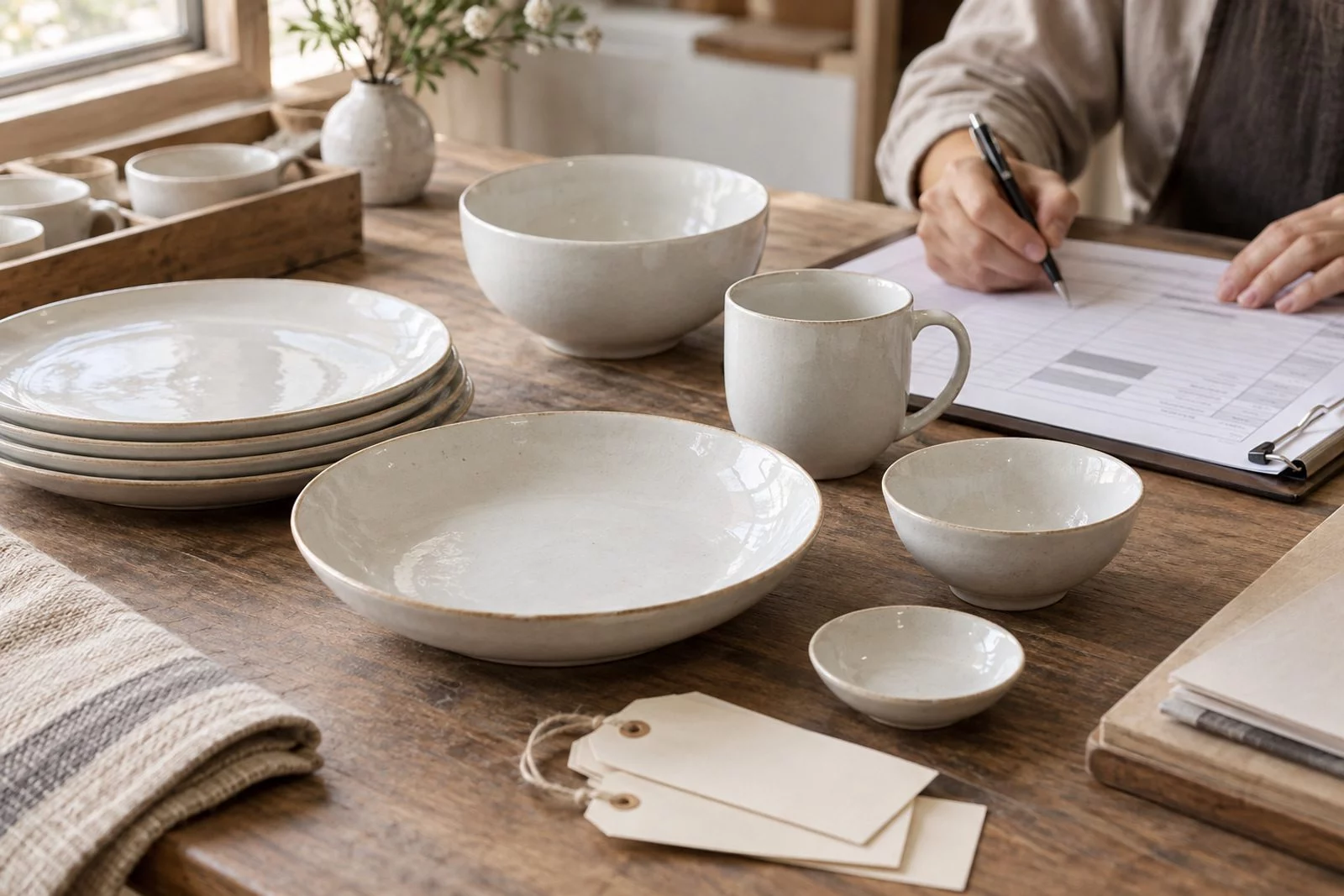
The simplest way to keep all three layers in order is one file per product, built before the first order ships and updated with every reorder. For each reference in your range, it should hold:
- The intended use: tableware, or decoration with the required marking.
- The approved sample record: photos, dimensions with tolerances, decoration, packing and the handmade variation range.
- The lead and cadmium report or reports that cover this exact glaze and decoration, for each market you sell in, plus the EU declaration of compliance where it applies.
- Evidence for every claim on the box or listing: dishwasher, microwave, thermal shock, chip resistance.
- The inspection reports for each shipment, with the AQL levels used.
- The packaging test result, if the piece ships by parcel.
- Supplier certificates, with their expiry dates.
A file like that answers a retailer’s audit in an afternoon, and it makes the next reorder safer, because everyone can see exactly what was approved.
The short version
Decide first whether each piece is tableware or decoration, and mark decoration as the rules require. For tableware, test to the limits of every market you sell in, and match each report to the exact glaze and decoration it covers. Make only the claims a test supports. Agree the sample, the tolerances and the variation range in writing before production, and inspect against them. Keep it all in one file per product. None of this is complicated, but all of it has to be done before the goods ship.
Our Quality Control page lists the reports and certificates behind our tableware, and Quality Approval shows how we fix a standard with each buyer before production starts.
Sources
- FDA, CPG Sec. 545.450, lead in pottery (ceramics)
- FDA, CPG Sec. 545.400, cadmium in pottery (ceramics)
- 21 CFR 109.16, ornamental and decorative ceramicware (2025 annual text)
- Canada, Glazed Ceramics and Glassware Regulations, SOR/2016-175
- Council Directive 84/500/EEC, ceramic articles in contact with foodstuffs
- Commission Directive 2005/31/EC, declaration of compliance
- European Commission, revision of EU rules on food contact materials
- Netherlands, Staatscourant 2026-16308 (ceramic food-contact limits)
- OEHHA, Proposition 65 guidance for businesses
- ASTM C738, lead and cadmium extracted from glazed ceramic surfaces (test method)
- ISO 6486-1, release of lead and cadmium from ceramic ware (test method)
- EN 12875-5, rapid dishwasher test for ceramic catering articles
- BS 8654, strength and chipping performance of tableware; ISO 2859-1, sampling by attributes (AQL)
All read October 2026. Test reports for KKCN products are available on request.
Lin Wan leads foreign trade at KKCN in Jingdezhen, coordinating buyers’ requirements, samples, orders and after-sales across Europe, North America, the Middle East and Southeast Asia. Ten years in ceramic export, working in English and Chinese.