By Lin Wan, Foreign-Trade Lead at KKCN, Jingdezhen
Most buyers choose a decoration from a photograph. They see a blue and white jar, a pink-shaded peony cup or a turquoise dinner service and ask for something like it. What the photograph doesn’t show is the technique behind the look, and the technique is what decides the price, how the piece holds up in use, and whether the second order will match the first. The main Chinese porcelain decoration techniques differ on all three counts, sometimes by a factor of four in price for pieces that look similar at arm’s length.
This guide walks through the techniques a buyer will meet when ordering painted porcelain from China: cobalt blue and copper red under the glaze, enamel colors over it, carving and relief, and printed decals. It is written from the export desk of a porcelain factory in Jingdezhen, where we see the same few misunderstandings come up in almost every first order. I’d suggest making the choice in two moves. First choose by layer, because each color has to survive a particular firing, and that firing sets its look and its durability. Then choose by repetition: how exactly the pattern has to repeat, across a set and across years, decides between a brush and a decal and shapes the reorder plan.
Where I describe how KKCN works, I say so. Historical points come from museum sources listed at the end.
Under, in or over the glaze: the firing decides
Every color on a piece of porcelain has to survive the heat that fixes it, and that single fact explains most of what a buyer needs to know about decoration. Some pigments can take the full high firing of porcelain, which in our kilns runs at about 1,300 °C (2,370 °F). Most bright colors can’t. They burn out, bubble or turn brown at that heat, so they have to be painted onto porcelain that has already been fired, and then fixed in a second, much cooler firing. Where a color sits on the piece follows from that.
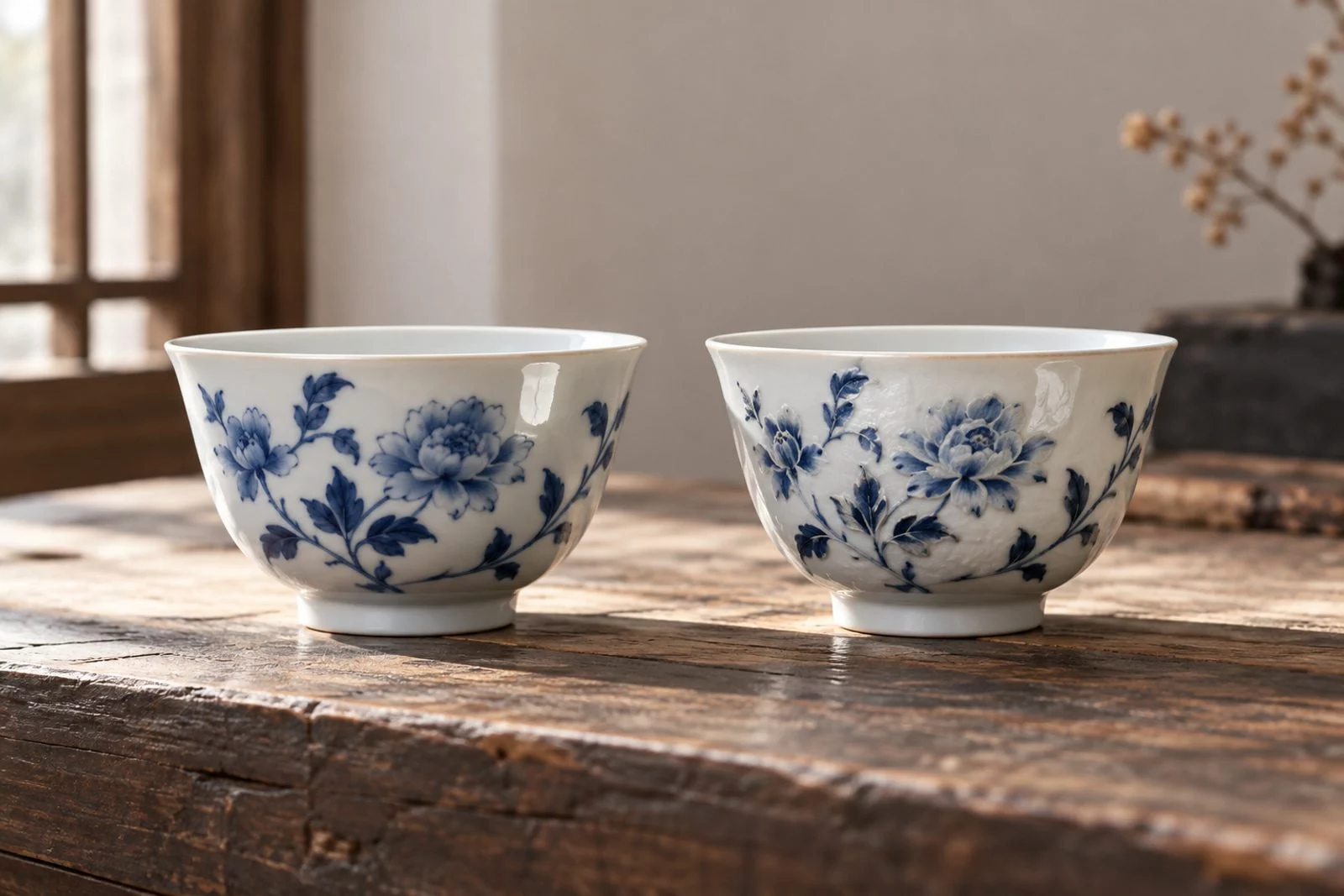
Our Glazing & Decoration page sets out the order of work in the studio. For buying purposes, the layers compare like this:
| Technique | Where it sits | Firing | How it looks | In use | Best suited to |
|---|---|---|---|---|---|
| Cobalt blue, copper red | Under the glaze, painted on the raw body | One high firing, about 1,300 °C | Color seen through glass; soft edges, depth | The most durable; the glaze protects it | Tableware, tea ware, jars, anything handled daily |
| Glaze as the color (celadon, monochromes) | Is the glaze | High firing | Color pools and thins with the form | As durable as the glaze | Tea ware, vases, plain table ranges |
| In-glaze decal | Sinks into the softened glaze | Second firing, 1,220–1,280 °C | Flat print, sealed into the surface | Close to underglaze for wear | Logos, exact repeats on tableware |
| Overglaze enamel (famille rose, Falangcai, Wucai) | On top of the fired glaze | Second firing, about 780–850 °C | Bright, opaque or shaded color you can feel | Softer than glaze; can wear with abrasion | Display, gifts, tea ware used with care |
| Overglaze decal | On top of the fired glaze | Second firing, 780–850 °C | Flat print, slightly raised | Like enamel | Decorative and low-turnover pieces |
The table makes the tradeoff plain. Underglaze painting offers a narrow palette, essentially blue and red, but it lasts as long as the piece. Overglaze enamel offers every color a painter could want, at the cost of a softer surface and an extra firing. Most of the decisions further down come back to which side of that line a piece belongs on. Glaze and firing get their own treatment in our guide to Chinese porcelain glazes and firing.
Blue and white: one pigment, many blues
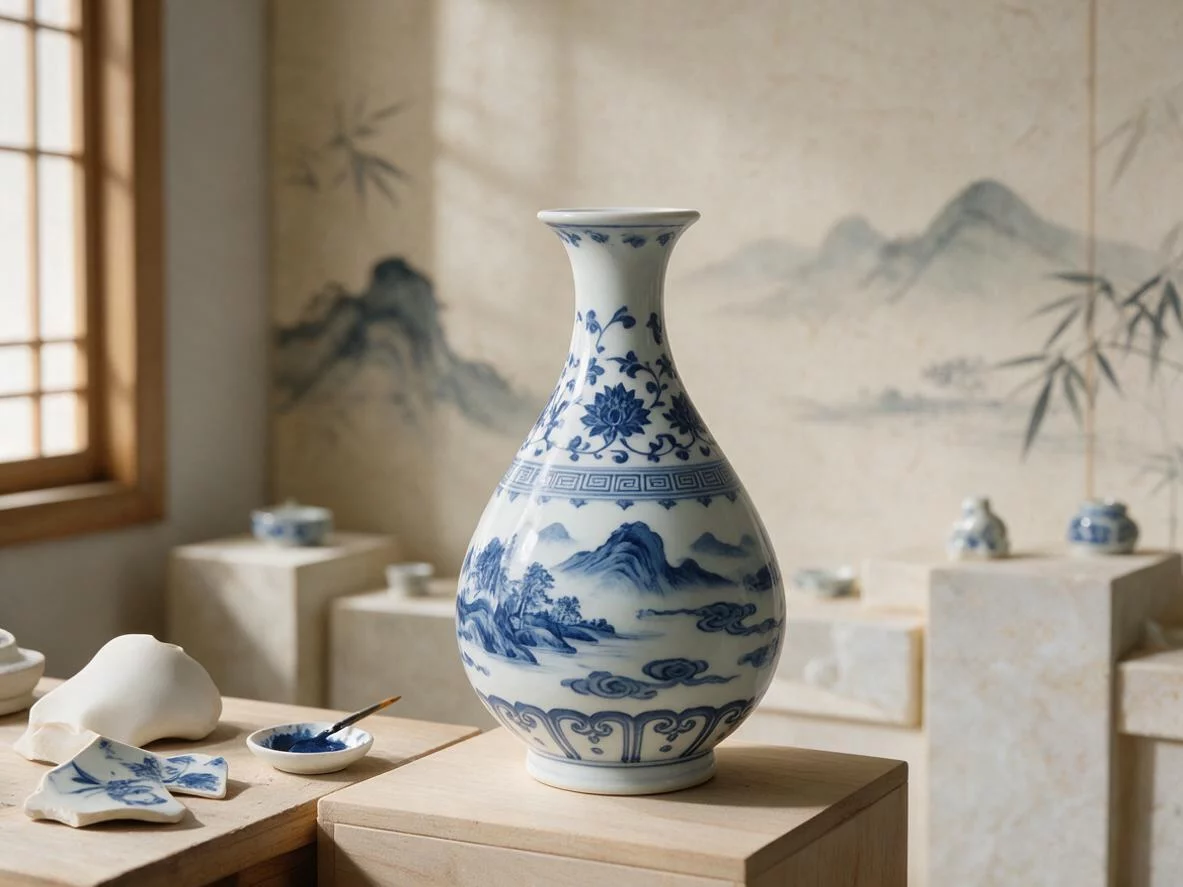
Blue and white is the technique most buyers start with, and for good reason. Cobalt is one of the very few pigments that keeps its color through a full porcelain firing, which is why Jingdezhen potters were painting with it as early as the fourteenth century. Asia Society’s account of excavations at the Jingdezhen kiln sites dates the earliest Yuan blue and white shards to between 1323 and 1336, and notes that the cobalt was imported from West Asia at the time. The look has been made in this town, more or less continuously, ever since.
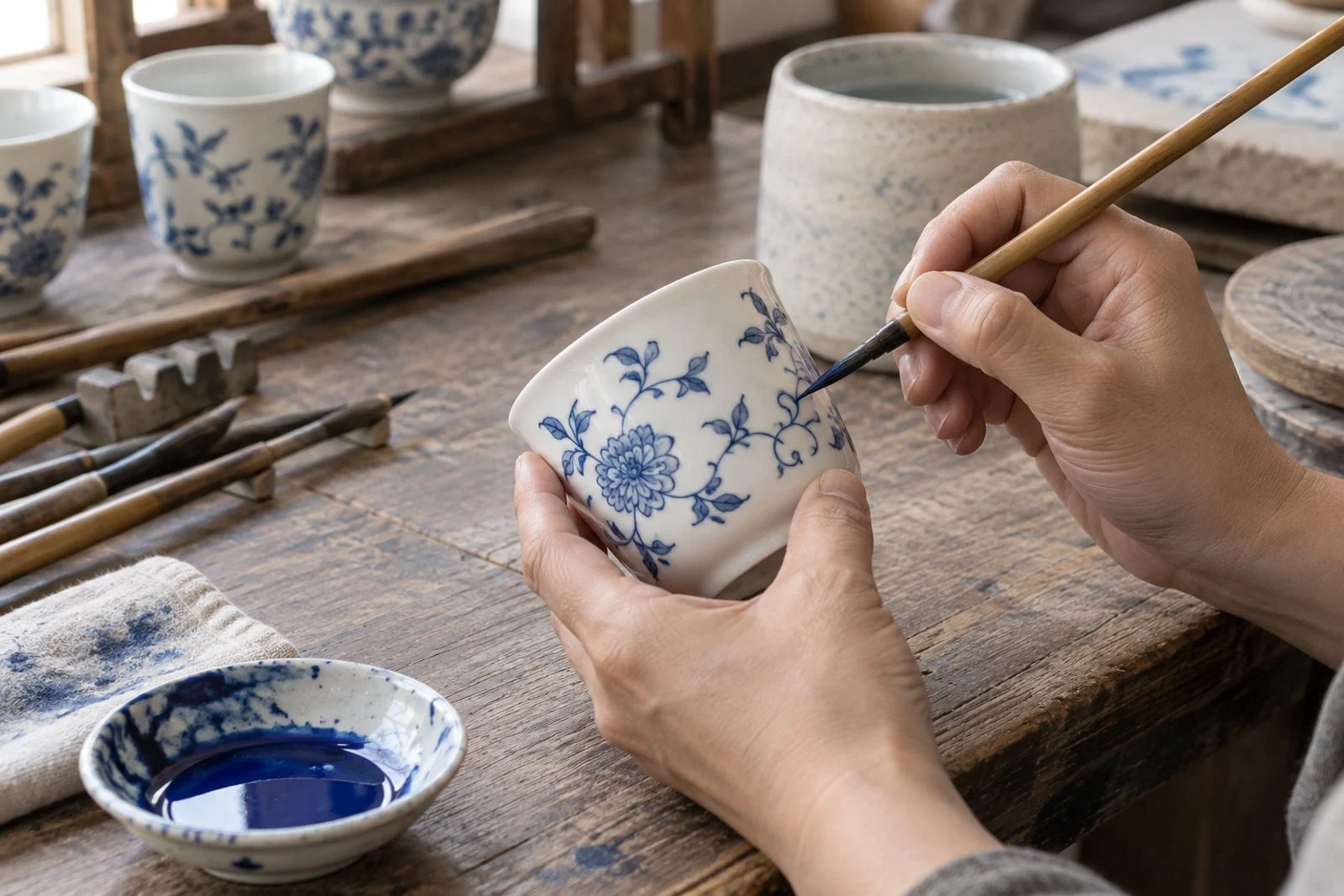
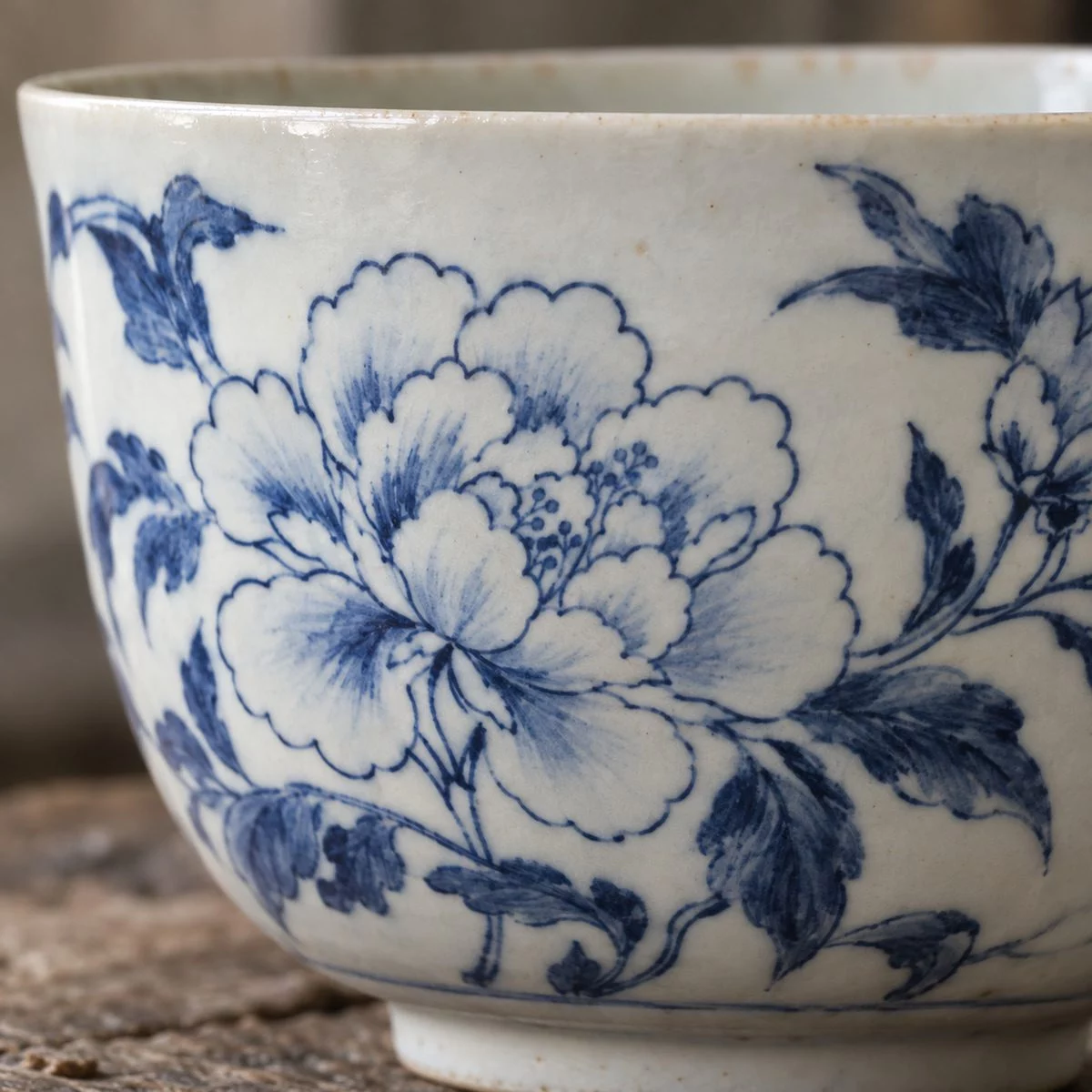
The painter works on the raw, bone-dry body, before any glaze. Cobalt goes on as a dark line for outlines and as diluted washes for the fill. Our painters grade the wash into several strengths of the same cobalt, a method known as water separation, so a single petal can run from deep blue at its base to pale at its tip. The clear glaze then goes over the top, and the whole piece is fired once. Nothing can be wiped away once it touches raw clay, so a blue and white painter has to commit to every stroke. That is part of what you are paying for.
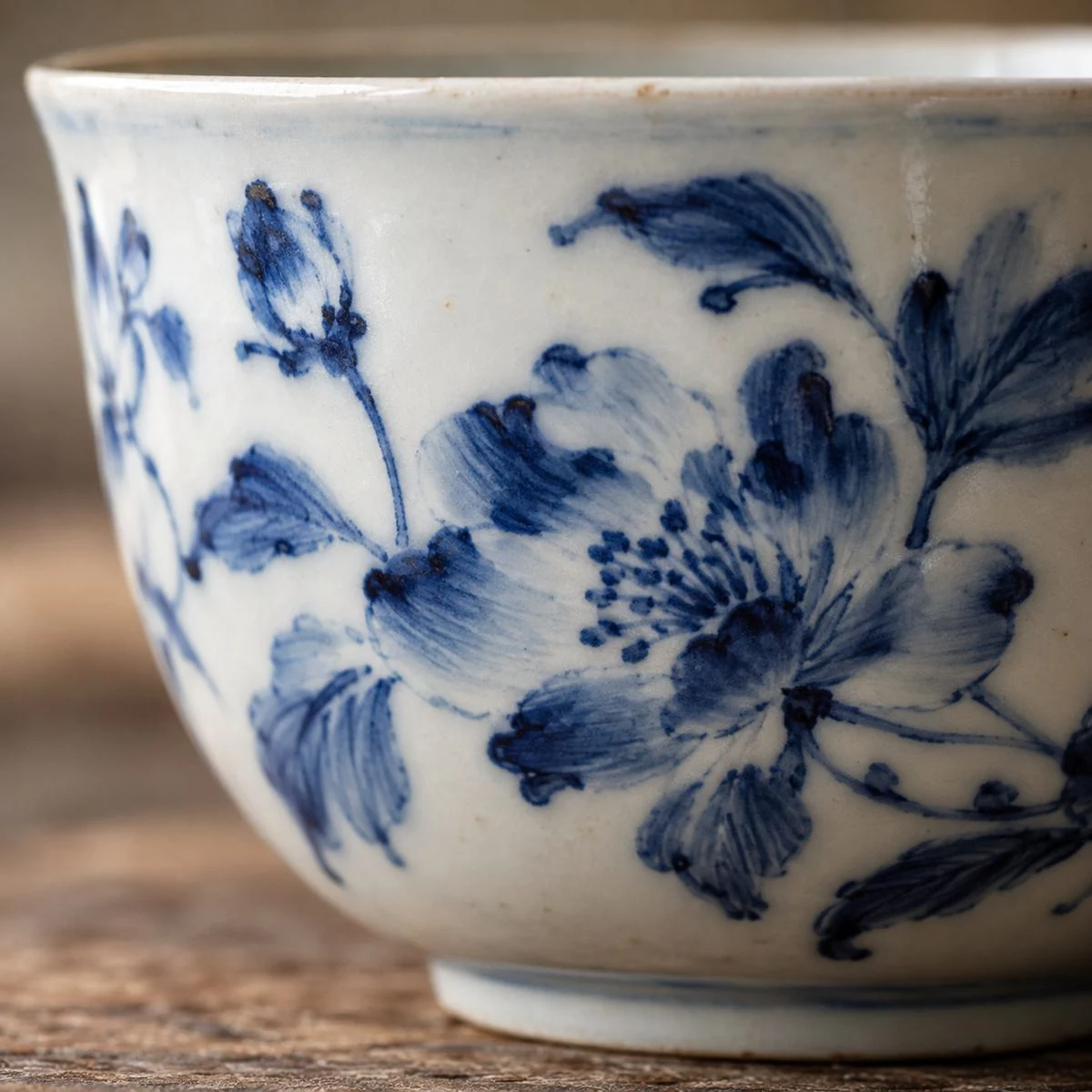
Two things surprise first-time buyers. The first is that the blue in a photograph is not the blue of the fired piece. Cobalt looks gray-black on the raw clay and only becomes blue in the kiln, and its final tone depends on how thickly it was applied, the glaze over it, and where the piece sat in the kiln. The second is that two blue and white pieces painted by the same hand, on the same day, will differ slightly in shade. That variation is a sign of the method, not a fault, and the honest way to handle it is to agree the lightest and darkest blue you will accept on a fired sample before production.
The density of the painting matters more than most buyers expect. Our blue and white chrysanthemum scroll jar carries graded cobalt over almost its whole surface. The blue and white flower scroll dish is mostly a single light wash, with strong dark outlines doing the work. Both are hand-painted under the glaze, but the first takes far more painting time, and its price reflects it. Our Blue & White Porcelain Series shows the range, and blue and white porcelain: why a global icon still sells explains why the look keeps finding buyers in very different markets.
Copper red, the color the kiln decides
Copper is the other pigment that can go under the glaze, and it is far less forgiving than cobalt. Painted on raw clay, it fires red only when the kiln is starved of oxygen at the right moment; with too much air it turns green or gray, and with too much heat it can bleed or fade almost to nothing. Our kiln team controls that atmosphere, which our Kiln Firing page explains, but even with a well-run kiln, copper red varies more from piece to piece than cobalt does.
That is why we never quote a copper red decoration from a photo. The underglaze red lotus gaiwan combines copper red and cobalt in a single firing, and the balance between the two colors is approved on a fired sample before any run is painted. The underglaze red lion cup uses copper alone. If you want a red that is exactly the same on every piece, copper is the wrong choice and an enamel red is the right one. If you want a red that lives inside the glaze and shifts from blush to crimson, nothing else gives it. Our Underglaze Red page shows what that range looks like in practice.
Enamel color: Doucai, Wucai, Falangcai and famille rose
Enamel painting opened up the full palette. Because enamels are fired at around 780–850 °C rather than 1,300 °C, they can carry greens, yellows, pinks and purples that cobalt never could. The cost is a second firing, more painting time, and a surface that sits on top of the glaze instead of under it. Four enamel styles cover most of what buyers ask us for, and they are easiest to understand in the order they appeared.
Doucai combines both layers on one piece. In Asia Society Museum’s description of a Chenghua-period cup (the Chenghua emperor reigned 1465–1487), the outline is drawn under the glaze in cobalt blue, the vessel is fired, and enamels are then painted over the glaze to fill the design before a second firing fixes them. It is delicate, slow work, because the enamel fill has to sit precisely inside lines that were drawn before the first firing. Our Doucai page compares it with Wucai, and the Doucai lotus scroll gaiwan tea set shows the style at tea-table scale.
Wucai, “five colors,” is the bolder relative. Britannica places its rise in the Ming dynasty, particularly the Jiajing and Wanli reigns of the sixteenth century, with bright overglaze colors laid over and around underglaze blue. In Jingdezhen today the name is also used more loosely for multicolor overglaze painting, with or without underglaze blue, and our Wucai page explains both senses. The Wucai lotus scroll covered jar is Wucai in the strict sense; our Wucai tea cups use the broader one.
Falangcai began as a palace art. The British Museum describes a Kangxi-period Falangcai bowl from about 1716–1722 as porcelain glazed in Jingdezhen with its overglaze enamels added in Beijing, in the palace workshops. The style is defined by very fine brushwork and dense, formal patterns, often on a solid colored ground. Our Falangcai range includes the turquoise lotus dinner service, where the whole outside is a hand-laid enamel ground with lotus scrolls painted over it.
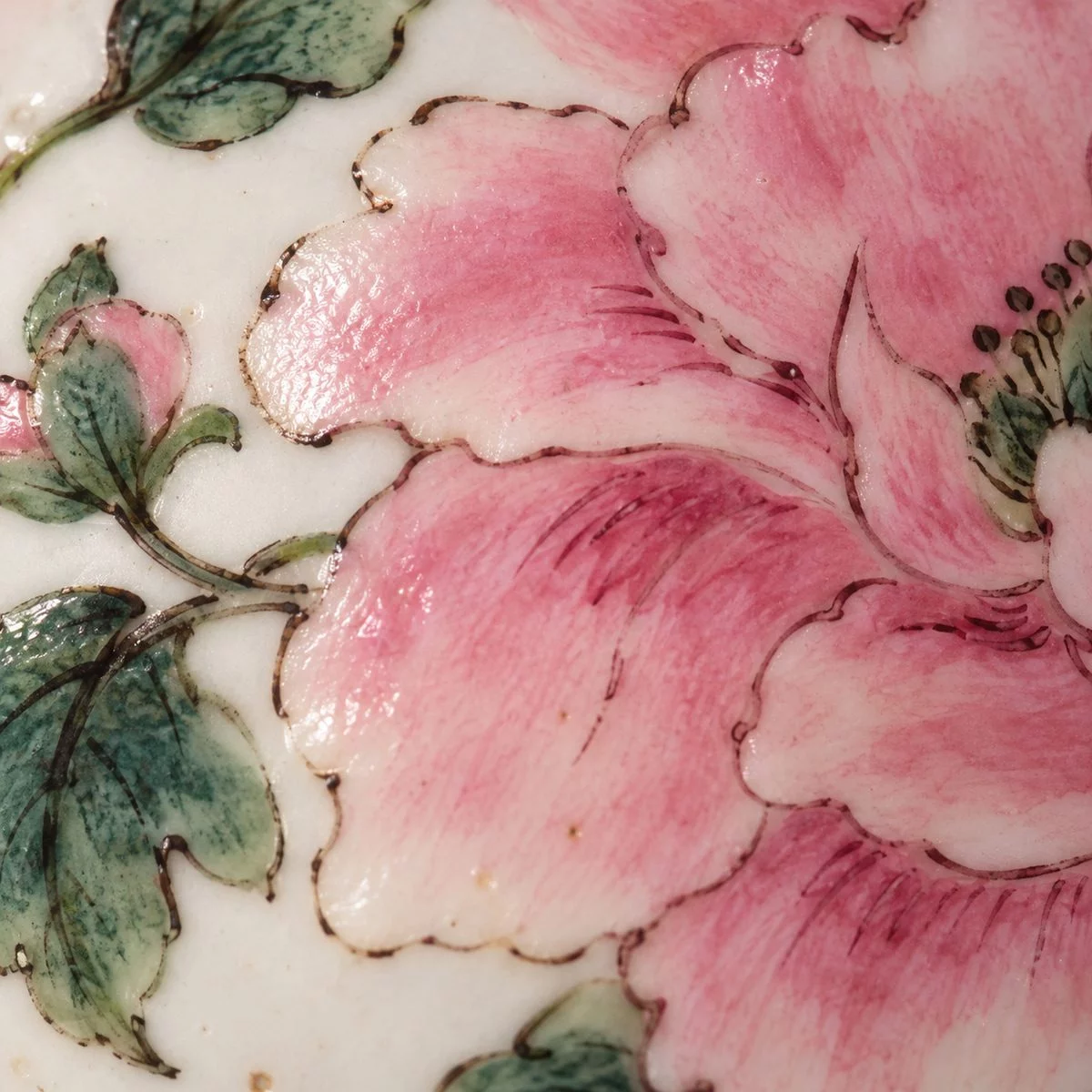
Famille rose is the softest of the four. The Qing addition of pinks to the enamel palette, along with an opaque white that let painters blend and shade, changed what porcelain painting could do; Asia Society Museum notes that the opaque white and pale pink were among the last opaque overglaze enamels to be developed. A famille rose petal can fade from deep rose to almost white within a few millimeters. The famille rose flying apsara tea set and the mottled pink gaiwan show two quite different uses of the same palette, and our Famille Rose page has more.
| Style | Underglaze blue? | How the color reads | What to look at |
|---|---|---|---|
| Doucai | Yes, as fine outlines | Light, clear enamel inside blue lines | Whether the fill sits inside the outline |
| Wucai | Often (strict sense) | Bright, flat, strong contrast | Saturation and the boldness of the red and green |
| Falangcai | No | Dense, precise, often on a colored ground | Fineness of line at close range |
| Famille rose | No | Soft, shaded, with pinks and white | Smooth gradation within one petal |
One more style is worth knowing: ink painting in black enamel, sometimes called mocai, which reads like a brush painting on paper. The ink landscape tea cup is shaded from black to soft gray with a single touch of red. The whole family of enamel styles is in our Imperial Wucai & Painted Porcelain Collection.
Decoration without color: carving and relief
Not every decorated piece is painted. Carving, incising and relief work cut the pattern into the body itself while it is still leather-hard or dry, and the glaze then does the rest. Under a clear glaze, a carved pattern reads as light and shadow. Under a celadon, the glaze pools in the cut lines and turns darker there, so the pattern appears as a deeper green within the lighter surface. It is one of the oldest Chinese porcelain decoration techniques and one of the least understood by buyers, who often expect it to be cheap because it has no color.
It isn’t. Our white porcelain carved flower cup and carved riverside cup are carved by hand, and a cut, like a cobalt stroke, can’t be undone. A carver also works on a body that is fragile at that stage, so losses before firing are part of the cost. We price carving like painting: by how much of the surface is worked and how fine the detail is.
Hand-painted or decal, and when to use both
A decal is a printed transfer. It is made separately, laid onto fired porcelain by hand, and fired on. Ours come from specialist printers in Chaozhou, one of China’s main centers for ceramic decals, and are applied and fired here in Jingdezhen under our own process standards. Depending on the firing, a decal either sinks into the softened glaze at 1,220–1,280 °C (in-glaze) or sits on top of it at 780–850 °C (overglaze). In-glaze decals wear far better and are the right choice for tableware that will see heavy use.
There is nothing second-rate about a decal used for the right job. If a hotel needs its logo identical on 3,000 plates, or a brand needs a fine typeface reproduced at 4 mm, or a dense repeating pattern has to be affordable at volume, a decal does it better than any painter could. Where decals fall short is depth and life: a printed blue can’t grade the way a cobalt wash does, and a printed brushstroke has no pressure in it. Many good ranges combine the two. A decal carries the logo or the fine border, and a painter adds the motif. We offer that hybrid finish: a decal carries the repeatable background pattern, and painters add brush accents, outlines or focal details by hand. It is priced as the decal cost plus the quoted painting time for the hand-finished elements, so the buyer pays for brushwork only where it shows.
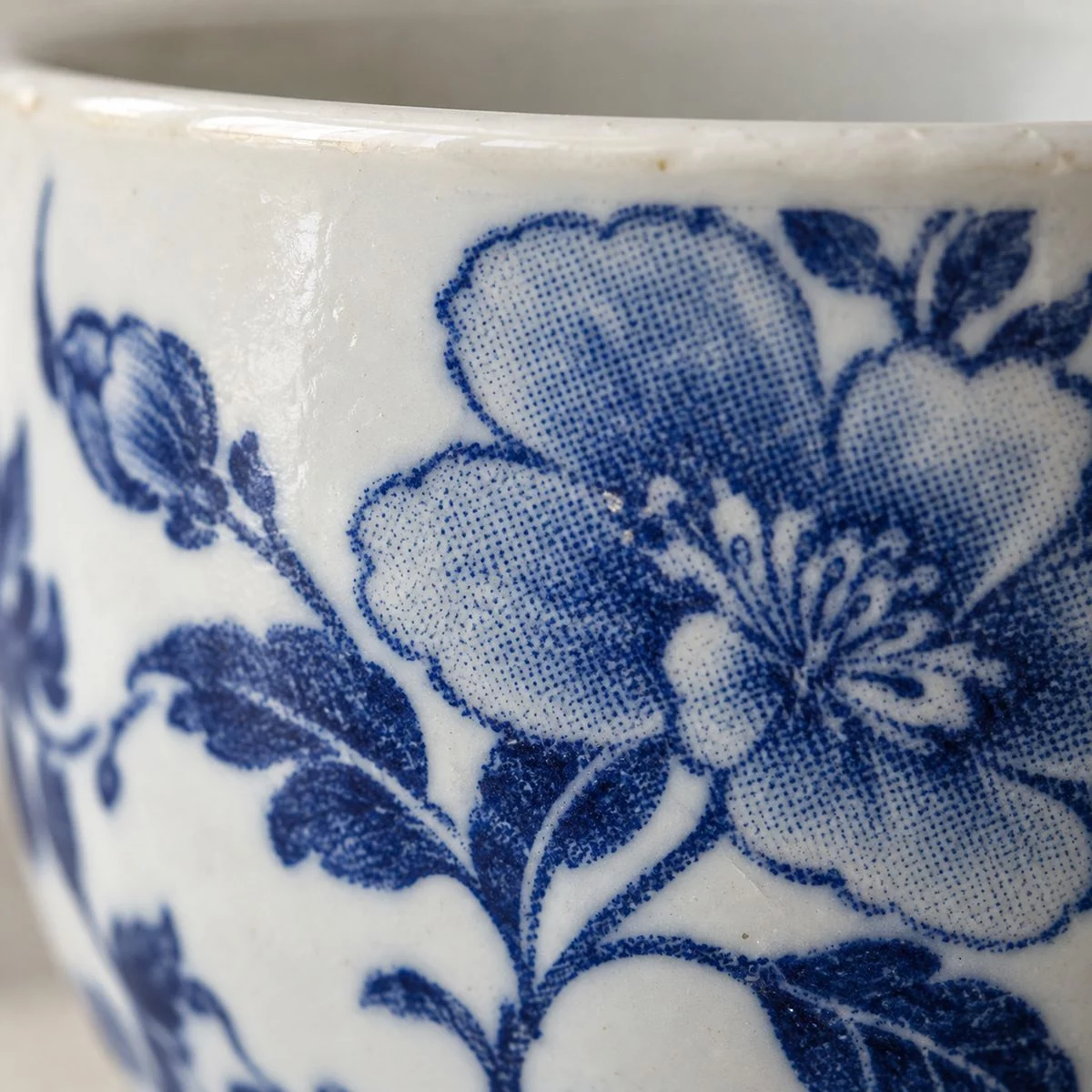
The problem is not decals. The problem is decals sold as hand painting. A buyer can check for themselves with a loupe and a few minutes:
- Under magnification, a printed decal often shows a regular dot or screen pattern; a brushstroke shows pigment pooling unevenly.
- Along the edges, a decal may leave a faint film outline or a slight step; brushwork fades out.
- Across a set, decal motifs are identical in every detail; hand-painted motifs differ slightly in line, spacing and tone.
- Under the glaze, a cobalt stroke is sealed in and can’t be felt; an overglaze decal or enamel sits on the surface and often catches a fingernail.
- At the seams, a decal wrapped around a curved form may show a join or a small wrinkle.
For minimums, a first custom decal run with us starts at 50 pieces per shape, and reorders of an approved decal artwork run from 300 pieces, because the artwork is printed in sheets. Logo methods in general are covered in our guide to custom porcelain product development, and our hotel tableware buying guide looks at how logos survive commercial dishwashers.
Motifs: what they say and where they sell
Chinese motifs carry meaning, and buyers selling into markets that read them, or into gift programs where the meaning is part of the story, should know what they are choosing. The lotus, which grows out of mud and flowers clean, stands for purity. The peony, long called the king of flowers, stands for wealth and honor, which is why it appears on so many gifts. The chrysanthemum is the flower of autumn and long life. Children at play, as on our Doucai children at play gaiwan tea set, are an old wish for a large and happy family. Lions playing with a ribboned ball stand for joy and good fortune, and the persimmon is a pun on a wish that all things go as you hope, which is why the Wucai persimmon tea cup sells as a gift for a new job or a birthday.
For most Western retail buyers, meaning matters less than how the motif reads on the shelf. Our experience is that loose floral scrolls and landscapes travel well across markets, because they read as pattern before they read as symbol. Dragons and dense figure scenes are strong in collector and museum-store markets and harder in general home retail. If a motif has a meaning that might work against you in a particular market, it is better to ask before sampling than after. Our designers redraw any motif for the form it goes on, since a scroll drawn for a jar rarely fits a cup without adjustment.
What you are paying for in a painted piece
The price of hand-painted porcelain is mostly labor, and labor follows how much of the surface is painted and how finely, more than how big the piece is. For a small teacup at FOB prices, the ranges we gave in our guide to sourcing porcelain from China show the scale: about $1.20–2.60 for a decal cup, $3.80–7.50 for hand-painted blue and white, and $7.80–14 or more for famille rose. The same white cup sits underneath all three. What changes is painting time, the number of firings, and the losses each firing brings.
A worked example shows how that plays out, using our own painting times for a small teacup. In hand-painted blue and white, a single border band takes a painter roughly 8 to 15 minutes per cup. A fully detailed scene around the body takes 70 to 110 minutes, so the painting time goes up something like five to ten times while the cup underneath costs the same. That is most of the distance between the bottom and the top of the hand-painted range. Famille rose takes longer at every level: a simple border runs 12 to 22 minutes, and a complete painted composition 90 to 150 minutes per cup. An enamel piece also needs a glaze firing first, then painting on the fired surface, then a second firing in which some pieces will be lost, which is why famille rose starts roughly where blue and white tops out. A buyer who wants to bring the price down has a few honest levers: paint less of the surface, move the fine repeating border to a decal, or choose a palette with fewer firings. Reducing the size of the piece rarely saves as much as people expect.
Two more things move a price. Very large pieces cost more than their surface suggests, because they are harder to handle, paint and fire, and a loss in the kiln costs more. And quantity helps less with hand painting than with most manufacturing, since each piece takes the same painting time whether it is the fifth or the five hundredth. Setup, sampling and color approval are spread over the run, but the painter’s hours are not. Signed pieces are a separate case. Selected high-end tea ware can carry the handwritten seal or signature of a master painter or an intangible cultural heritage inheritor, and those pieces carry a documented premium that depends on the artist’s grade and the complexity of the work. Unsigned production runs are priced on our standard matrix.
Who paints, and how a reorder stays the same
A painted range depends on people, and the way the work is organized decides how consistent it will be. In a Jingdezhen painting workshop the work is divided by skill, and ours is no exception. Outline painters draw the precise contour lines. Color fillers lay pigment within those boundaries. Enamel specialists handle overglaze color, the layering of tints and the preparation of pieces for their second firing. For large custom runs we assign a stable team of 12 to 28 painters, grouped by style, so blue and white and famille rose are painted by different people who do that work every day. KKCN’s six in-house designers turn a buyer’s idea into a pattern drawing redrawn for the form, and they produce about 50 new forms or pattern adaptations a year. The painting itself draws on our own workshops and on a long-term network of 86 partner artisans in Jingdezhen, including two provincial-level inheritors of traditional porcelain techniques.
Consistency comes from what is written down and kept, not from hoping the same hand is free next year. For each painted order we work from an approved pattern drawing, and the first painted piece of a run is compared with the confirmed sample before the rest of the run is painted. Fired color is judged against a signed range rather than a single shade, which our Quality & Approval page describes. The approved piece stays at our headquarters as the reference for every reorder. Where practical, a repeat run of the same motif goes back to the original painter or the same stable crew. For every custom artwork we permanently archive the master pattern sketch, the signed pre-production sample, the pigment batch logs, the firing curve records and the reference color tiles.
That system doesn’t make hand-painted reorders identical; nothing can. It makes them sit within a range the buyer has already agreed to, which is the only realistic promise for handmade work. The East Art Gallery, which supplies museum stores in the Washington, D.C. area, has taken quarterly repeats of hand-painted Wucai pieces from us for five years on exactly that basis.
One customer shows how this works over several years. A North American specialty tea brand launched with decal-printed blue and white teacups, which let it scale consistently at low cost. As the brand matured, it wanted a premium tier with real brush texture and the slight irregularity of hand painting, without losing its signature motif. We painted side-by-side sample sets, calibrated the cobalt and the kiln schedule until the hand-painted blue matched the hue of the reference decal, and locked the result on a standard color tile. A dedicated group of painters took on the pattern. The brand now runs both versions: the decal cup for entry-level retail and the hand-painted one for high-end boutiques. When the painted cup was reordered years later, the work went back to the same crew, working from the archived master sketch, the color batch records and the approved sample tile, and the new cups sat comfortably beside the old ones.
Use and care by decoration
How a piece is decorated decides how it should be used, and a buyer should pass that on to the end customer. Underglaze decoration is the most durable, because the glaze covers it completely; a blue and white cup wears like a plain white one. In-glaze decals come close. Overglaze enamel and overglaze decals sit on top of the glaze, so they are more exposed to abrasion, strong detergents and the scrubbing of a commercial dishwasher. For enamel-painted tea ware, hand washing keeps the color longest. Metallic detail of any kind is not microwave-safe, and on our spec sheets metallic lines are marked as not microwavable.
Whether a decorated piece is suitable for food and drink is a separate question, settled by testing, not by the decoration’s name. That depends on the glaze, the enamel and the firing of the specific piece, and on the rules of the market where it is sold. Our guide to ceramic tableware compliance explains how to match test reports to pieces, and our Quality Control page lists the reports behind our tableware.
The short version
Choose the layer first. Under the glaze, cobalt and copper give you depth and durability in a narrow palette. Over the glaze, enamels give you every color at the cost of a second firing and a softer surface. Then choose by how exactly the pattern has to repeat: a brush for life and variation, a decal for logos and exact repeats, and often both on one piece. Approve every color on a fired sample, agree the range you’ll accept, and expect to pay for painting by the surface covered rather than the size of the piece.
To plan a decoration with us, start from our Glazing & Decoration page, which shows how each layer is applied in our workshops and what you can specify.
Sources
- Asia Society, New Discoveries of Early Yuan Blue-and-White from the Jingdezhen Kiln Site
- Asia Society Museum, wine cup 1979.175 (Chenghua doucai)
- Britannica, wucai ware
- British Museum, falangcai bowl A_PDF-A-806
- Asia Society Museum, dish 1979.188 (Yongzheng enamels)
All read October 2026. Test reports for KKCN products are available on request.
Lin Wan leads foreign trade at KKCN in Jingdezhen, coordinating buyers’ requirements, samples, orders and after-sales across Europe, North America, the Middle East and Southeast Asia. Ten years in ceramic export, working in English and Chinese.