
Resources
Buyer guides from Jingdezhen
Ten guide collections on sourcing, craft and selling Chinese porcelain, written by our export team.
Browse all guides ↗ Resources
Buyer guides from Jingdezhen
Ten guide collections on sourcing, craft and selling Chinese porcelain, written by our export team.
Browse all guides ↗Home » Products » Celadon Legacy Series » Ge Ware
KKCN collection
Ge ware is a Song dynasty glaze prized for its crackle: a thick, gray-green surface crossed by a network of dark lines, with finer golden ones running between them. KKCN makes and fires its Ge pieces in its own Jingdezhen kilns, then checks and packs them in-house. The reference cup is in stock, and cups, vases and other tea ware are made to order.
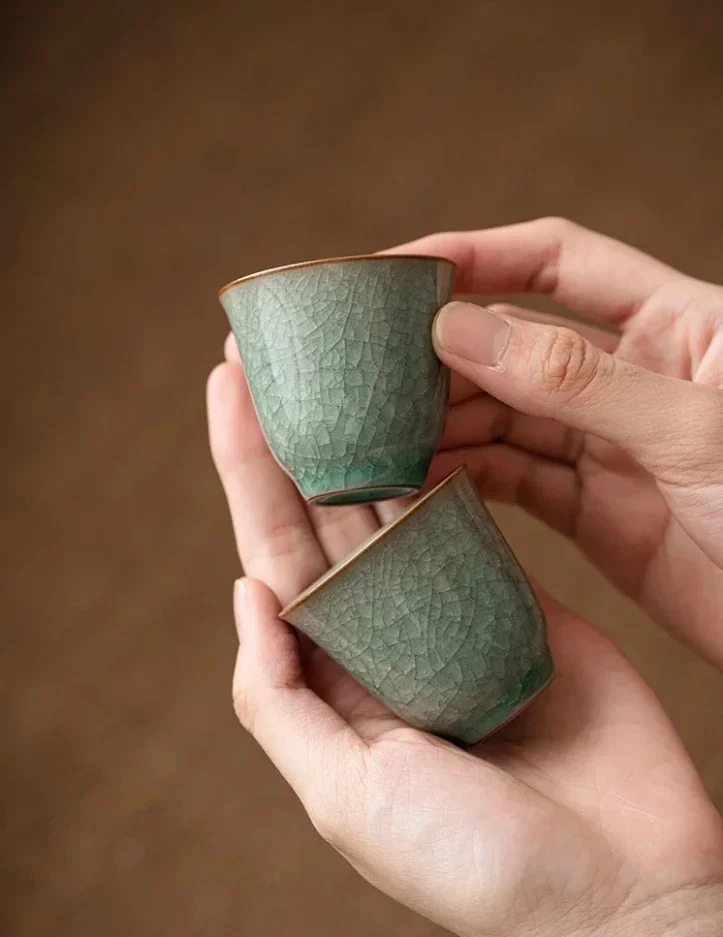
Celadon Legacy Series · Ge Ware
Ge glaze is fired to crack, and on this small tapered tea cup the thick gray-green surface breaks into a dense dark net with finer golden lines between. We fire it in our Jingdezhen factory under a reduction flame, and you can order it as shown or with a finer or bolder crackle.
Most potters spend years learning to stop a glaze from cracking. A Ge potter sets out to make it crack, and then to steer how. The glaze is mixed to shrink more than the clay under it and laid on thick. As the kiln cools, the body contracts a little and the glaze contracts a lot, and the surface gives way.
The first lines open in the kiln. They are wide, and they wander across the piece in long, uneven loops. Then the piece keeps working. Over the following days and weeks, finer cracks branch out between the wide ones, sometimes with a faint ping you can hear in a quiet room. Chinese collectors call the result jinsi tiexian, "gold thread, iron wire": the large network dark, almost black, and the small one a warm golden brown.
That contrast does not come from age alone. Traditionally the wide lines are stained dark soon after firing, while the fine lines that open later take a lighter color, and tea finishes the work in use. A new Ge cup and the same cup a year into daily service do not look alike, and many tea drinkers would say that is the reason to own one.
Ordering Ge means choosing a crackle as much as a shape. A wide, open network reads boldly on a vase across a room. A fine, dense one suits a cup held close to the face. Plain forms show the glaze best (straight-walled vases, lobed cups, brush washers), while carving and painted decoration only compete with it. The tone moves as well, from cool gray-green to a warmer gray-cream, and both are agreed on a fired piece of your own form before the run.
Why crackle forms, and how buyers agree its density, is explained in our guide to Chinese porcelain glazes.
Who makes it
Ge ware is glazed and fired in our own kilns in Jingdezhen by a team that works in Song-style crackle glazes. The finished pieces travel to KKCN's headquarters, where the crackle, rim and foot are checked before anything is packed. Every order passes three inspection levels led by Li Qiusheng, a municipal-level intangible-heritage inheritor of traditional firing techniques.
Custom orders
Process
Choose a reference or send your own design.
Approve a fired sample or photos before production.
Inspected, packed and shipped from Jingdezhen.
FAQ
Wash it by hand in warm water with a mild soap, and let it dry fully before stacking. The lines sit inside the glaze, so they take up color from whatever the piece holds: tea gives the classic golden brown, while coffee or red wine leave a darker cast that will not wash out. Bleach and long soaks in strong detergent can fade the staining. A display piece needs nothing more than a soft, dry cloth.
No. Crackled celadon is a translucent green glaze that happens to craze, usually in one even network. Ge is thicker and more opaque, gray-green rather than green, and made to crack in two sizes of line with two colors. If you want green with a light crackle, celadon can be ordered crackled. For the classic dark-and-golden network, choose Ge.
It depends on whether the set should be noticed. Ru's opaque sky blue and sparse, fine crackle keep a gaiwan, pitcher and cups calm and uniform, which suits a tea room serving many guests. Ge makes each cup look different as its crackle fills in, so it works best as the host's cup or as a set for a single collector. Some tea rooms mix the two: Ru for the service, one Ge cup for the host.
For a while, then it settles. The wide lines open in the kiln, and most of the fine network appears over the first days and weeks after firing, sometimes with a faint ping. After that the pattern stays put and changes mainly in color, as tea works into the lines.
Yes. Plain, straight-walled vases show the crackle well, because a wide network reads clearly from across a room. A vase is quoted by height and sampled at full size, since a large surface crackles differently from a small cup.
Order minimums, samples and shipping are covered on Samples & Quotations and Packing & Shipping. Technique names on this page are defined in our Chinese porcelain glossary.
Send a photo, a sketch or a size, and we will tell you which reference comes closest or quote it as a custom piece.
Product inquiry
Share the PP numbers, quantity, destination and any customization. We reply within 1–2 business days.