Resources
Buyer guides from Jingdezhen
Ten guide collections on sourcing, craft and selling Chinese porcelain, written by our export team.
Browse all guides ↗ Resources
Buyer guides from Jingdezhen
Ten guide collections on sourcing, craft and selling Chinese porcelain, written by our export team.
Browse all guides ↗Home » Products » Imperial Wucai & Painted Porcelain Collection » Tang Sancai
KKCN collection
Tang sancai is glazed earthenware, fired low so that its amber, cream and blue glazes melt and run down the form. These are display pieces for interiors, not for the table. The grid holds two standing horses from our Jingdezhen factory: a classic Silk Road horse and a Chang’an horse in a modern blue crackle glaze, both made to order.
Imperial Wucai & Painted Porcelain Collection · Tang Sancai
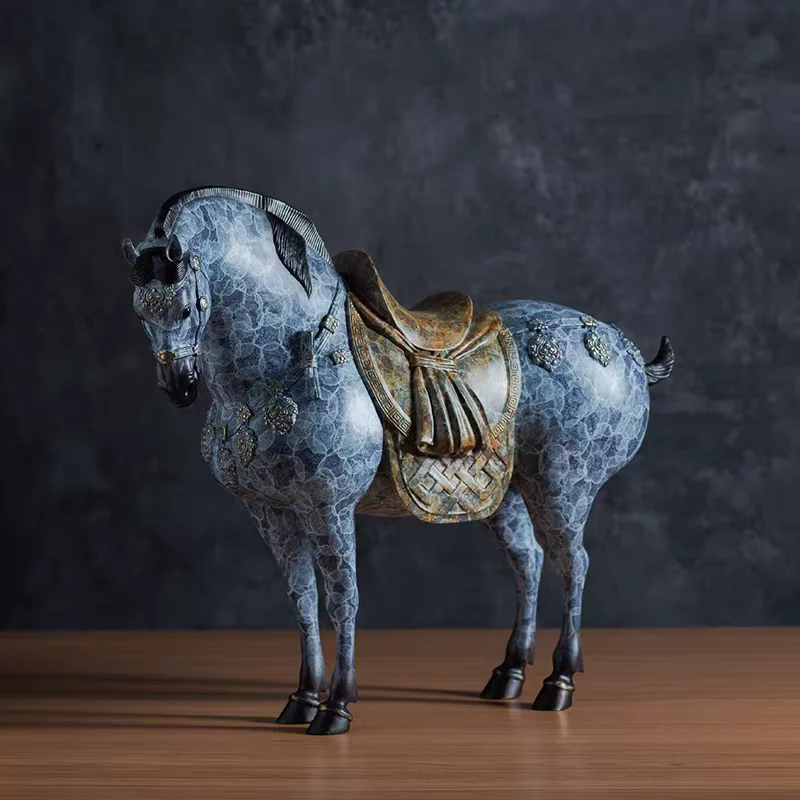
A blue crackle glaze, its cracks traced in white, covers this Tang-form horse, and a bronze-toned metallic luster picks out the saddle and harness. Made in KKCN's own Jingdezhen workshops, it is chosen for interiors, executive gifts and design retail.
Imperial Wucai & Painted Porcelain Collection · Tang Sancai
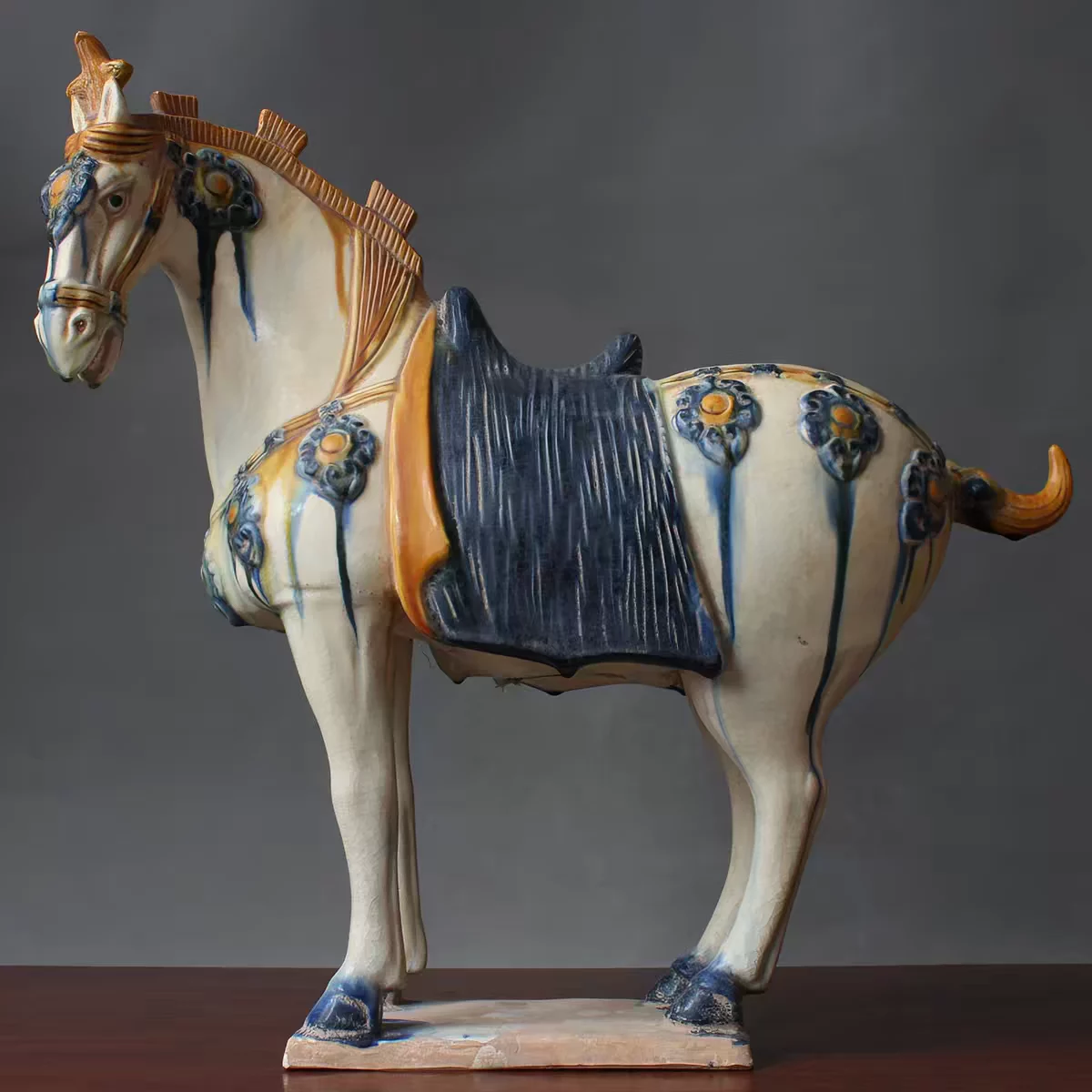
A Tang-style horse stands square on a flat slab base, head turned slightly left, in crackled cream glaze with an amber mane and a cobalt saddle cloth. Made in our Jingdezhen factory, it goes to hotel lobbies and cultural retailers, from one horse to a matched pair.
Sancai means "three colors", though the count was never strict. Potters in the Tang dynasty used amber, green and cream most often and added cobalt blue when they could get it, and their glazed horses and camels are the pieces most people picture. Their story is told on Tang Ceramics.
The making has hardly changed. A horse is pressed in molds, in sections, and the parts are joined while the clay is still soft, with the mane, bridle and tassels sharpened by hand. After a first firing, the glazes go on: iron for amber, copper for green, cobalt for blue, each mixed to melt at a low temperature. In the second firing they turn liquid and slide downhill. Where two colors meet they streak into each other, and as they travel they thin out, so the drips stop short above the hooves and leave the pale clay bare below.
The two horses in the grid start from the same Tang form and end up far apart. The Silk Road horse is classic sancai: a crackled cream body, an amber mane and tail, a cobalt saddle cloth, and blue drips falling from the harness rosettes. The Chang'an horse keeps the shape and changes the surface, with a blue crackle glaze traced in white lines and a bronze-toned metallic luster on the saddle and harness. One looks back to the eighth century; the other would sit as easily in a modern apartment as in a museum store.
When you order, you approve the form, the size and the palette, and whether the glaze stays in clear zones or drips freely. The exact path of each drip you cannot approve, because nobody decides it. A sample is fired at full size, since glaze travels further down a large horse than a small one, and you review it in Jingdezhen in person or by photo and video.
Placing a sancai horse in a lobby, office or home is covered in our guide to decorative Chinese porcelain for interiors.
Who makes it
Sancai-glazed pieces and Tang forms in custom finishes, like the Chang'an horse, are all made in KKCN's own Jingdezhen workshops. Every piece is checked in Jingdezhen by Li Qiusheng's team, with legs, ears and tail looked over closely, and crated in fitted foam.
Custom orders
Process
Choose a reference or send your own design.
Approve a fired sample or photos before production.
Inspected, packed and shipped from Jingdezhen.
FAQ
Because the glazes demand it. Sancai colors are made to melt at a low temperature, far below the roughly 1,300 °C that porcelain needs. At porcelain heat they would boil, burn out or run straight off the piece. So the body is a buff earthenware fired at a matching low heat, which also keeps it easier to mold into large, detailed forms. It is a decorative ceramic, made for display rather than for food or drink.
Partly. The palette, where each color is applied and how thickly are all set in advance, and a glaze kept in clear zones moves much less than one left to drip. What no potter can fix is the exact line each drip takes, which is why no two sancai horses are identical. The approved sample shows how far the glaze is allowed to travel, and pieces outside that range are pulled before packing.
Yes. Bactrian camels, jars and wide display dishes were all part of the Tang repertoire, and each can be made in the same glazes as the horses. A new form starts from a drawing or a reference photo, is sampled at full size, and is quoted on its own. Pairs, such as a horse and a camel for either side of an entrance, are sampled together so the glazes match.
We make them for indoor display. Low-fired earthenware is more porous than porcelain, and frost or standing water can crack the glaze. A lobby, an office or a sheltered gallery is where they last.
In a fitted foam bed inside a solid wood frame. On full-container shipments our breakage rate is 0.6% or less. If up to 3% of an order arrives broken we replace it at equal value in your next order, and above 3% we replace it free or credit it.
Order minimums, samples and shipping are covered on Samples & Quotations and Packing & Shipping. Technique names on this page are defined in our Chinese porcelain glossary.
Send a photo, a sketch or a size, and we will tell you which reference comes closest or quote it as a custom piece.
Product inquiry
Share the PP numbers, quantity, destination and any customization. We reply within 1–2 business days.