By Lin Wan, Foreign-Trade Lead at KKCN, Jingdezhen
Most buyers who set out to source porcelain from China start by asking who has the best price. After ten years in ceramic export, I’ve seen that question cause more failed orders than any kiln. Orders rarely go wrong on the unit price. They go wrong in three gaps: between what you asked for and the sample you approved, between that sample and the bulk run, and between the factory door and your warehouse. Pick a supplier by how well it closes those gaps, and the price question gets easier to answer.
In practice that comes down to six steps, and the rest of this guide takes them in order:
- Know where your kind of porcelain is made, so you know what to ask.
- Decide who you want across the table: a maker, a trading company or an agent.
- Check the supplier before any money moves, with documents, a live look at the workshop and references.
- Make quotes comparable by sending everyone the same written specification.
- Test small, then sign the sample as the standard the bulk order is inspected against.
- Plan payment and the calendar around how Chinese factories actually work.
You should know where I sit. I work for KKCN, a porcelain maker in Jingdezhen that forms, paints and fires its own pieces and exports them to buyers in 36 countries. We’d like your inquiry, of course. But the checks here are written to work on any supplier, ourselves included, and where I quote our own terms I say so, because other factories set theirs differently.
Where China’s porcelain is made, and why it changes what you ask
China doesn’t make porcelain everywhere. It makes most of it in a handful of places that have specialized for decades, and sometimes for centuries. If you know which place does what, you can ask better questions of any supplier, because many finished pieces pass through more than one of them.
Jingdezhen, in Jiangxi province, is where handmade, hand-painted and high-fired porcelain is concentrated. The city has made porcelain for roughly a thousand years. In July 2026 UNESCO inscribed the Jingdezhen Handicraft Porcelain Industry Sites on the World Heritage List, recognizing how the city organized porcelain production from the 10th to the 19th century, from raw materials to kilns. Its ceramic industry chain still employs more than 100,000 people. What Jingdezhen does best is work that depends on hands: wheel throwing, trimming thin walls, underglaze blue painting, enamel painting, carved decoration, and the reduction-fired glazes that need an experienced kiln master.
Dehua, in Fujian province, works at a different scale. Its local porcelain development center describes the county as China’s largest base for producing and exporting porcelain, with more than 4,500 porcelain enterprises and exports to over 190 countries and regions. Dehua is strong in high-white bodies, molded figures and volume production.
Chaozhou, in Guangdong province, made 2.76 billion pieces of daily-use ceramics in 2025, about 14.8% of China’s national total, according to a February 2026 report in the Guangdong press. For a buyer, Chaozhou matters for volume tableware, printed decals and gift packaging.
| Region | What it does best | What to ask a supplier based there |
|---|---|---|
| Jingdezhen | Handmade and hand-painted porcelain, high-fired glazes, small and mid-size custom runs, large decorative pieces | Which steps happen in your own workshop, and who fires the piece? |
| Dehua | High-white bodies, molded figures and forms, large volumes | Is the decoration done here, or sent out? |
| Chaozhou | Volume daily-use tableware, decals, printed gift boxes | Is this piece decal or painted, and where was it fired? |
Our own work shows how these places connect. We form, paint, glaze and fire in our Jingdezhen workshops. Dehua partners supply some high-white bodies and molds, and Chaozhou partners supply decals and export packaging. There’s nothing unusual about that arrangement. What matters is that the supplier tells you which part happens where, so you know who is accountable for each one. When a listing says “Jingdezhen porcelain” and the supplier can’t say which steps happened in Jingdezhen, treat the label as marketing until proven otherwise. If any of the terms above are new to you, the Chinese porcelain glossary defines them in a line each.
Maker, trader or agent: who should be on the other side of the table
Porcelain suppliers in China fall into three groups, and each one earns its margin in a different way. A maker owns workshops and kilns and earns from production. A trading company buys from makers and earns from selection, consolidation and service. A sourcing agent works for you, usually on commission, and earns by finding suppliers and checking them on the ground.
None of the three is automatically the right choice. If you’re buying a mixed basket of stock items across porcelain, glass and textiles, a good trading company can save you months of supplier management, and its margin is often worth paying. If you can’t travel and need someone to stand in a workshop on your behalf, a competent agent earns the fee.
For custom or decorated porcelain, though, I hold a firm view: deal with whoever controls the kiln, or make your trader name the maker in writing. The defects that hurt buyers most come from production decisions only the maker controls. Those include a cheaper clay body, a shortened firing, or a decal swapped in where you approved painting. A trader can promise you the clay grade, but the workshop is the one that has to keep the promise, and a trader can’t always see whether it does. When the maker stays anonymous, every problem has to travel through one more company before anyone can fix it.
Telling a maker from a trader is easier than many buyers think, as long as you look at several signs together rather than one. A maker can usually show you its kilns on a live video call the same day, not a photo from a brochure. Its business license normally lists production in the business scope. It can send workshop video or kiln footage of your type of piece on request. And it can tell you which kiln will fire your order, at what temperature, and how many pieces a kiln load holds. Any one of these can be faked or explained away; all four together are hard to fake. We send factory photos, workshop video, kiln footage, and stamped copies of our business license and kiln filings to anyone who asks, and any maker should be able to do the same.
Where to find suppliers worth checking
There are four ways buyers usually find candidates, and each one shows you something different.
Search engines and B2B platforms give you reach and very little proof. They’re useful for building a long list, but a polished catalog tells you nothing about who made the pieces in it. Trade fairs let you handle the product, see glaze and weight in person, and meet the people you’d work with. The most important one for porcelain is the Canton Fair in Guangzhou, held in a spring and an autumn session each year. Phase 2 of each session carries the General Ceramics and Art Ceramics sections; the autumn 2026 Phase 2 was set for October 23 to 27, and the fair publishes each session’s dates on its official site. We have exhibited in Phase 2 since 2018, as well as at Ambiente in Frankfurt and Maison&Objet in Paris. On its own, though, a booth proves little about who makes the product.
A visit to Jingdezhen shows you the process itself. In two days you can see throwing, painting, glazing and firing, and walk the markets where painters and small studios sell their work. It’s the fastest way to calibrate what handmade porcelain should cost and how long it takes.
Referrals beat all three. A buyer in a market like yours who has reordered from a supplier for several years is better evidence than any certificate. Ask for one, and call them.
| Where you find them | What you can verify there | What you can’t |
|---|---|---|
| Search and B2B platforms | Range, responsiveness, basic documents | Who actually makes the product |
| Trade fairs | Product quality in hand, the team you’d deal with | Production capacity, consistency across a run |
| Factory visit | Process, kilns, workshop conditions, finished stock | How they behave when an order goes wrong |
| Referral from another buyer | Reliability over years and how problems were handled | Whether they can make your specific product |
Check the supplier before any money moves
Buying porcelain from a Chinese factory you have never met feels risky because, without checks, it is. The checks themselves are quick and mostly free, and skipping them is the most expensive mistake I see. Run them in order: documents first, then a live look at the workshop, then a paid sample.
Every company in China carries an 18-character Unified Social Credit Code on its business license. You can enter that code or the company name on the government’s National Enterprise Credit Information Publicity System at gsxt.gov.cn, which is free and public. The record shows the registered legal name, legal representative, registered capital, business scope, current status and annual report filings. Compare the legal name with the name on your contract and on the bank account you’d pay. Read the business scope too. A scope that lists only trading points to a trading company, whatever its website says. Treat it as one signal rather than a verdict, though: some groups register their factory and their export arm as separate companies, so check the scope against the live video and ask which entity you’d be contracting with.
Certificates and test reports can be checked with whoever issued them. An ISO certificate has a number, an issuing body and a date, and the issuer will confirm it. Ours, for example, is ISO 9001:2015, certificate ISO-CER-20260218-044, audited by SGS. A test report should name the lab, the report number, the date, the standard and the exact items tested. A report on someone else’s mug proves nothing about your cup. Our guide to lead and cadmium reports shows how to read one line by line.
Before paying anything, I’d run these eight checks on any porcelain supplier:
- Look up the company on GSXT and confirm its status, legal name and business scope.
- Confirm that the contract, invoice and bank account all carry that same legal name.
- Ask for a live video walk-through of the workshop and kilns, with a view of today’s date.
- Ask who forms, decorates and fires your specific piece, and where.
- Verify any certificate with its issuing body.
- Read test reports for the lab, the date and the exact item tested.
- Ask for a reference customer in your market and call them.
- Order a paid sample of your exact item before discussing bulk prices.
Why three quotes for the same cup disagree
The most common mistake in first inquiries is focusing on price before the specification is agreed. A buyer sends a reference photo and asks for a quote. They don’t give a size, capacity, wall thickness, packing method, or the tests their market requires. Three suppliers then quote three different products, and the buyer compares the numbers as though they were the same cup.
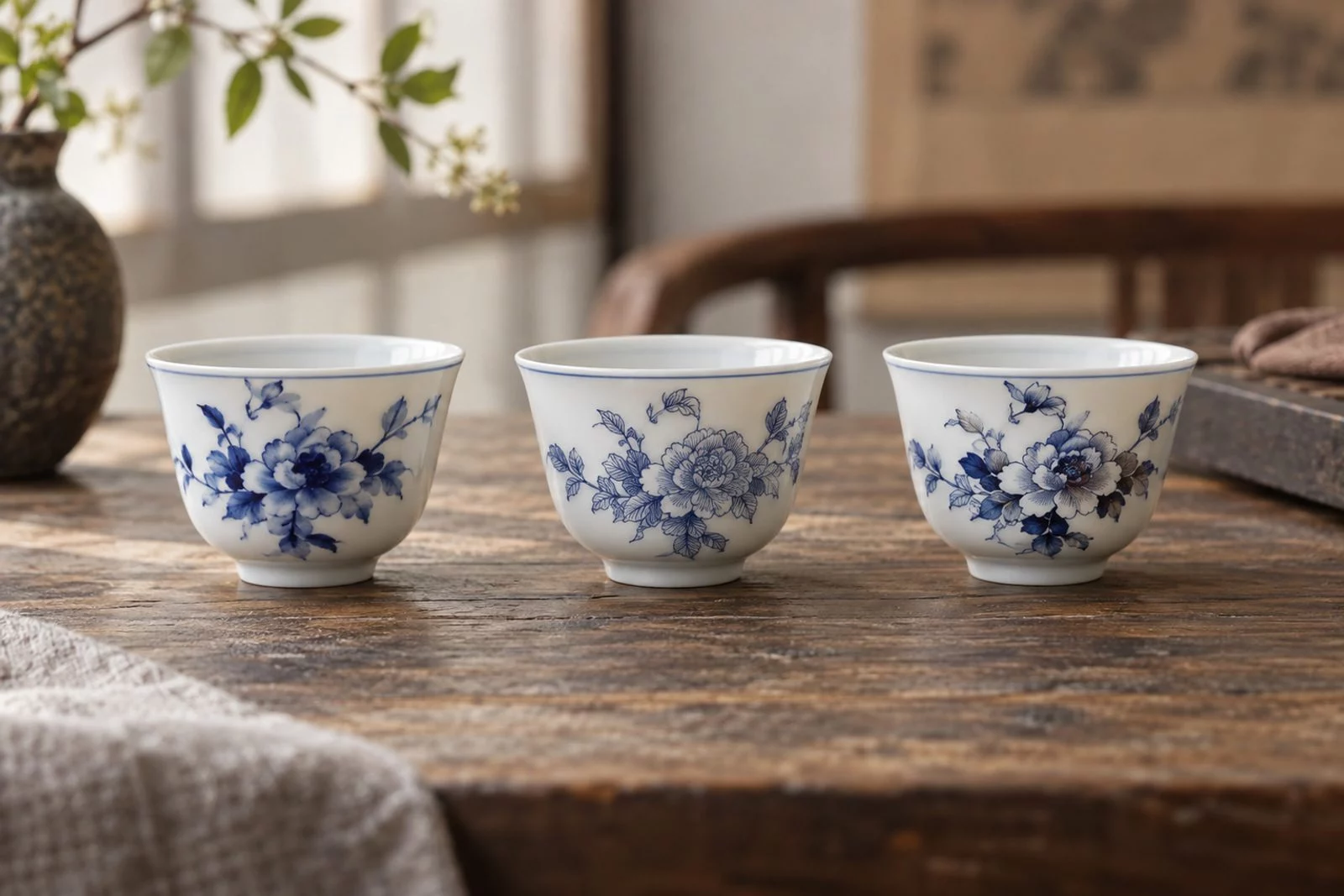
Here is what that spread looks like for one ordinary item. The basis is a small tea cup of about 120 ml (4 oz), ordered at 500 pieces for one design, packed in standard export cartons with no gift box, and quoted FOB Shanghai in late 2026, before any special packaging, testing or certification charges. These are ranges we see across the market, our own quotes included, and like any price they move with materials, labor and exchange rates, so treat them as a guide to the gaps between methods rather than as a price list:
| Decoration method | Typical FOB price per cup | What drives the price |
|---|---|---|
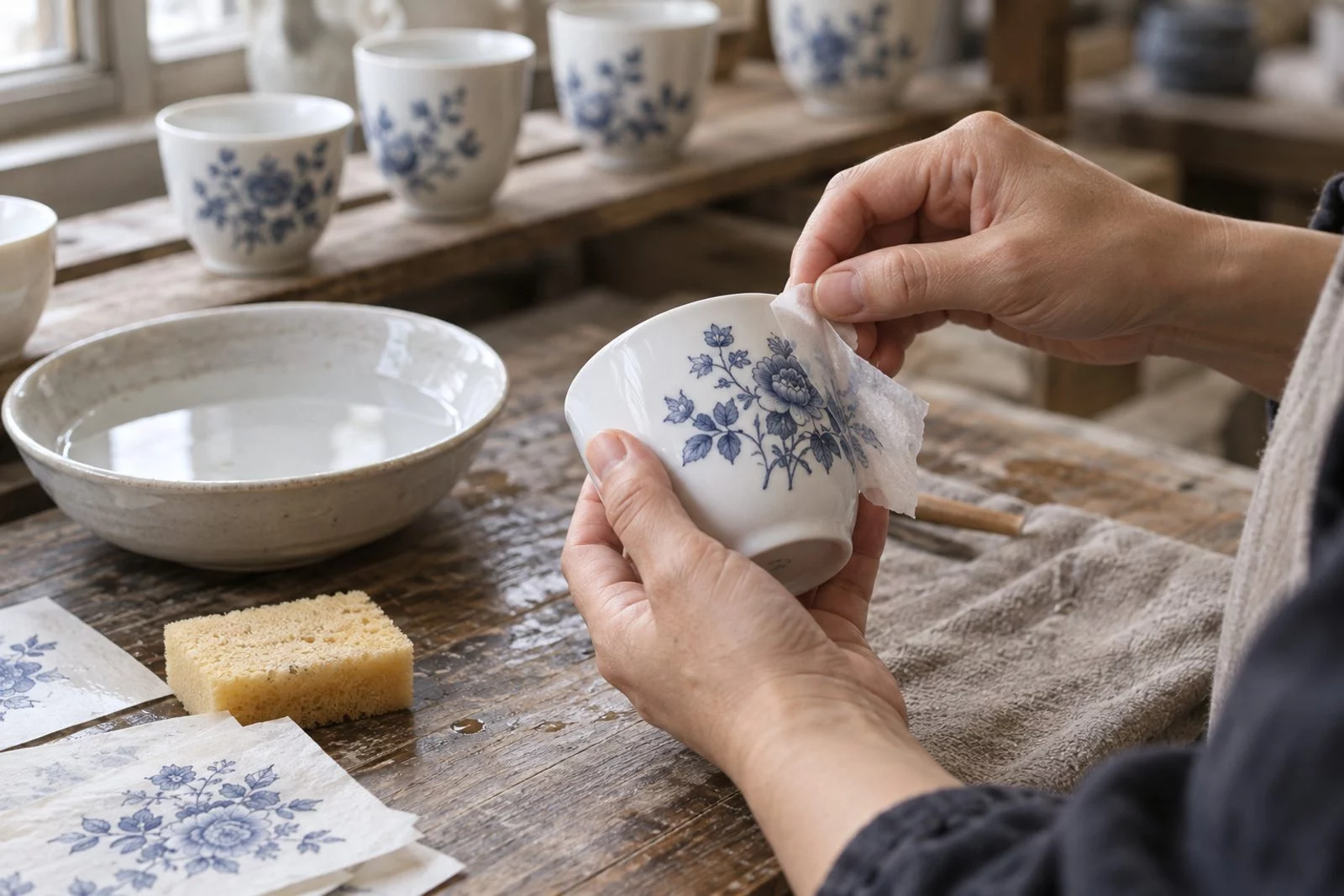
| Decal on white porcelain | $1.20 – $2.60 | Body usually mold- or machine-made; decal applied by hand and fired on at low temperature |
| Hand-painted blue and white (underglaze cobalt) | $3.80 – $7.50 | A painter’s time on every piece; one high firing; losses when cobalt blurs or the glaze fails |
| Hand-painted enamel (famille rose, overglaze) | $7.80 – $14.00+ | Painting on top of fired glaze, a second firing at about 780–850 °C, more skilled hours, more pieces lost |
So a cup quoted at $2 and a cup quoted at $9 can both be fair prices. What makes them different is the work, not the margin. The gap grows as automation drops and skilled hours rise. Every extra firing adds days and adds pieces lost in the kiln. When one supplier quotes “hand-painted” at a decal price, ask for a close-up of the brushwork. More often than not, the explanation is a decal.
Even within one method, quotes differ on things that never appear in a photo. Those include the clay grade, wall thickness and weight per piece, glaze quality, how many pieces in the run are inspected, how each piece is packed, and whether mold or sampling fees are hidden in the unit price or billed separately. The trade term matters too. An EXW price and a DDP price for the same cup can be far apart, because one stops at the factory gate and the other runs to your door.
The fix is simple to describe and tedious to do. Write one specification and send it to every supplier: dimensions, capacity, wall thickness or weight, body, decoration method, glaze color range, base mark, packing, test requirements and trade term. Ask each supplier to quote against it line by line. The quotes that come back will finally be comparable.
Start smaller than your forecast
Buyers often assume a factory will only take them seriously with a big first order. The opposite approach works better. Test the supplier on stock pieces and a small mixed order, then commit to custom work once you’ve seen how they ship.
Minimums exist for practical reasons, not to keep small buyers away. A kiln is fired full. One of our natural-gas shuttle kilns holds roughly 1,000 to 1,500 standard pieces per firing. Making a new mold, testing a glaze and setting up a pattern cost about the same whether you order 50 cups or 5,000. That’s why custom minimums sit at around 50 pieces per style at our workshops, while stock items can be ordered from a single piece. Mixed orders across our stock items start at 10 pieces. Other makers set different numbers, sometimes much higher for decorated work, but the logic behind them is the same, and knowing it helps you negotiate. Combining several styles into one firing, choosing an existing form, or accepting a stock glaze can all bring a minimum down.
A trial order costs little next to a failed custom run. Ceramic Home MY, an online home-goods seller in Malaysia that has bought from us for three years, started with a 50-piece mixed order of stock pieces and moved to monthly repeat orders after that. That’s a sound way to begin with any supplier. In-stock samples from us ship in 3–7 business days, so a trial costs you a few weeks, not a season.
Treat the signed sample as the contract
A good sample proves that a supplier can make one good piece. It doesn’t prove that the thousandth piece will match it. What connects the two is a signed standard that the bulk run is inspected against.

We learned how much this matters from a US home-goods wholesaler who came to us after their previous workshop, also in Jingdezhen, let them down. Their pre-production samples had been good. In bulk, the workshop switched to a lower-grade clay, and the cups came out thin, with frequent glaze pinholes and decals that bled. The workshop reported a kiln breakdown right before the shipping cutoff, which delayed the order by three weeks, and then offered only limited replacements with no faster fix. Nothing in their agreement had locked the clay grade or the glaze standard, so the buyer had little to hold the workshop to.
When that buyer came to us, we put every specification in writing before production: clay grade, glaze standard, dimensions, decoration and packing. Each order then passed three inspections: one on the body, one on the glaze, and a full final check. When they later needed urgent help, we rearranged kiln slots and gave them two options: a split shipment, or replacements from ready stock. We also stated in writing who was accountable for any quality issue. None of that is special. It’s what the signed sample is for.
Our quality management lead, Li Qiusheng, puts the approval checklist this way: “When approving samples, verify dimensions, capacity, glaze texture, artwork placement and color, wall thickness, base mark, test requirements, packaging and acceptance criteria to avoid bulk production discrepancies.”
Two of those points deserve more attention than they get. The first is glaze. Handmade glazes vary from kiln to kiln, especially reduction-fired celadons and kiln-transformed glazes, so the right standard is an agreed color range, not a single color. Approve two or three samples that mark the light and dark ends of what you’ll accept. The second is acceptance criteria: state in writing what counts as a defect and how many defects in an inspected batch fail the batch. Without that, every disagreement turns into a debate after the goods have shipped.
New-form samples take 15–30 business days at our workshops, which in our experience is realistic for handmade work. If a supplier promises a new custom form in a week, ask how. Sometimes the answer is an existing mold adapted to your design, which can be perfectly fine. Sometimes it’s a shortened drying or firing cycle, which tends to show up later as cracks and glaze faults in bulk. Our guide to going from a reference photo to an approved sample explains what a photo leaves out. For a product that’s new from the ground up, our guide to custom porcelain product development walks through form, glaze, logo and sample rounds. Our Quality & Approval page lists what our written standard locks before production.
Paying a factory you haven’t met
Most porcelain orders from China run on a deposit with the balance paid before shipment. At KKCN that’s 30% in advance and the balance before the goods leave, by bank transfer or letter of credit, with staged payments for large projects. Many Chinese suppliers use a similar split, though the percentages vary. The details are on our samples and quotations page.
The structure matters less than who you pay. Pay only into a company account whose name matches the legal name on GSXT and on your contract. Never pay a personal account, however convincing the reason. Treat any email that changes bank details as fraud until you’ve confirmed it by phone with someone you already know at the supplier. This kind of fraud works because the email looks routine. For a first order of real size, a letter of credit costs more in bank fees but ties payment to shipping documents. Many buyers find that worth it the first time and drop it once trust is built.
Time zones, language and the Chinese calendar
Most misunderstandings between buyers and Chinese suppliers have nothing to do with language. They come from vague specifications. “Light blue” means a dozen colors. “Thin” can mean 2 millimeters or 4. Write specifications in numbers and drawings, mark changes on photos of the sample itself, and keep one named contact on each side. That way decisions aren’t lost between colleagues and time zones. If your supplier’s English is limited, short sentences and numbered points will help more than a long email.
The calendar needs planning around two pinch points. The first is Chinese New Year. At our workshops, production winds down around the 20th day of the twelfth lunar month and most work stops for two to three weeks. Some work restarts around the 10th day of the first lunar month, and normal lead times return after the 15th. For the 2027 New Year, which falls on February 6, that means a slowdown from late January, a partial restart in mid-February and full production after February 20. Most workshops we know follow a similar pattern, and the weeks after the holiday are crowded as everyone restarts at once. We publish exact dates each December.
The second pinch point is peak season. From August to December, export orders for the holidays fill kilns. Expect 5–10 extra days on lead times, and know that many makers, ourselves included, book peak capacity about three months ahead for existing customers. Outside those periods, our regular production runs 15–25 days, custom pattern or mold work 30–45 days, and fully handmade art pieces 45–60 days. To have a range on shelves in early November, you should approve the sample before the summer, not after it.
Getting it home is a separate decision
Sourcing ends at the factory door, and a different set of decisions begins there. The first one is the trade term, which settles who pays for each leg of the journey and where risk passes from seller to buyer. The International Chamber of Commerce’s Incoterms 2020 rules define eleven of these terms. For porcelain, most buyers use EXW, FOB, CIF or DDP, and we work with all four.
Choose the term before you choose a freight route. Your choice depends on how much of the journey you want to manage yourself, and on whether you have a freight forwarder and customs broker you trust. Our guide to importing porcelain from China picks up from here, covering trade terms, routes, customs codes and the landed cost of a first order.
The cases that don’t fit the standard path
Some sourcing projects don’t follow the steps above, and these are where buyers get caught out most often.
A single art piece or a small run of commissions. Large decorative porcelain and sculpture are quoted per piece. They take longer (45–60 days for fully handmade work at our workshops), and some pieces are lost in the kiln, which is priced in. Art Space Milano, an interior design studio we’ve worked with for two years, commissioned 30 one-of-a-kind pieces this way, each with an original form and a glaze made for it. If you’re specifying for a hotel or a residence, our hotel and restaurant porcelain page covers what project orders need.
A reorder three years later. Ask on day one where the mold, the glaze record and the signed sample will be kept, and for how long. We keep more than 1,200 molds and form references for this reason. About 72% of our active trade clients reorder (KKCN production and sales records, 2025–2026), and they’ve stayed with us for close to five years on average, so for us a reorder years later is the normal case rather than the exception. Our German client Living Oriental has placed a repeat batch of 800 to 1,500 pieces every year for six years, which only works if each batch matches the forms and glazes of the one before. A supplier who can’t tell you where your mold will be in three years is telling you something.
A range that mixes techniques. A collection with celadon cups, painted bowls and white plates may involve different kilns and different specialists. You can manage three suppliers yourself, or ask one maker to coordinate the range and take responsibility for matching it. I’d pick the second for any range sold as a set.
Buyers who can’t travel. A live video audit, a third-party inspection before the balance is paid, and a paid sample of every style will cover most of what a visit would. Keep the visit for when the relationship is worth it.
Quick answers
How much does porcelain from China cost? It depends far more on decoration than on size. For a 120 ml tea cup quoted FOB in late 2026 at 500 pieces per design, we see roughly $1.20–$2.60 with a decal, $3.80–$7.50 hand-painted in underglaze blue, and $7.80–$14.00 or more hand-painted in overglaze enamel, before special packaging, testing or certification charges. Your own quotes will vary with size, design and order quantity.
What’s the minimum order for porcelain from a Chinese factory? There’s no industry-wide number. Factories set minimums by how their kilns load and what a new mold or pattern costs to set up, so stock items often have low or no minimums while custom work runs from a few dozen to several thousand pieces per style. At KKCN, stock pieces start at one piece, mixed stock orders at 10, and custom styles at 50 per style.
How long does a porcelain order from China take? It depends on whether the piece exists already. At our workshops, stock ships in 3–7 days, regular production takes 15–25 days, custom patterns or molds 30–45 days, and fully handmade art pieces 45–60 days, after a new sample of 15–30 business days where one is needed. Other factories’ times differ, but nearly all slow down from August to December and stop for two to three weeks around Chinese New Year.
How can I tell whether a porcelain supplier is a real factory? Use several checks together. Look up its business license on GSXT and see whether production appears in the business scope, ask for a live video of the kilns and workshop, and ask who fires your specific piece and at what temperature. A maker can usually answer all three quickly; a supplier that can’t answer any of them is probably not the one making your porcelain.
What to put in your first inquiry
The quickest way to get a useful first reply from any porcelain supplier is to send the specification with the question. A quote built on a photo alone is a guess, and you’ll spend weeks correcting it. Whether you write to us or to anyone else, include:
- the item, with dimensions and capacity, and a drawing or photo marked with measurements;
- the body (porcelain, bone china, stoneware) and any wall thickness or weight you need;
- the decoration method (decal, hand-painted underglaze, enamel, carved) and the glaze color range you’d accept;
- your logo or base mark, if any;
- the quantity per style and the total order;
- how each piece should be packed, and whether you need retail boxes;
- the tests your market requires and the trade term and destination port;
- the date the goods need to reach you.
If you send that to us, my team at our Jingdezhen ceramic factory will reply within one to two business days with the route we’d use, the sample type, its cost and its timing. If you’d rather start from what’s ready to ship, our in-stock range can be ordered from a single piece. Either way, you’ll be dealing with a Chinese ceramic supplier with its own kilns, and you’re welcome to run every check in this guide on us first.
Lin Wan leads foreign trade at KKCN in Jingdezhen, coordinating buyers’ requirements, samples, orders and after-sales across Europe, North America, the Middle East and Southeast Asia. Ten years in ceramic export, working in English and Chinese.