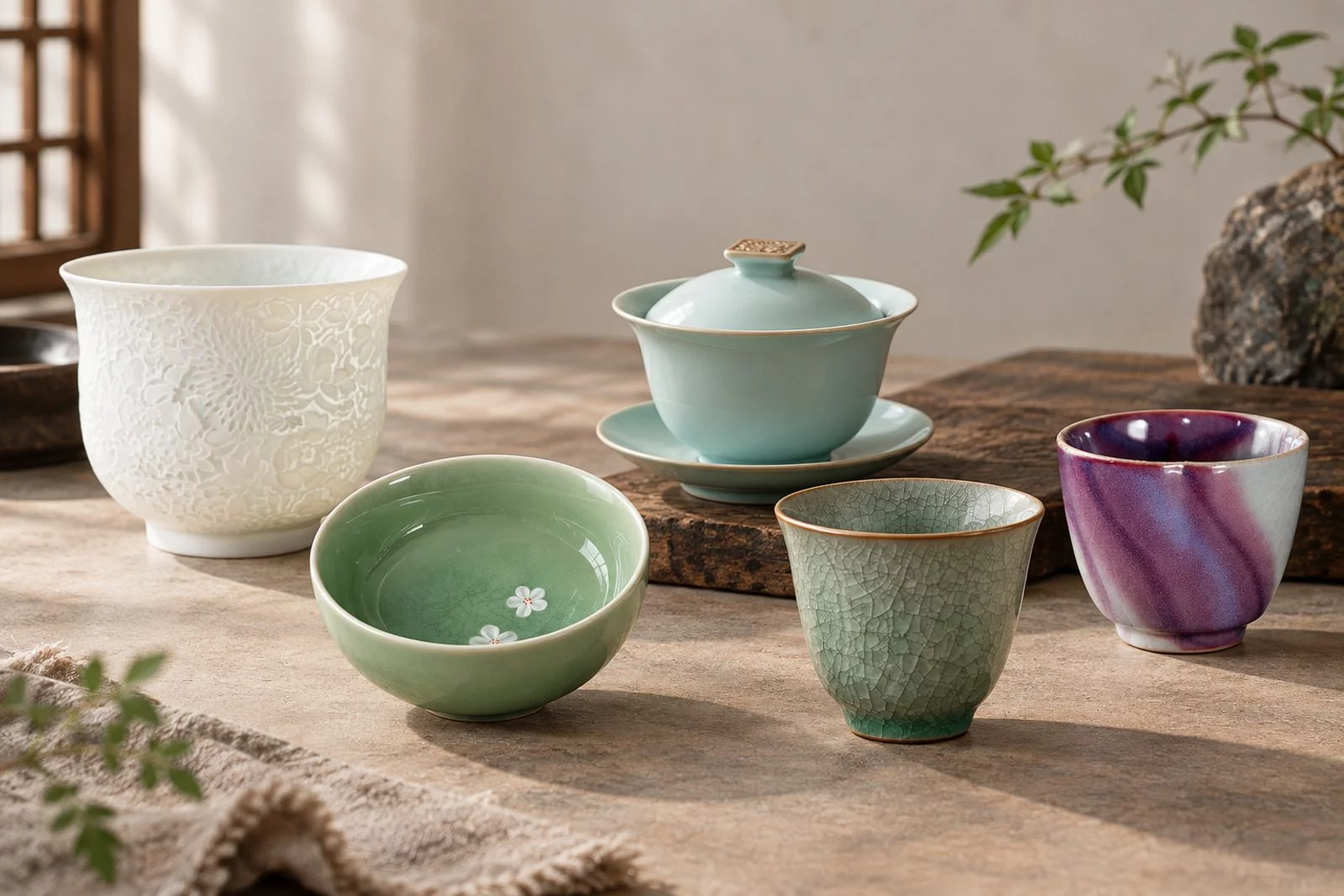
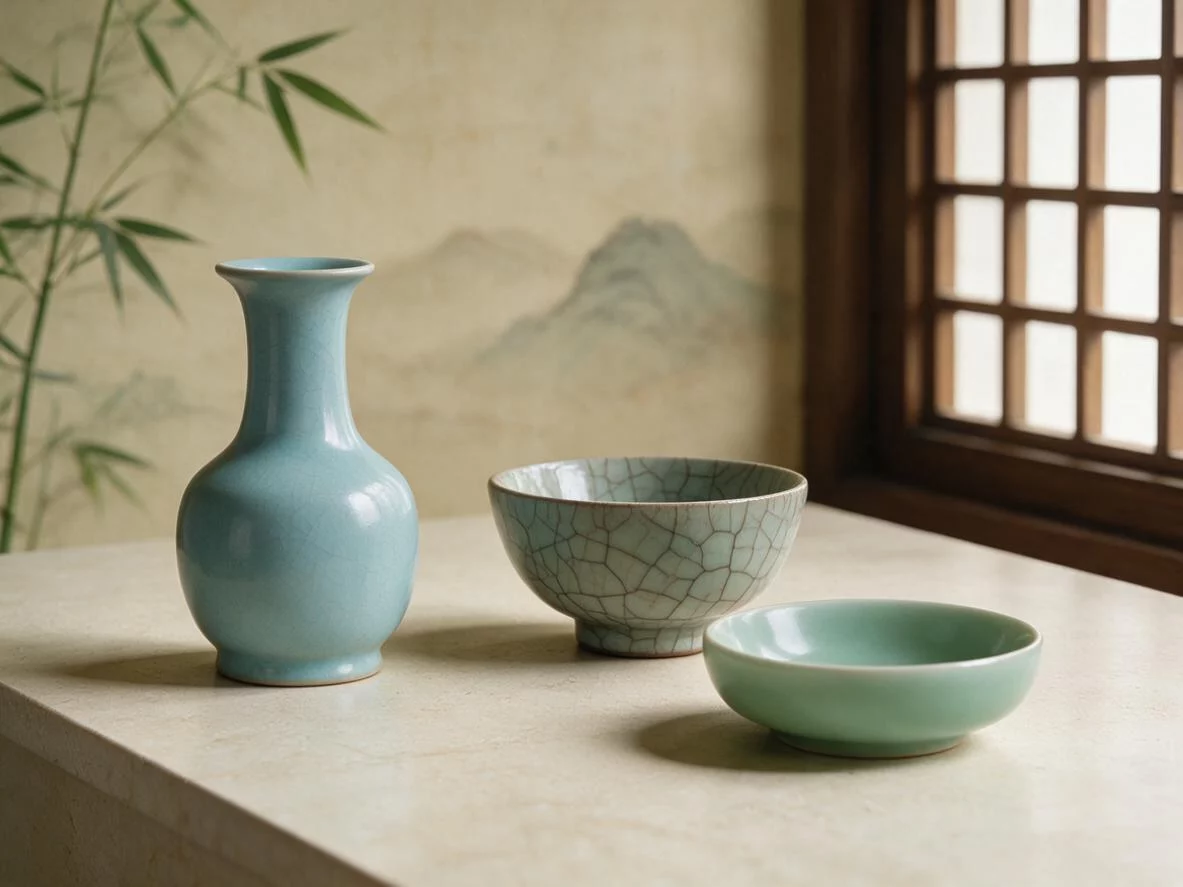
Put two celadon cups side by side: one thrown in Jingdezhen porcelain, one in a darker stoneware. Both are dipped in the same green glaze and fired in the same reducing kiln, and they will not match. The porcelain cup reads clear and cool, with light coming back up through the glaze. The stoneware cup reads deeper and grayer, and its rim turns a warm brown where the glaze runs thin.
For a buyer, that difference decides more than color. The body under a celadon sets the weight in the hand, the thickness of the wall, how the piece stands up to daily service and how closely a reorder will match the first run. This guide takes the body first, then the glaze, then the specification you send us.
Why the same glaze fires two different greens
A celadon glaze is a glass tinted with a small amount of iron, fired in a reducing atmosphere that brings out its green. It stays translucent, so you look through it to the clay beneath. A white porcelain body reflects light back up through the glaze, and the green looks clear and cool. A stoneware body carries iron of its own and fires gray or buff, so the same glaze sits on a darker ground and turns deeper, closer to olive or gray-green. At every rim, ridge and carved edge, where the glaze thins, the body shows through: pale on porcelain, brown on stoneware. Our Kiln Firing page shows how the reducing flame is set and held.
What Jingdezhen porcelain does under a celadon glaze
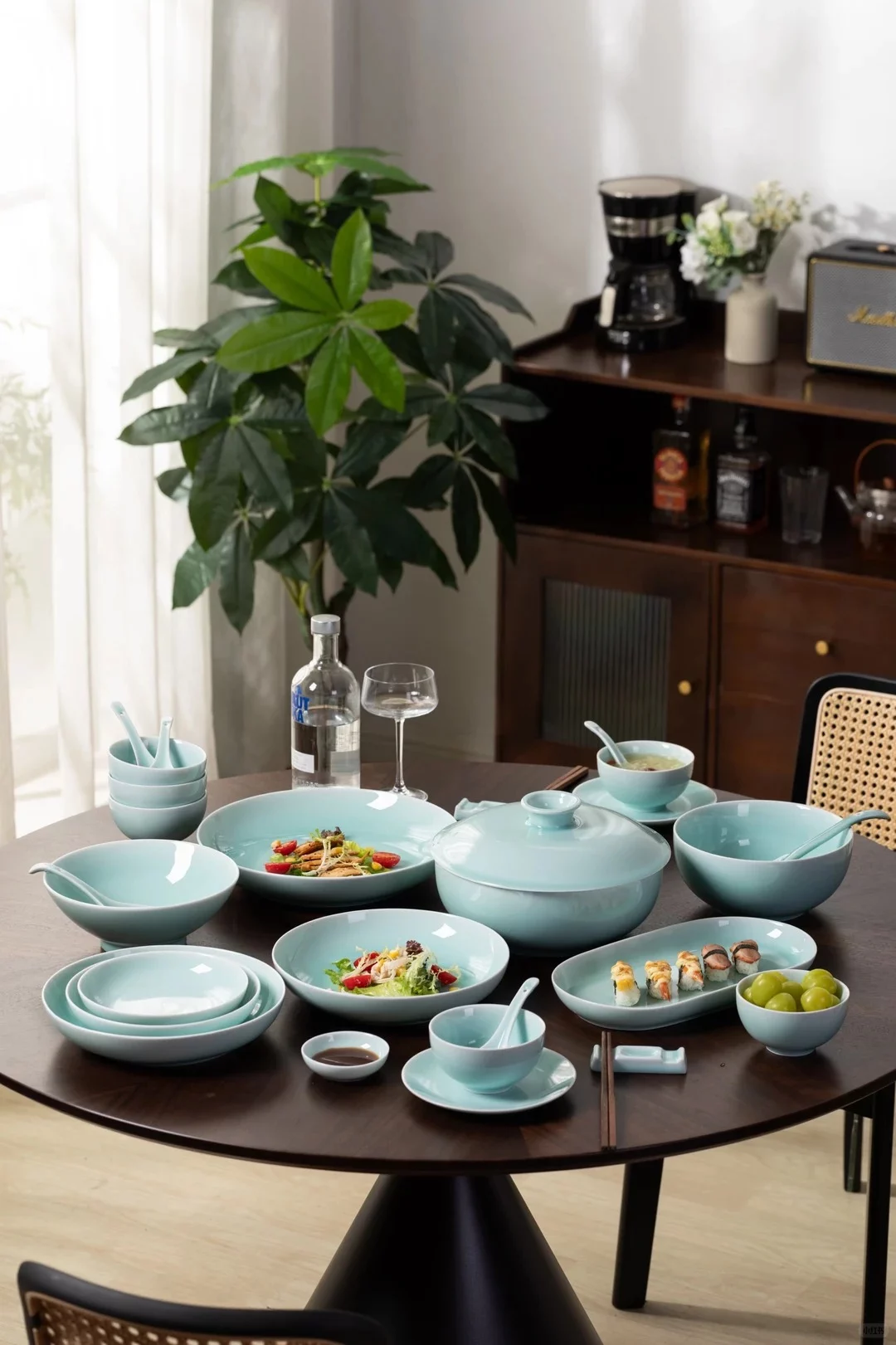
Our Song-style celadon is thrown, glazed and fired in our own Doufunong workshops on Jingdezhen porcelain. The kaolin and porcelain stone come from the Yaoli and Gaoling Village areas and are blended into a celadon body of its own before they reach the wheel. Fired at about 1,300 °C, body and glaze mature together, so the surface stays sound through years of washing and handling. Porcelain also lets us trim a wall thin, carve a band under the glaze and keep a tea cup light enough to lift all day. It is the body behind our celadon daily-use tea ware, one of the lines covered by our food-contact test reports. It is also the body behind the Celadon Dinner Service, whose bowls, plates and covered tureen ship from stock.
Darker bodies, deeper greens and heavier pieces
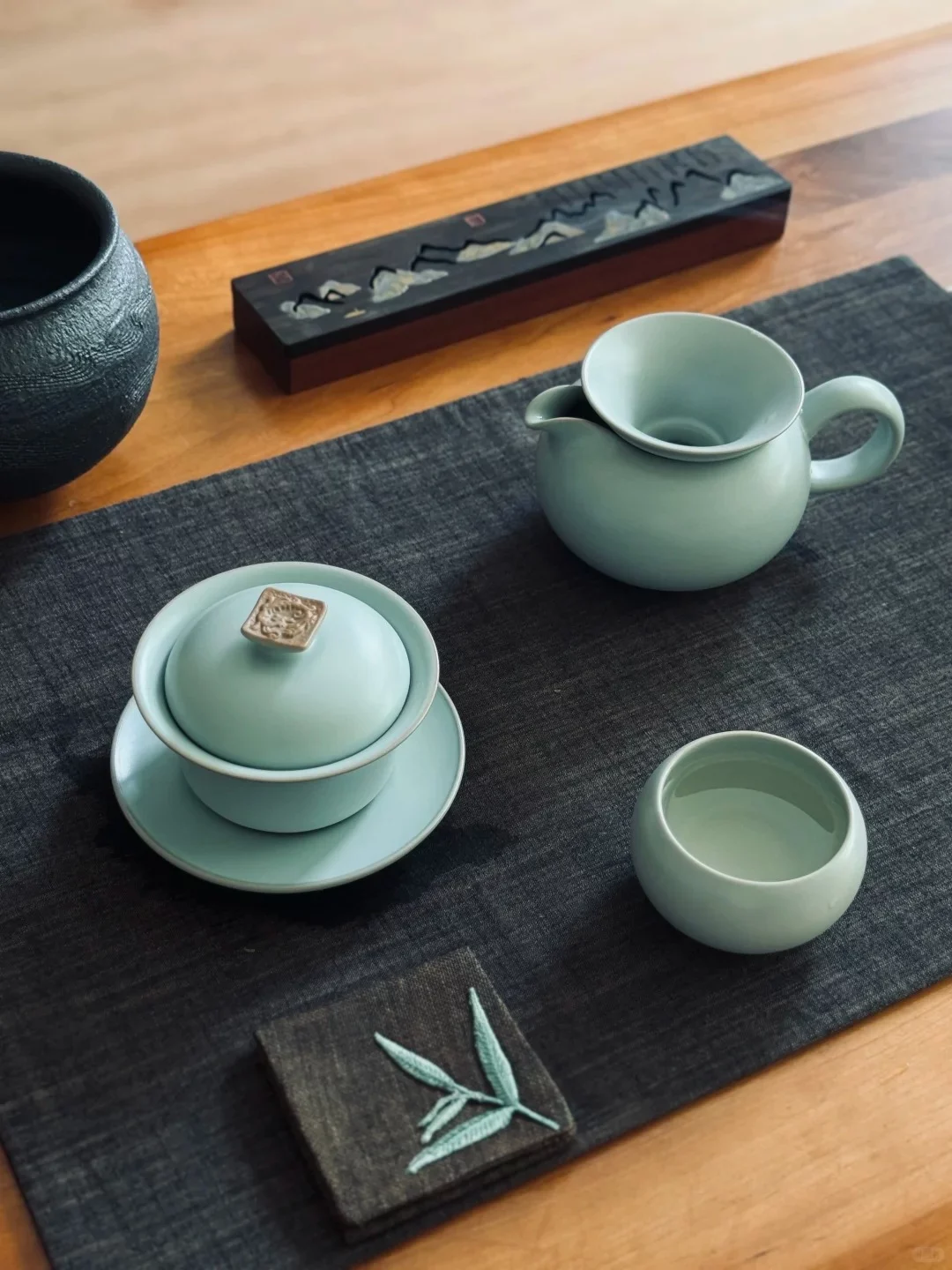
A darker body earns its place where depth matters more than lightness. Under the same family of glazes it gives a heavier, warmer piece with thicker walls and a green that holds its weight across a room. That suits lobby vases, display pieces and tea sets with an older, earthier presence. At KKCN the darker-bodied side of the family, Ru, Ge and Jun, is made and fired in our own kilns. Our Ru Ware Tea Set is one example: an opaque sky-blue Ru glaze over a darker revival body, fired in-house, with a square relief knob on the gaiwan lid. Stoneware and earthenware lines come from heritage partners. Every partner piece returns to our Jingdezhen headquarters for final inspection and packing, and your quotation names the workshop that makes it.
Tea service, table, gift set or lobby: which body
Use and market decide the body before taste does. Below are four common celadon programs, the body we would put under each, and the first line to settle in the specification.
| Program | Body | Settle first |
|---|---|---|
| Hotel or tea-room service | Jingdezhen porcelain | The target green on a fired cup and saucer, the wall thickness, and the tested daily-use line it joins |
| Retail dinnerware range | Jingdezhen porcelain | One approved green across plates, bowls and serving pieces, plus stacking heights for the shelf |
| Gift tea set | Jingdezhen porcelain celadon, or Ru on a darker revival body | Tone on a fired sample, the full set contents and the branded gift box |
| Lobby vase or display piece | Porcelain for a clear green; a darker revival body for Ru, Ge or Jun depth | Height (we make pieces up to 130 cm), crackle or smooth, and a solid-wood frame for transit |
For the wider choice between bodies, glazes and decoration, see the trade-offs in our selection guide.
Six lines that make a celadon order repeatable
- The body: Jingdezhen porcelain, or the heritage partner route named in your quotation.
- The green, approved on a fired piece of your own form, with the lightest and darkest pieces you will accept recorded beside it.
- The surface: gloss or matte, smooth or crackled.
- Wall and weight, written as measurements: finer for tea, sturdier for hotel and daily tableware.
- The foot: bare or fully glazed, plus any mark engraved into it before glazing.
- Quantity per style and the reorder plan, so the confirmed sample and craft file are kept for the next run.
These six lines go into the standard you sign before production. There, natural variation in tone is written down as a range both sides have already seen. Quality & Approval shows how that range is recorded.
From a sample to a first celadon order
Stocked celadon pieces, such as the Plum Blossom Celadon Tea Cup and the dinner service, go out as samples within 3–7 business days. A new form, carving or green is sampled in 15–30 business days, and the sampling fee is credited against the order once it reaches the agreed minimum. Celadon can join white porcelain in a mixed order from 10 pieces, and Ru, Ge and Jun can travel with it on one packing list. Your own form or green starts at 50 pieces per style.
The Song potters who set the standard for celadon worked over pale and dark bodies alike, and our Song chapter tells that story. When you are ready to price, send the program, the quantity and a photo of the celadon you are matching. Lin Wan replies within 1–2 business days with a body, a route and a sample price.