By Lin Wan, Foreign-Trade Lead at KKCN, Jingdezhen
The most telling order a tea shop sends us is rarely the first one. It is the small one that comes a few months later: six more celadon cups, two gaiwans, a fair cup to replace one that broke. Behind it there is usually a customer who bought four cups, liked them, and came back to finish the set. Whether the shop can say yes depends on decisions it made long before, when it chose the pieces, the glaze and the maker. This Chinese tea ware guide is written for the people who make those decisions: tea shops and tea rooms, tea brands that want ware under their own name, gift and lifestyle retailers, and hotels that serve tea in a lounge or a suite.
Most of these buyers know tea far better than they know porcelain. They can tell a good oolong in one sip but haven’t had a reason to learn why one gaiwan burns the fingers and another doesn’t, what a celadon interior does to the color of a green tea, or why a reorder cup can come back a shade off. The guide follows the order in which those questions matter: how the tea reaches your customer, the pieces on the table, what makes a cup or gaiwan work in the hand, glaze and decoration, the range you open with, gift sets, your own mark, and what to tell customers about care.
One of our longest tea ware relationships shows why that order matters. Ceramic Home MY, a Malaysian seller on Lazada and Shopee, started with a mixed trial of 50 pieces of white dinnerware and celadon tea ware, then moved to monthly repeats from stock. Living Oriental, a German home brand with stores in Munich, Berlin and Frankfurt, has reordered monochrome white tea sets and celadon pieces with its own mark every year for six years. Neither business could work if the cup in this year’s carton looked different from last year’s. Where I quote KKCN’s terms, times and test results, I label them as ours. Other makers set theirs differently.
Start with how the tea reaches your customer
Chinese tea ware reaches people in three ways, and the same cup can succeed in one and fail in another. Before you look at a single glaze, decide which of the three you are buying for.
The first is the shelf. A shop that sells loose tea and ware to people who brew at home is selling the vessel itself. The piece has to look right under shop lights, feel right in the hand of someone who may never have used a gaiwan, and survive a home kitchen. Price per piece matters more here, and so does the ability to sell singles, because many customers buy one cup and come back for more.
The second is the pour. A tea room, a hotel lounge or a restaurant tea service uses the ware dozens of times a day. Staff rinse it fast, stack it on trays and handle it with wet hands. Here the rim, the lid fit and the foot matter more than the painting, and breakage sets the real cost of the program. You also need spares on a shelf, because a broken lid in the middle of service turns a gaiwan into a bowl.
The third is the gift. A boxed set for Lunar New Year, a corporate present or a hotel turndown gift is bought for how it looks when the lid of the box comes off. The person who pays for it may never brew a cup. Decoration and presentation lead, but the set still has to be a real tea set, because the person who receives it often does use it.
| How it reaches the customer | What decides the piece | What fails first | Where we see it |
|---|---|---|---|
| The shelf (home brewing) | Hand feel, single-piece price, reorderable shapes | A set customers can’t complete later | Ceramic Home MY: mixed trial, then monthly repeats |
| The pour (tea room, lounge) | Rim, lid fit, foot, stacking, spares | Lids and cup rims in daily handling | Hotel lounge tea service, tea-room programs |
| The gift (boxed sets) | Decoration, box, delivery date | Sets arriving after the holiday | Al Masa Grand Hotel’s blue and white tea gift sets |
Most shops end up in two of these modes at once. A tea room sells ware on the way out; a tea brand sells loose leaf with a gift set at the holidays. That is fine, but write the mode next to each piece on your list. It stops a fragile, hand-enameled gift cup from drifting into daily service, where it will be the first thing to chip.
The pieces on a Chinese tea table and what each one does
Chinese porcelain tea ware is built around two ways of brewing. The first is gongfu brewing, which uses a small vessel, a lot of leaf and many short infusions, poured out in seconds rather than minutes. The practice is closely tied to Chaozhou in eastern Guangdong, where gongfu tea was listed as national intangible cultural heritage in 2008, and China Daily’s account of it describes a pot small enough to sit in an adult’s palm and cups smaller than a table tennis ball. The second is the larger, single pour familiar to Western tea drinkers and to most hotel rooms: one pot or one gaiwan, one big cup, one infusion or two. The tea itself sets the stage. When UNESCO inscribed China’s traditional tea processing techniques and associated social practices in 2022, it described six categories of tea (green, yellow, dark, white, oolong and black), and the ware that suits each is not the same.
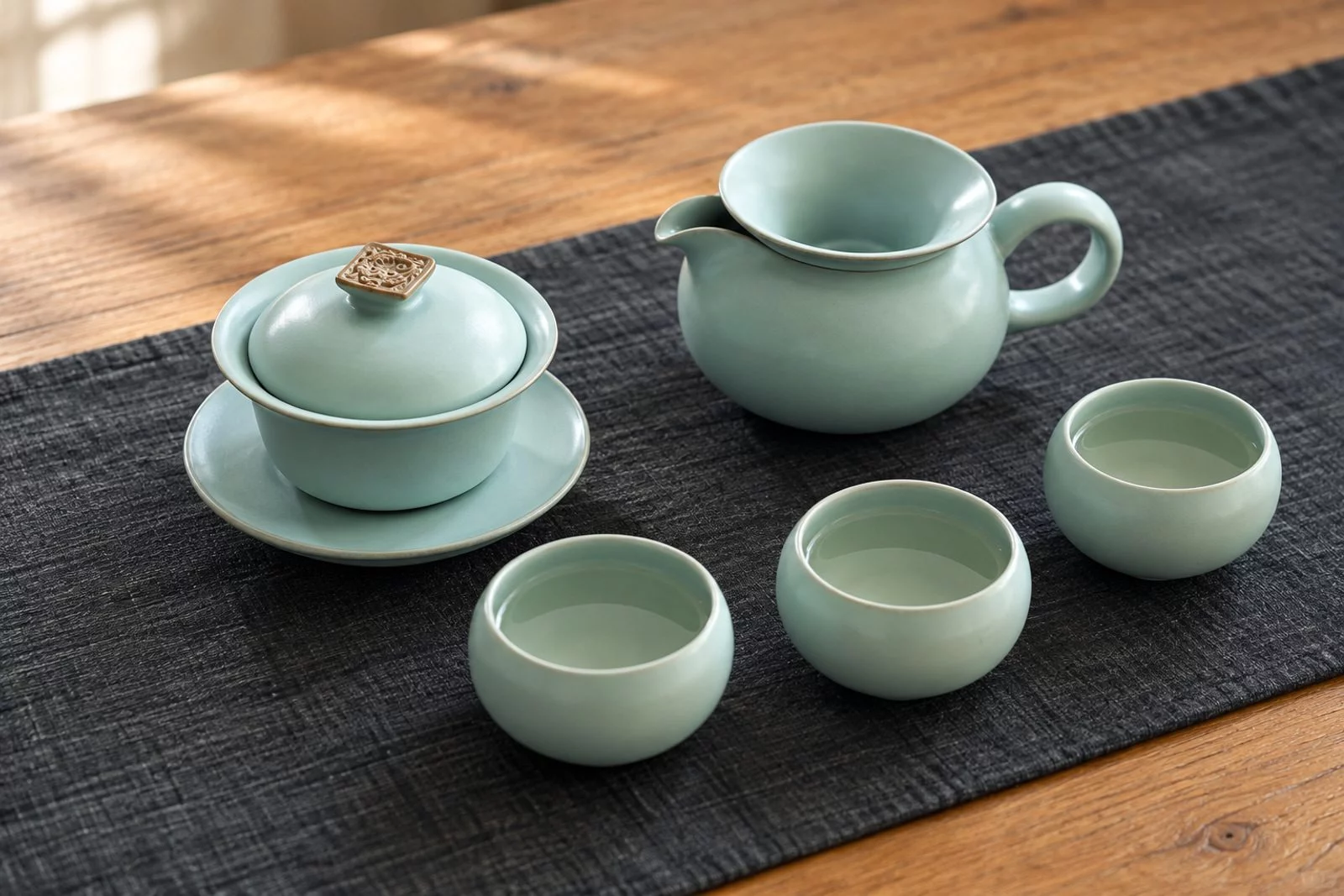
A gongfu setup has a handful of pieces, and each one does a job:
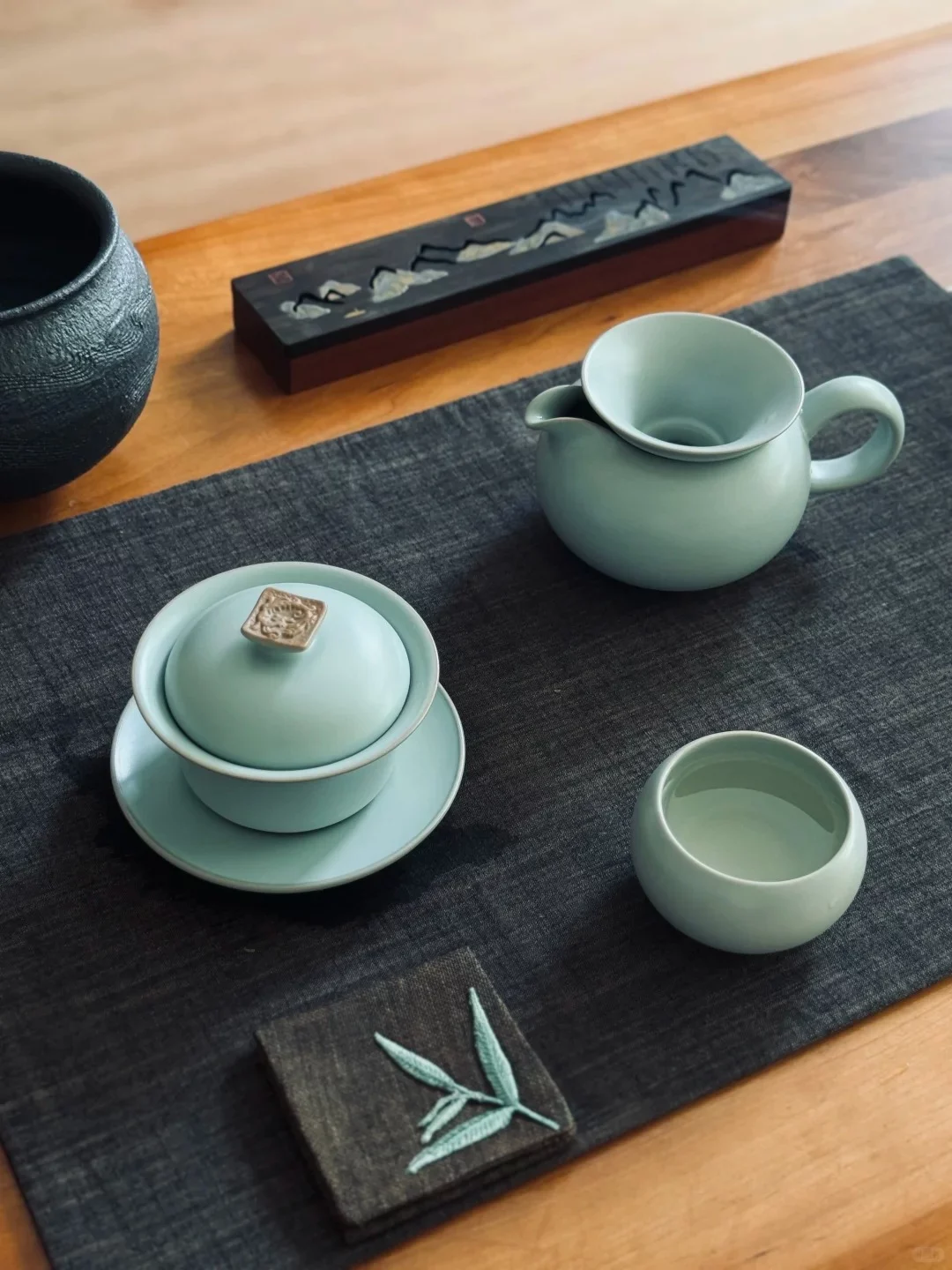
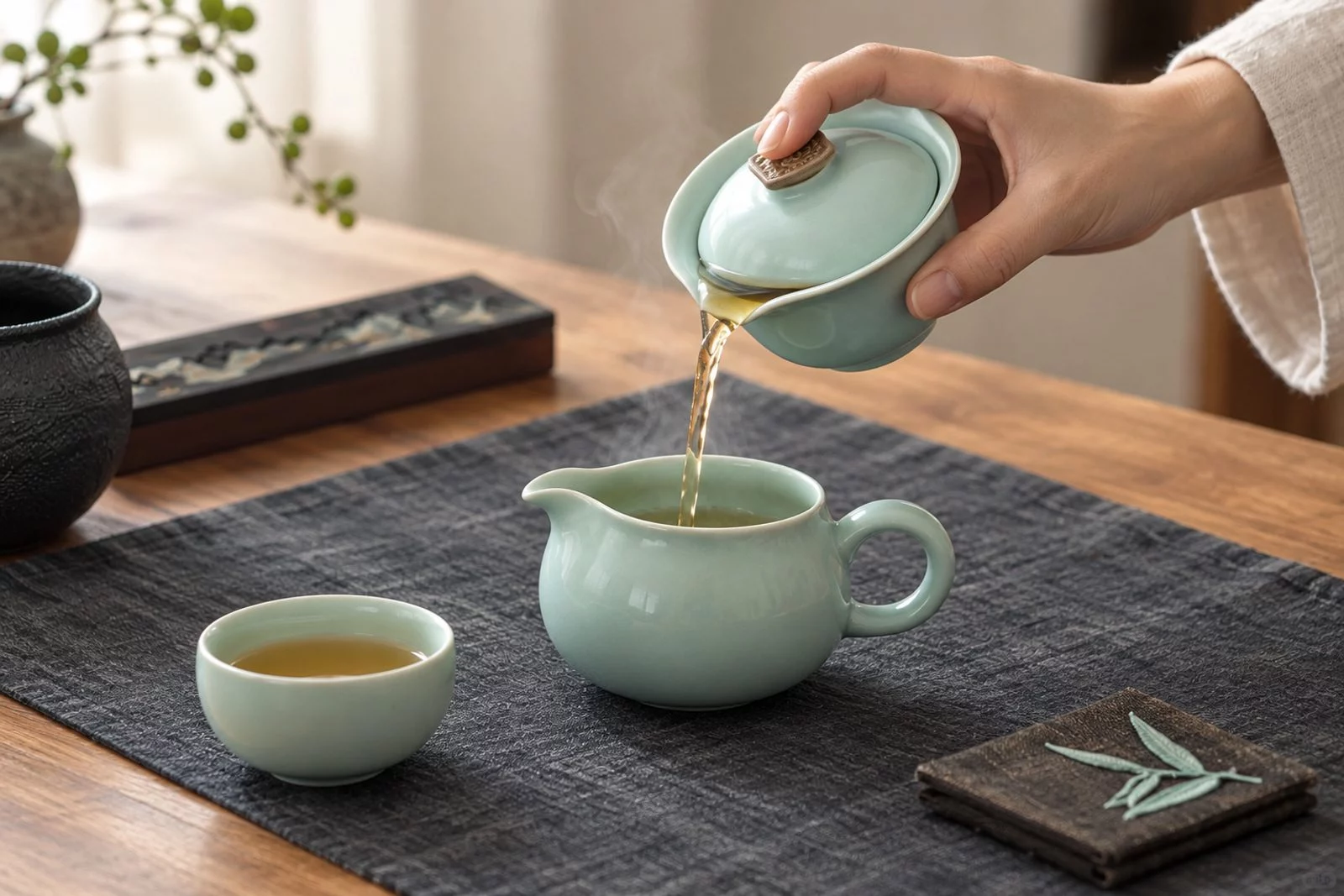
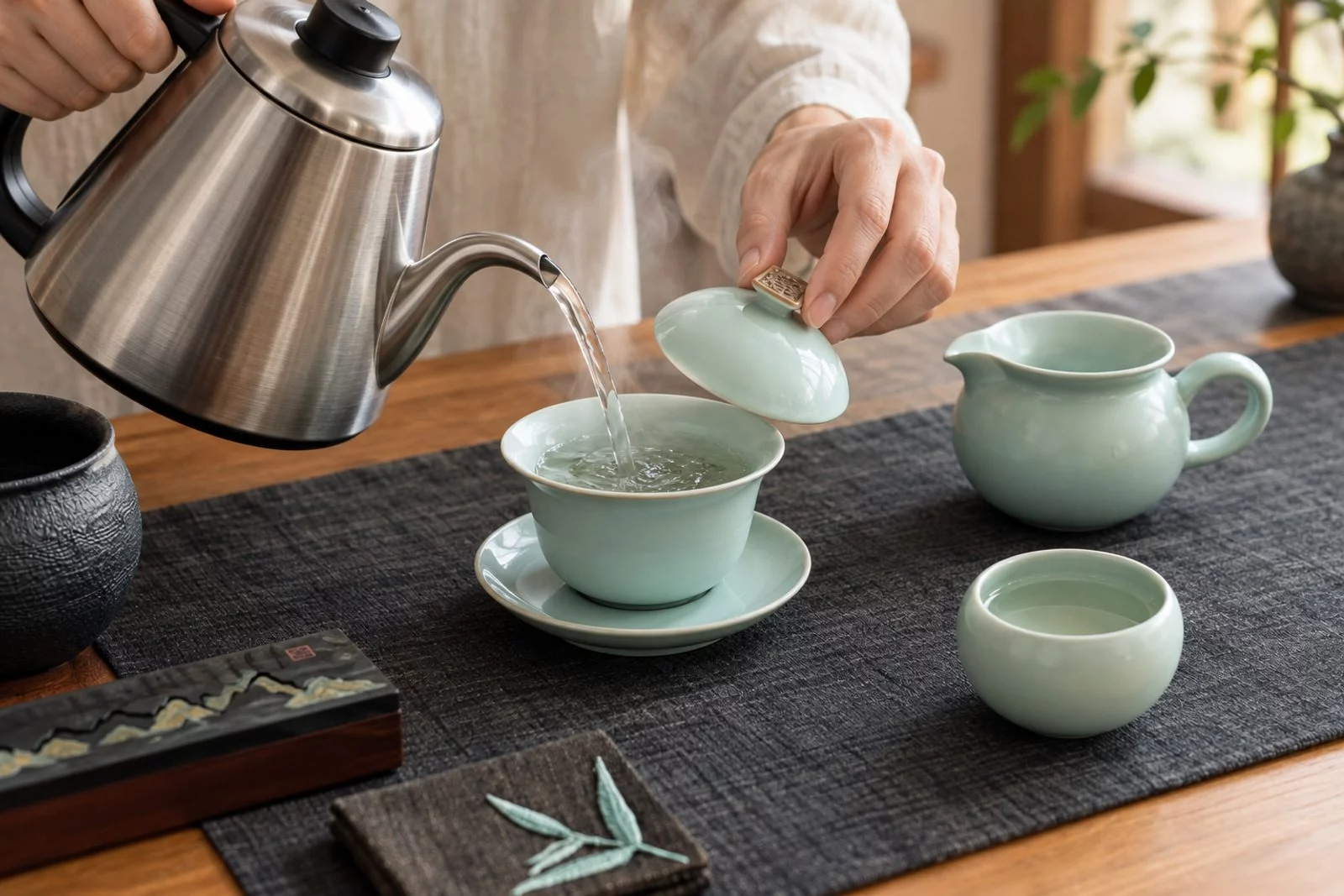
- The brewing vessel. Either a gaiwan, the lidded bowl on a saucer, or a small teapot. The gaiwan is the more versatile choice for a shop because one piece brews any tea, you can see the leaves, and it is easy to clean. A porcelain teapot holds heat a little longer and pours more neatly for customers who find the gaiwan tricky.
- The fair cup. A small pitcher, 180 to 350 ml in our range, that receives the whole infusion at once, so every cup gets tea of the same strength. Without it, the first cup poured is weak and the last is strong.
- The tasting cups. Small, usually 30 to 70 ml in our gongfu sets, sized so the tea is drunk while it is hot. Sets usually come in fours or sixes.
- The strainer and the tray. The strainer catches broken leaf on its way into the fair cup. The tray, often with a drain, takes the spills and the rinse water.
The larger Western-style tea cup, with a handle or a pronounced foot, holds 180 to 280 ml in our range and is what a hotel room or an afternoon tea service needs. It is a different product from the gongfu cup, and a range that mixes the two without saying which is which confuses customers.
We keep a curated stock of standard porcelain teapots and fair cups that ship straight away; a fully custom shape, size or decoration is made in a scheduled production run. For a shop, the gaiwan is usually the anchor of the range and the cups are the volume.
What makes a gaiwan or a cup work in the hand
The photo on a product page shows the decoration. It doesn’t show the four things that decide whether a customer keeps using the piece: capacity, wall, rim and lid. A good tea ware factory designs those deliberately, and a buyer can check all four on a sample in five minutes.
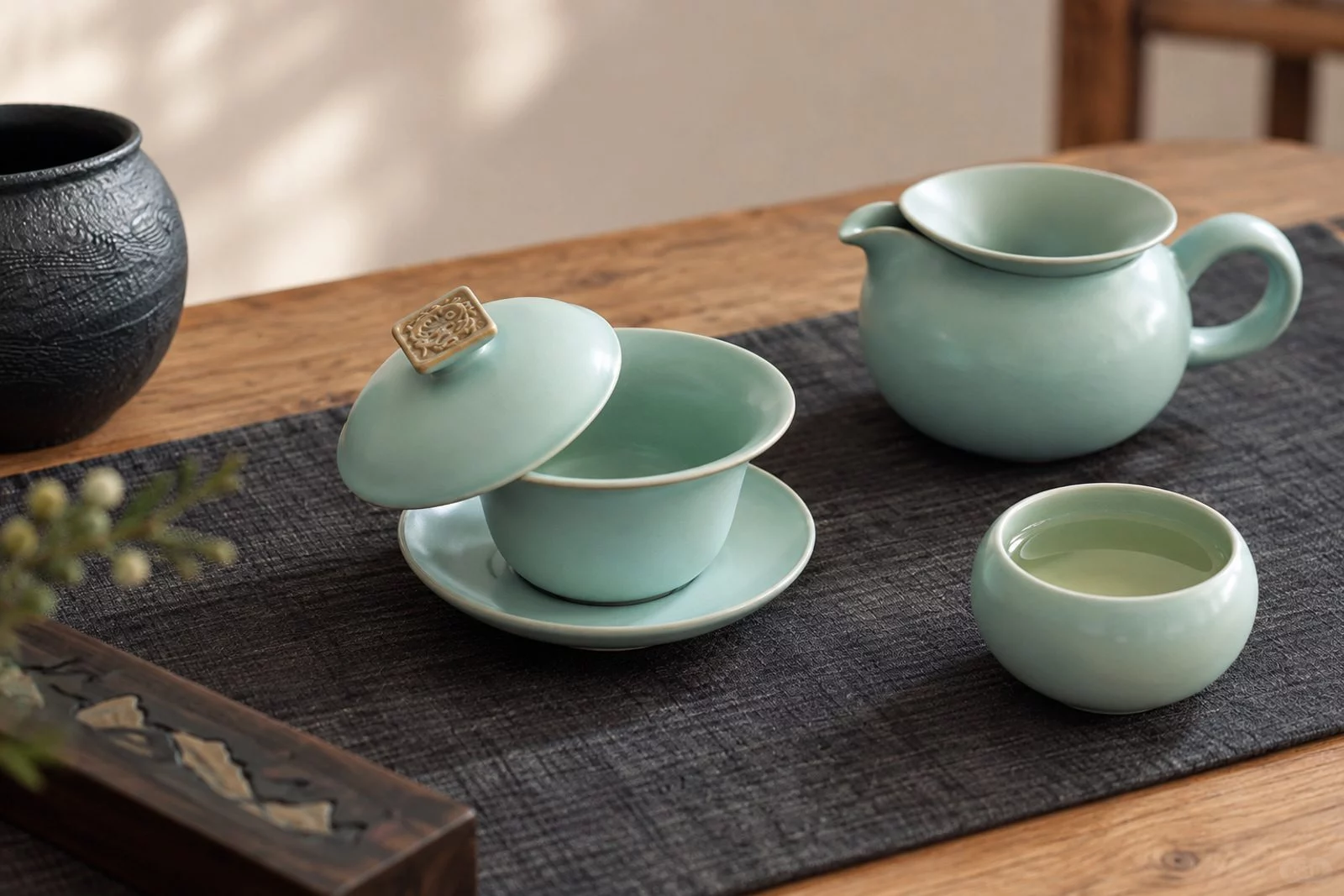
Capacity. Our classic gongfu gaiwans hold 110 to 220 ml, small enough to fill a few cups with each short infusion. The larger hospitality versions, at 240 to 300 ml, suit a single generous pour or a tea room serving two people at once. When a shop orders gaiwans and cups separately, check that the cups divide the gaiwan sensibly: a 120 ml gaiwan pouring into four 30 ml cups works; the same gaiwan with 80 ml cups leaves every guest with half a cup.
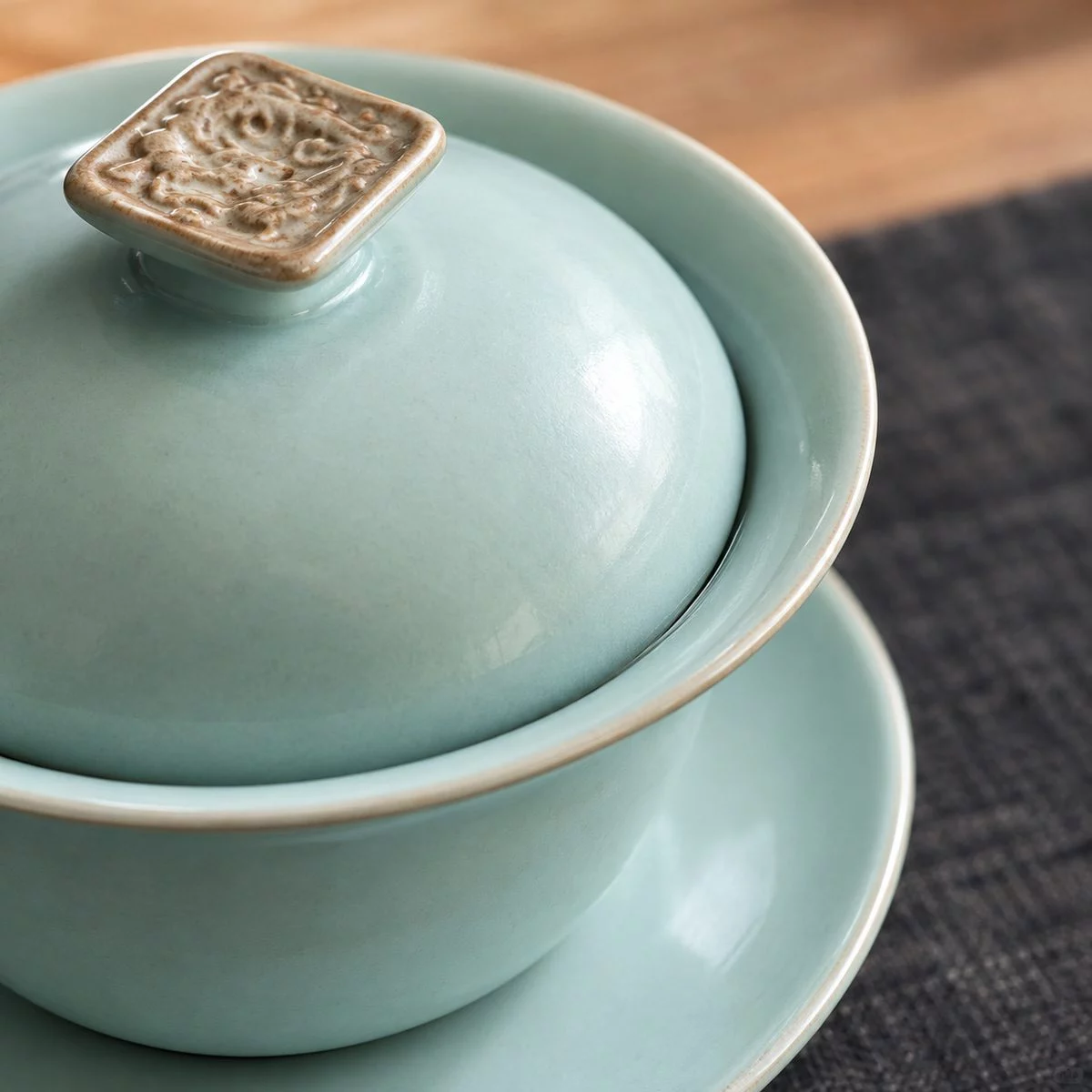
Wall and heat. A gaiwan is held at the rim, with the thumb and middle finger on the flared lip and a finger on the lid’s knob. Hot water at the boil transfers heat through the wall quickly, so what keeps the fingers comfortable is the flare: a rim that turns out far enough holds the fingers away from the hot body. A gaiwan with an almost straight wall can be beautiful and still be unpleasant to use. Cups follow the same logic. A thin, flared cup cools the lip quickly and feels refined; a thicker, straighter cup holds heat longer and suits a tea room where a cup is refilled at the table. Neither is better; they suit different tea services.
The foot. A cup with a proper foot ring can be picked up by the foot when the body is too hot, and it sits on a wooden tray without rocking. A flat-bottomed cup is cheaper to make and stacks better, which matters in a hotel, but it transfers more heat to the hand and to the table.
The lid. A gaiwan lid has to seat without rocking, lift without sticking, and leave a small gap when it is tilted so the tea can pour while the leaves stay in. Lids and bowls shrink by slightly different amounts in the kiln, so a lid that fits one bowl perfectly can rock in its neighbor. We deal with this in two steps. Lids and bowls are fired together as matched sets, from the same clay batch and from molds calibrated for shrinkage, which gets the fit close. Then every set is lapped by hand on the sealing shoulder, where lid meets bowl, until it seats without rocking and turns smoothly. Firing together gives the baseline; the hand lapping is the check that matters. That is also why we box every gaiwan with its lid seated in its own bowl, and why a shop should never unpack a carton of gaiwans and shuffle the lids.
Why porcelain for tasting. Porcelain fired in Jingdezhen at 1,280 to 1,330 °C has a dense, vitrified body under a glassy glaze. It doesn’t take on the flavor of one tea and give it back to the next, which is why tea professionals tend to judge tea in white porcelain. That neutrality is the reason a tea shop’s tasting set is almost always porcelain, even when the shop sells clay pots for the customer’s own collection.
Boiling water. The one failure a tea shop can’t afford is a cup that cracks when boiling water hits it. It happens when a thick base and a thin wall heat at different rates, or when a glaze is under stress from the firing. Ask any tea ware supplier in China how they test for it. We test our tea ware to GB/T 3298, China’s national method for the thermal shock resistance of domestic ceramic ware: boiling water is poured straight into a cup at room temperature, and the piece is inspected for cracks. Buyers who need a different protocol, such as ASTM C554, which tests glazed ceramics for crazing by thermal shock, can have it run for their project. Warming a cup with a splash of hot water first, which gongfu brewers do anyway, also helps.
Glaze, the liquor and what your customers expect
Glaze changes what the drinker sees before they taste anything. Our guide to wholesale tea ware has a line-by-line table of which glaze suits which tea and which buyer, so here I want to explain the reasoning behind it, because it is what a shop’s staff will need to explain at the counter.
A clear white interior shows the true color of the liquor. That matters most to people who judge a green, white or yellow tea partly by its color, and it is why the inside of a tasting cup is so often plain white even when the outside is painted. Our white porcelain cups go further: the Translucent Carved Flower Cup is trimmed thin enough that the carving glows when light falls through it.
Celadon tints everything slightly toward green or blue. A pale green tea in a jade-green cup looks fresh and bright; a dark roasted oolong can look muddy. Celadon sells beautifully to tea rooms and to customers who value the look of the cup as much as the liquor, and the Plum Blossom Celadon Tea Cup is a good place to start.
Crackle glazes are where a shop needs to be honest with its customers. Ge ware has a deliberate network of dark lines in a thick gray-green glaze, and Ru ware carries a finer crackle under its soft sky-blue. Over weeks and months of use, tea works into the crackle, and the lines slowly darken. Collectors and experienced drinkers buy these cups precisely for that: the cup becomes their own. A customer who expects a cup to look the same in a year as on the day they bought it will think it is stained. Put one line on the shelf card and the complaint never comes. We fire Ru, Ge and Jun glazes in our own Jingdezhen kilns, and the Ge Ware Crackle Tea Cup and the Ru Ware Tea Set are good references for how the two crackles differ.
Jun ware and the painted enamel styles sell on their looks. A Jun cup, with copper-purple streaks running through a moon-white glaze like the Jun Ware Purple Swirl Cup, is a statement piece; no two are alike, and a shop should present it that way. Famille rose and doucai sets are bought as gifts first and used second.
Decoration near the lip, and what a test report really covers
This is the section most tea ware buyers skip, and it is the one that causes real trouble at customs and on retail compliance checks.
Porcelain decoration sits in one of two places. Underglaze decoration, such as blue and white cobalt or the copper red in our underglaze red pieces, is painted on the unfired body and sealed under the glaze in a single high firing at around 1,300 °C. Overglaze enamel, the bright pinks, greens and yellows of famille rose, falangcai and the enamel colors of doucai, is painted on top of the fired glaze and fused at a much lower temperature, about 780 to 850 °C in our kilns. Overglaze colors are softer and brighter, and they sit on the surface where a lip touches them.
Regulators treat cups more strictly than plates for this reason. The FDA’s compliance guide for ceramic ware sets its lead action level for cups and mugs at 0.5 micrograms per milliliter, against 3.0 for flatware, because a cup holds hot liquid against the glaze for longer and is drunk from directly. Canada goes a step further for the rim itself: its Glazed Ceramics and Glassware Regulations apply a separate test to any drinking vessel with an exterior decorative pattern within 20 mm of the rim, with limits of 4 mg/L for lead and 0.4 mg/L for cadmium, using a method in which the rim is turned upside down and soaked in acid.
What this means in practice is simple. A lead and cadmium report covers the glazes and the pieces that were tested, not a whole catalog. Our glazes are tested for lead and cadmium release by the ASTM C738 extraction method, which measures what leaches out but sets no limits of its own. The results are then read against the FDA action levels for the US and against LFGB for Germany and the EU. The US report (SGS-CER-2026-0418-14567) adds the ASTM C927 lip-and-rim test, the method Canada’s rule is built on. That report and the others, including one for Canada’s regulations and California’s Proposition 65, are listed on our Quality Control page. When you build a range, ask your supplier which report covers each piece on your list, and check the report against the guidance in how to check lead and cadmium reports. If a piece isn’t covered, ask for it to be tested before it goes on your shelf.
For decoration near the lip, a short decision guide:
| Where the decoration sits | What to ask the supplier | If you’re selling into Canada or to strict retailers |
|---|---|---|
| Under the glaze anywhere (blue and white, underglaze red) | Which report covers this glaze and body | Usually the simplest route |
| Overglaze enamel on the body, well below the rim | Which report covers these enamel colors | Ask for the report on the finished piece |
| Overglaze enamel or decal within 20 mm of the rim | Whether a lip-and-rim test has been done | Ask for a separate rim test on that piece, or move the band down |
| Metallic lines or luster anywhere | Whether the piece is marked not for microwave use | Keep metallic detail off daily-service pieces |
When overglaze or decal artwork falls inside that 20 mm band, we run a separate rim test for lead and cadmium release under the Canadian regulations. Our own advice, though, is to move the artwork below the band wherever the layout allows. It removes the extra test and the risk, and on most cups the decoration looks just as good a little lower.
The last row matters for gift sets in particular. Metallic lines look rich in a box but don’t belong in a microwave, and we mark them that way on our spec sheets. A brand that wants its cups used every day should keep metallic detail for the gift pieces and leave the daily cups plain at the lip.
Building a range a shop can sell through and reorder
A tea shop’s first order is a guess about what its customers will buy. The way to keep that guess cheap is to buy in steps, and Jingdezhen tea ware suits that better than most porcelain, because so much of it is made in small runs by hand.
At KKCN, the steps look like this. You can buy one piece of anything in stock, which is how most tea shops start: one of each candidate, in hand, compared side by side with the tea you sell. When you know what you like, a mixed order starts at 10 pieces, across as many references as you want. Once a shape is selling, a version with your own glaze color, mark or box starts at 50 pieces per style. Our wholesale Chinese porcelain range shows every reference with the PP number you’ll use to reorder it, and the section on prices in How to Source Porcelain from China gives typical FOB ranges for small tea cups, from a decal cup to a hand-painted famille rose one.
Plan the range around set completion. In our experience, customers buy tea ware in groups: a gaiwan and two cups, then two more cups, then a fair cup. A shop that sells out of the cups but still has gaiwans has lost the second and third sale. So hold more cups than gaiwans in the opening order, and keep one full set of each reference back from the floor so you can always show what the complete set looks like.
Then protect the reorder. Keep the PP number of every piece you stock on your own list, and quote it on every reorder. A reorder quoted by PP number is made and checked against the same reference by Li Qiusheng’s inspection team, which is how a cup bought next spring sits beside one bought this year. Be realistic about hand-painted and kiln-variable pieces. A hand-painted blue and white cup will differ slightly from its neighbor in the stroke and the depth of the blue, and a Jun cup will differ completely; the approved sample sets the range, not a pixel-perfect copy. Tell your customers the same thing, and they will treat the difference as character rather than as a fault.
One of our clients shows how far this can go. A North American loose-leaf tea brand launched a signature blue and white gongfu set with us, and its one non-negotiable was a blue that stayed the same through quarterly replenishment. The first small batch passed visual sign-off. The second trial came out a cooler blue, because of a small shift in the kiln atmosphere. Rather than ask the brand to accept it, or start again with new molds, our color team made a graduated set of tiles running from the target blue to warmer and cooler limits, and ran paired kiln tests side by side to settle the firing curve, the cobalt loading and where the pieces sit on the kiln car. We now reserve a fixed zone of the kiln for that set on every run, and fire color tiles for approval before each reorder. The brand reorders without surprises, and that blue has become its signature.
Our packaging guide by sales channel covers what changes when the same cups ship to an online customer rather than a shelf.
Gift sets: the piece, the box and the calendar
A gift set is bought with the eyes, in about the time it takes to lift a box lid. That changes the order of the work. For daily ware, you approve the piece and then think about packing. For a gift set, the box, the insert and the pieces are one product, and we sample them together so the cup sits snugly in its cutout and the colors of the box and the glaze have been seen side by side before anything is made. Al Masa Grand Hotel in Dubai is a good example: alongside its hand-painted blue and white lobby vases, the hotel orders miniature blue and white tea gift sets with its own logo and patterns, in custom gift boxes, and has repeated them every year for four years.
Price tiers in gift sets follow the decoration more than the number of pieces. A decal set in a printed box, a hand-painted blue and white set, and a fully enameled famille rose or doucai set sit at very different points, and the right mix depends on where you sell.
The calendar is the part buyers underestimate. Tea gifts peak before Lunar New Year, Mid-Autumn and the year-end holidays, and August to December is also the busiest season in our kilns. Work backward from the date the sets need to be on your shelf. A worked example for a new custom gift set aimed at a mid-January Lunar New Year launch:
| Step | Typical time at KKCN | Done by |
|---|---|---|
| Set on shelf, ready to sell | Mid-January | |
| Sea freight and customs | 30–45 days door to door | Ship by late November |
| Inspection and packing | About 1 week | Mid-November |
| Production | 30–45 days | Start by early October |
| Sample, including box, and one revision | 15–30 business days per round | Brief by early August |
In other words, a Lunar New Year set needs its brief on our desk in the summer, not in the autumn. A set made from stock pieces in a stock box needs much less time, because production drops out of the schedule. If a date slips, a small first allotment by air can cover the launch while the bulk follows by sea, though air freight changes the cost per set considerably.
Putting a tea brand’s name on the ware
Tea brands use ware to make the tea look like theirs. The options run from almost invisible to very visible, and the right one depends on how the ware will be used.
The quietest option is a mark on the foot: your name or logo in cobalt under the glaze, or engraved into the body. It survives anything the cup will ever go through, it doesn’t touch the lip, and the customer finds it when they turn the cup over. Living Oriental uses engraved logos on its white tea sets for exactly that reason. Next is your own glaze color on a proven shape: a celadon matched to your packaging, or a white with a specific warmth. It costs nothing in safety terms and makes a set recognizable across a room. Then there is a decal mark, fired into the glaze or onto it, which is the practical route for a detailed logo. The most visible option is a painted band or panel left open for a name, as on our Private-Label Landscape Tea Cup, which works best for gifts and limited editions. If that band sits near the lip, the previous section applies.
Minimums follow the method. A version of a stock shape with your glaze, mark or box starts at 50 pieces per style at KKCN. A first run of a new custom decal design starts at 50 pieces per shape, and reorders of that approved decal artwork start at 300 pieces, because each repeat run needs its own setup. A new shape is a different project, with its own mold and sample rounds; we explain how that works, and what you own at the end of it, in Custom Porcelain Product Development. For a brief, our Custom Development page sets out the process, and the custom order page is the place to send artwork.
What to tell your customers about care
Most tea ware complaints are really care complaints, and most of them can be headed off with a line or two on a care card in the box.
Porcelain tea ware needs very little, but the rules differ by finish, and a care card should say which applies. Our underglaze pieces, such as blue and white and underglaze red, and our celadons go through a commercial dishwasher without trouble. Crackle glazes such as Ge and Ru should be washed by hand, because the network of lines traps detergent residue and can stain with repeated machine cycles; in hand use, the lines darken with tea, which is the point of them. Hand-painted overglaze enamel, such as famille rose, is best washed by hand too, because repeated commercial dishwasher cycles wear the enamel colors. Metallic detail should never meet an abrasive pad or a microwave. Gaiwan lids should be lifted by the knob and set down on a cloth or a saucer, not on stone. And a cup that has been sitting in a cold car should be warmed with a little hot water before it takes boiling water.
The Canadian Conservation Institute’s advice on caring for ceramics, written for museum objects, makes a point that holds for a shop too: physical handling, not light or air, is the main risk to porcelain. A tea room should train staff to carry a gaiwan by its saucer and to stack cups no higher than they would be comfortable catching.
The short version
Decide first whether each piece is for the shelf, the pour or the gift. Then choose the shape and size for the way your customers brew, the glaze for the teas you sell, and the place for any decoration with the lip in mind. Buy in steps, keep a list of reference numbers, and give your customers one honest line about crackle and care. If you do those things, the small reorder a few months from now will be the easiest order you place.
Our wholesale Chinese porcelain range lists every tea ware reference we keep in stock, and the custom order page is where to start a version under your own name.
Sources
- FDA, CPG Sec. 545.450, lead in pottery (ceramics)
- Canada, Glazed Ceramics and Glassware Regulations, SOR/2016-175
- ASTM C738, lead and cadmium extracted from glazed ceramic surfaces (test method)
- China Daily, Chaozhou gongfu tea (2021)
- UNESCO, traditional tea processing techniques in China (2022)
All read October 2026. Test reports for KKCN products are available on request.
Lin Wan leads foreign trade at KKCN in Jingdezhen, coordinating buyers’ requirements, samples, orders and after-sales across Europe, North America, the Middle East and Southeast Asia. Ten years in ceramic export, working in English and Chinese.