By Lin Wan, Foreign-Trade Lead at KKCN, Jingdezhen
For a high-end residential lobby, Art Space Milano asked us for a pair of hand-thrown floor vases in a reactive Jun glaze, each 95 cm tall, to stand symmetrically on either side of a double-height entry. The size was the easy part. The hard part was the pair. A reactive glaze changes color and flow with its position in the kiln, so two vases thrown to the same drawing and glazed from the same bucket can come out looking like distant relatives. We threw twelve candidates, fired them in controlled zones of the kiln, chose the two that balanced best, and offered the other ten to the client’s interior team as backups and secondary pieces.
That project sums up decorative Chinese porcelain for interiors better than any style guide. Art Space Milano, an art space and interior-design studio in Milan, has commissioned thirty one-of-a-kind pieces from us over two years for villas, galleries and light-luxury interiors, each quoted on its own and each signed off by our founder He Jiang and our master artisans before it leaves Jingdezhen. None of those pieces was chosen from a catalog. Each began with a room, a height, a wall color and a lighting plan, and only then a glaze. That order is the most useful thing I can pass on to anyone buying porcelain for a room.
Most buying guides start with styles: blue and white, celadon, famille rose. Styles matter, but they are rarely what goes wrong. What goes wrong is a vase that looked imposing in a photo and reads as an ornament once it’s installed, a “pair” that turns out to be two different pieces, a glaze that goes flat under warm downlights, a commission that takes longer than the install allows, or a lobby piece knocked off its plinth in the first month. This guide follows the decisions in the order that prevents those problems: scale, number, surface under the room’s light, the route to the piece, its safety in use, and its delivery to site.
I write as the person who coordinates these orders at a porcelain factory in Jingdezhen, so where I give KKCN’s times, ranges and terms, I say so. Other makers work differently.
What decorative Chinese porcelain covers today
The word covers more than vases. For interiors, the pieces we make most often fall into five groups: covered jars, including the ginger jar shape; vases, from small bud vases to floor pieces; plates and chargers made to hang or stand; sculptural pieces such as Tang-style horses; and sets made to be shown together. Our range runs from 3 cm miniatures to floor vases, and we reliably make floor vases up to 130 cm. Above that, the limits are the inside of the kiln chamber and whether a tall form can hold its shape through the firing.
What changes a room more than the form is the surface. Each family below is made and fired in our own Jingdezhen workshops, and each behaves differently in a space.
| Family | How it reads in a room | Under light | Works well with |
|---|---|---|---|
| Blue and white (cobalt under the glaze) | Graphic, legible from across a room | Stable; cobalt reads cool under daylight, deeper under warm light | White walls, natural wood, linen, strong architecture |
| Celadon and Song-style glazes (Ru, Ge) | Quiet, tonal; the depth is in the glaze | Changes most with light; reads greener in warm light | Stone, plaster, minimal and Japanese-influenced rooms |
| Jun and kiln-transformation glazes | Painterly; every piece differs | Pooling and color drift show strongly under raking light | Gallery lighting, plain backgrounds, single pieces or selected pairs |
| Painted enamels (Wucai, famille rose) | Detailed, colorful; rewards close viewing | Bright under even light; detail lost at a distance | Libraries, dining rooms, cabinets, smaller rooms |
| Monochrome and modern forms | Sculptural, architectural | Matte and satin glazes soften highlights | Contemporary residences, hotels, retail |
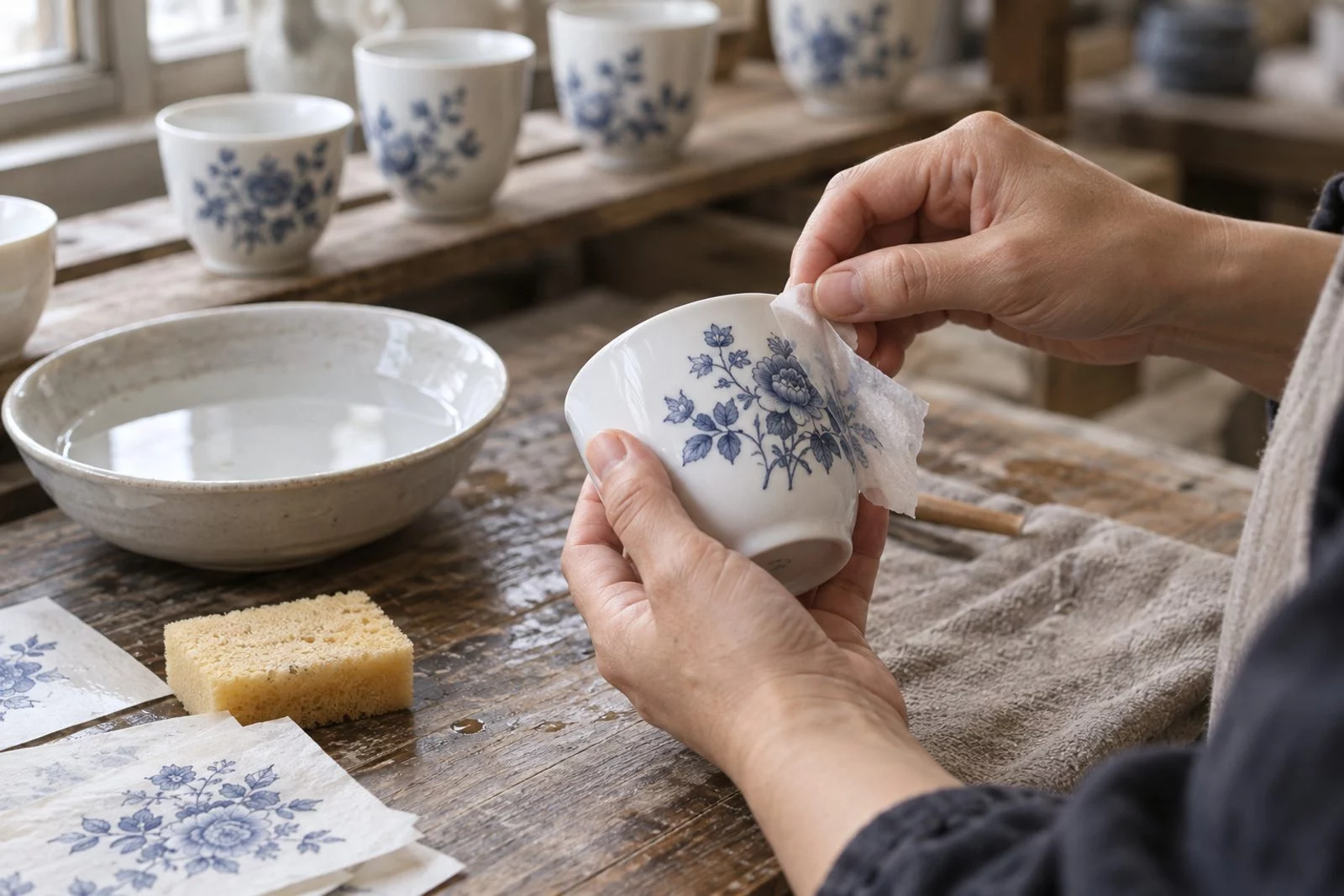
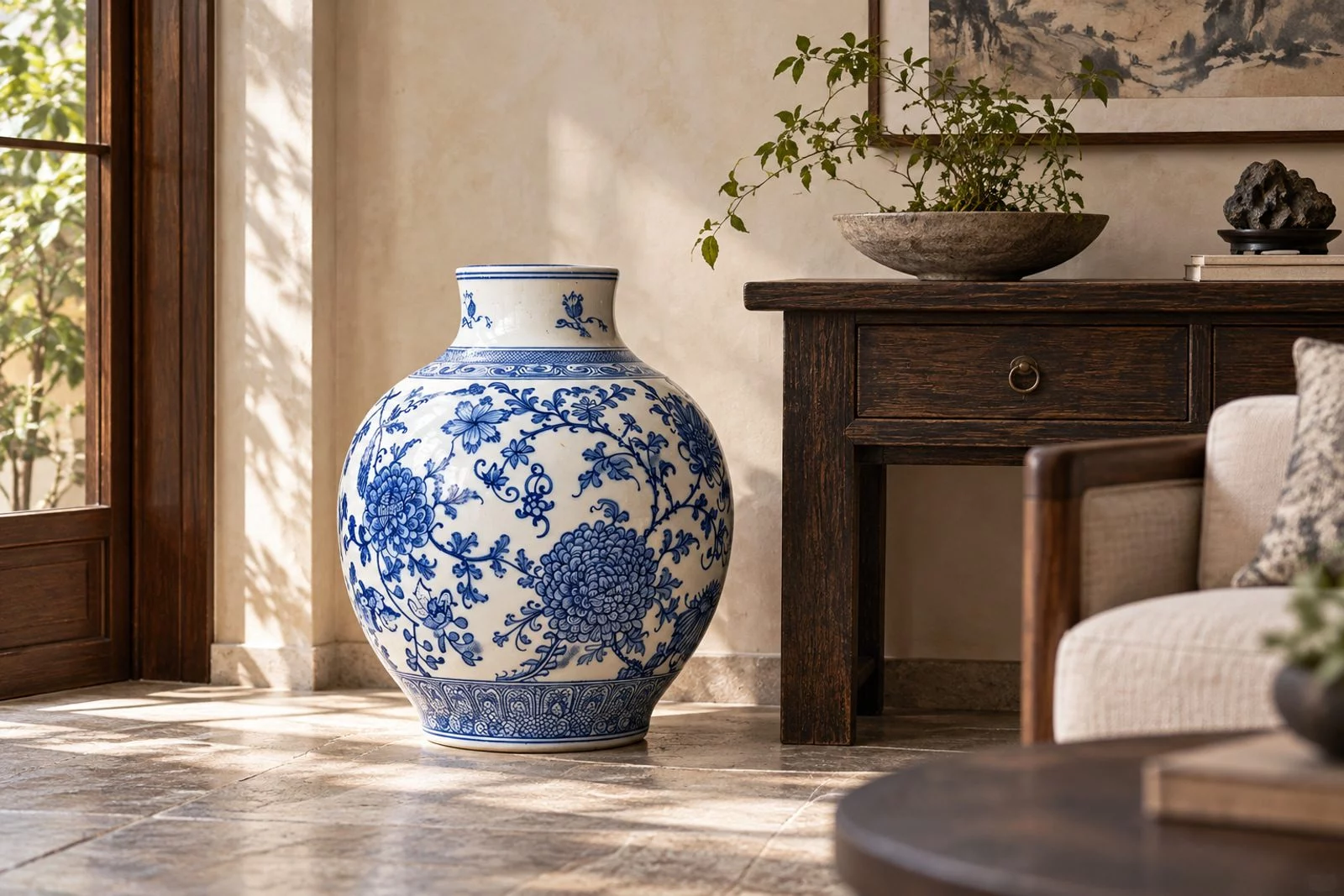
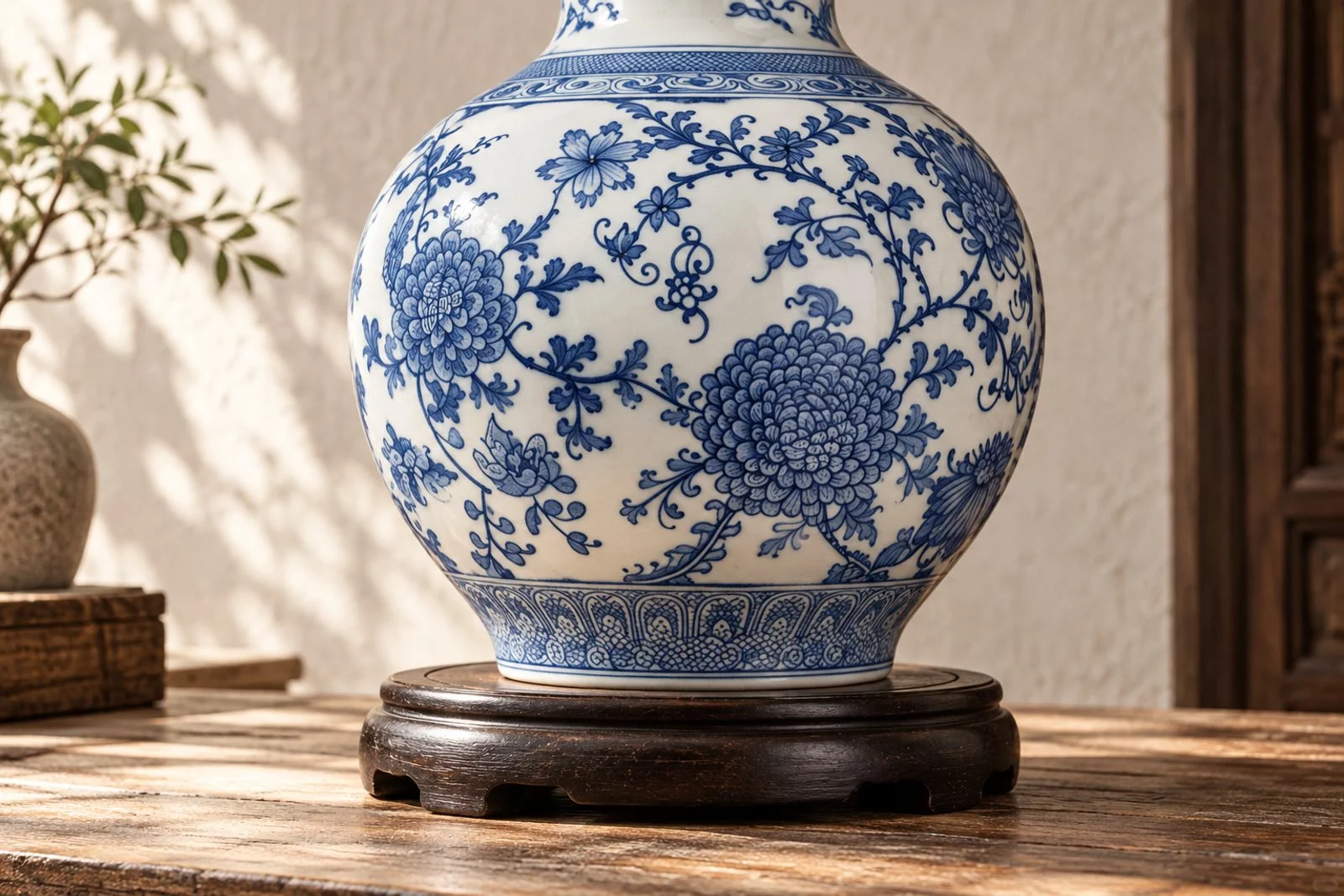
Blue and white is the family most people picture, and for good reason: the cobalt is painted on the raw body, sealed under a clear glaze and fired once at about 1,300 °C, so the pattern can’t wear. Our Blue & White Porcelain Series uses the water-separation technique, where a painter lays graded washes of diluted cobalt inside a drawn outline, which is what gives a well-painted jar its depth from across a room. The Celadon Legacy Series covers celadon, Ru, Ge and Jun, all reduction-fired in our own kilns. The Imperial Wucai collection covers painted enamels, which are applied over a fired glaze and fired again at about 780 to 850 °C, and our Tang Sancai horses sit there too. Modern monochromes and geometric forms make up our Minimal Modern Ceramic Art collection.
Start with scale
Most decorative porcelain mistakes in interiors are scale mistakes. A piece is bought from a photograph, where it fills the frame, and installed in a room where it competes with a sofa, a ceiling height and a doorway. The usual result is a piece that is too small, and buying a second piece to fill the gap rarely helps.
So the first number in any brief should be a height, and it should come from the place, not the catalog. On a console, think about the height of the mirror or artwork above it and how much wall should show between them. On a dining table or sideboard, think about sightlines across the table. On the floor, think about the furniture beside the piece and the ceiling. The simplest check costs nothing: cut the silhouette of the proposed piece out of card at full size, tape it in place and live with it for a day. Designers who do this almost always go bigger than they first planned.
Weight and footprint come next. A tall, narrow vase is more striking and less stable than a broad one, and that matters on a plinth in a corridor more than on a shelf at home. A hollow porcelain floor vase of 100 to 120 cm generally weighs about 18 to 30 kg (40 to 66 lb) after firing, so it takes two people to place it and a plinth built for the load. For pieces that will stand where people pass, we can supply a weighted stabilizing base or a solid timber stand, quoted separately. The base of a large piece should be specified with its plinth or floor finish in mind: an unglazed foot on polished stone needs a felt or cork pad, both to protect the floor and to stop the piece from sliding.
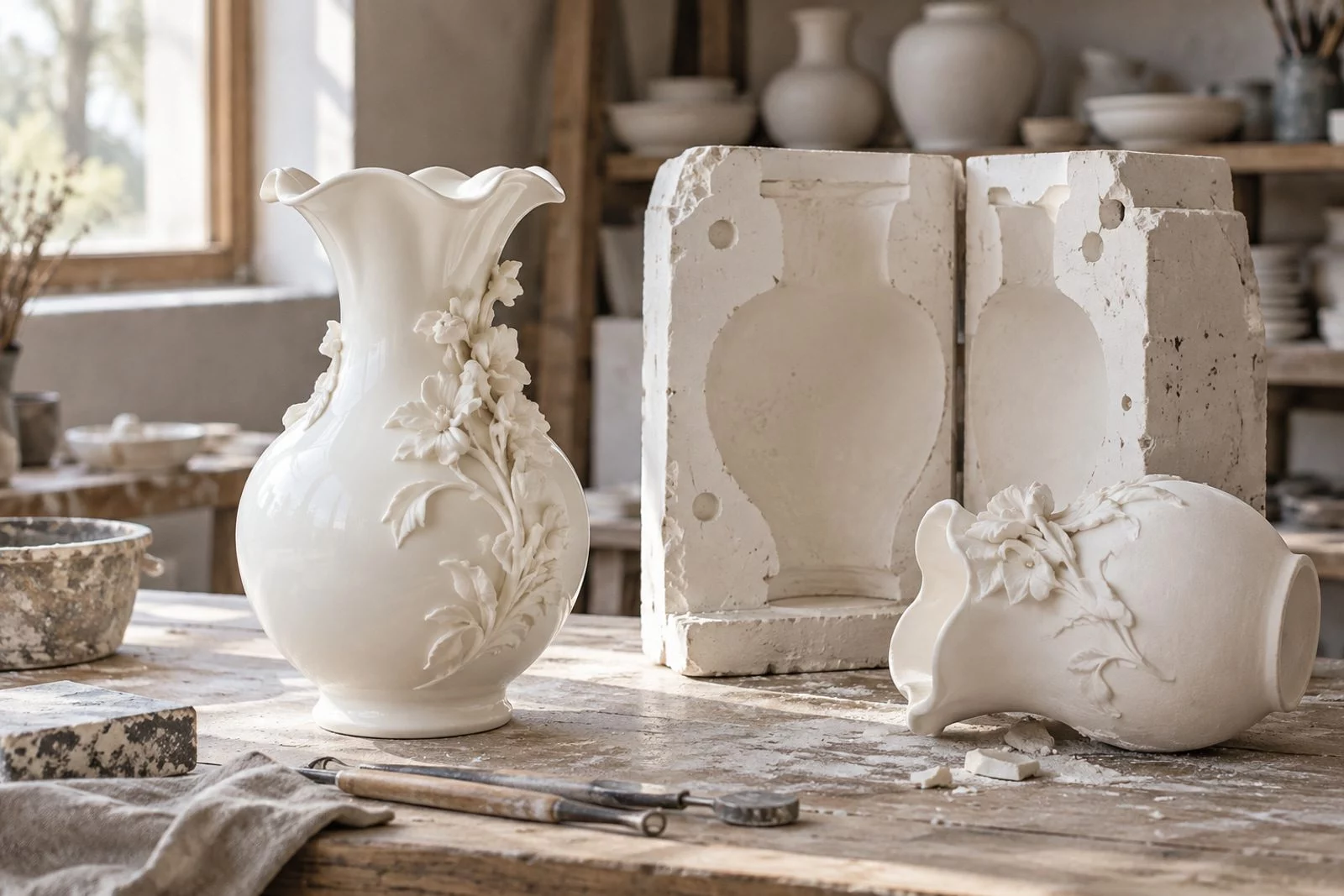
Size also changes how a piece is made. Small and medium forms can be thrown or molded and repeated closely. A floor vase is made in sections, joined, dried slowly over weeks and fired with more risk at every stage, which is why our large art output is a few hundred pieces a month rather than thousands, and why large pieces take longer to quote and to make.
One, a pair or a set
Chinese porcelain has been bought for rooms in pairs and sets for almost four centuries. The Victoria and Albert Museum’s research on garnitures describes matching sets of vases made to “garnish” a chimney piece or the top of a cabinet, notes that the British aristocracy was buying pairs of Chinese porcelain vases as early as the 1640s for symmetrical displays, and records inventories with twenty or more pieces arranged above a single lacquer cabinet. Many of the pieces in those sets came from Jingdezhen. The idea still works because a pair creates symmetry and a set creates rhythm, and both make a room look deliberate.
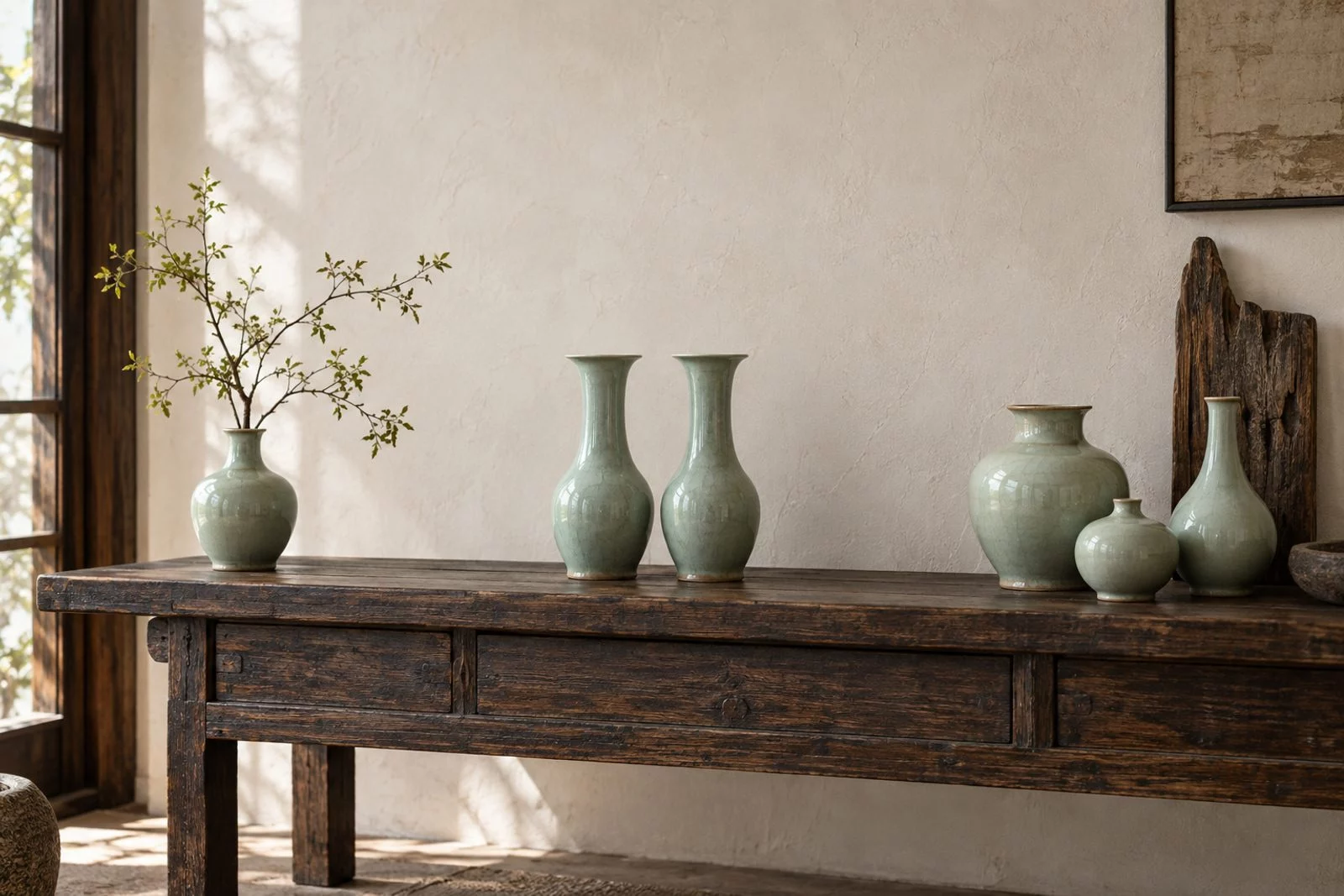
The practical question is what “matching” means for handmade work. A pair of hand-painted vases from the same painter, the same body and the same firing will be very close, but not identical: brushwork varies, the cobalt can fire a little warmer or cooler, and a glaze can pool differently. At KKCN the acceptable range is written into the approved sample, so the buyer agrees in advance what counts as a match. For a hand-painted pair or a curated set, we make extra pieces and choose among them: typically two to four spare candidates for a pair, and more for a large set. We match hue, brush rhythm, glaze flow and the distribution of tone to the standard a high-end interior needs. Even so, a handmade pair carries small, organic differences, and we say so before the order rather than after. For Jun and other reactive glazes the variation is the point, and a pair is a selection, not a repeat. The twelve candidates behind the Art Space Milano pair are typical of what that takes. If the schedule or budget can’t carry that, place a reactive piece alone.
Odd-numbered groups need a different eye. Three or five pieces in one family but different heights, a tall jar with two smaller ones, for instance, give a console or a long sideboard more movement than a matched pair. Choose one constant (the color, the glaze or the motif) and let the forms vary. For a wall, plates and chargers work the same way: one pattern family, two or three diameters, laid out on the floor first at full size.
Surface and light
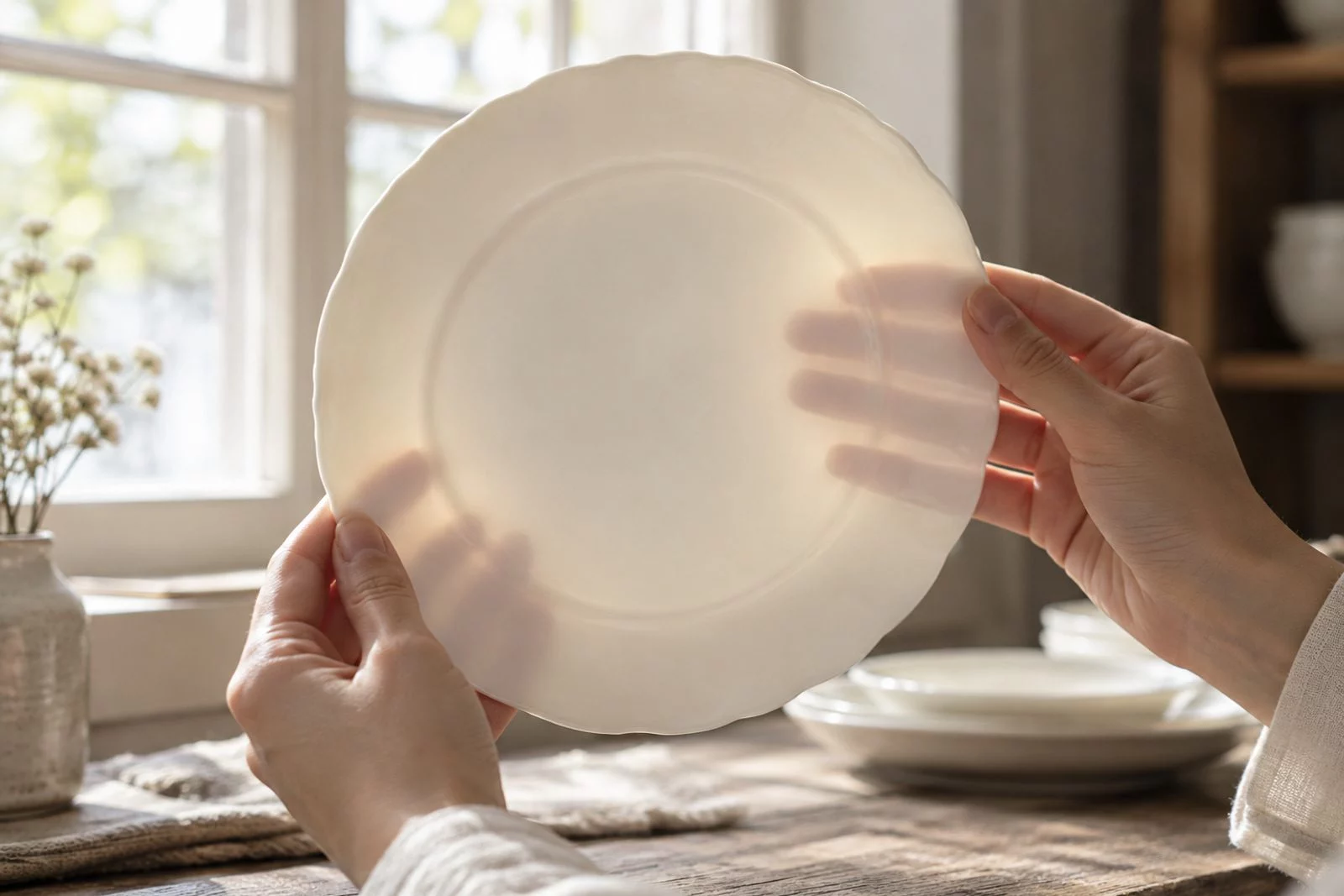
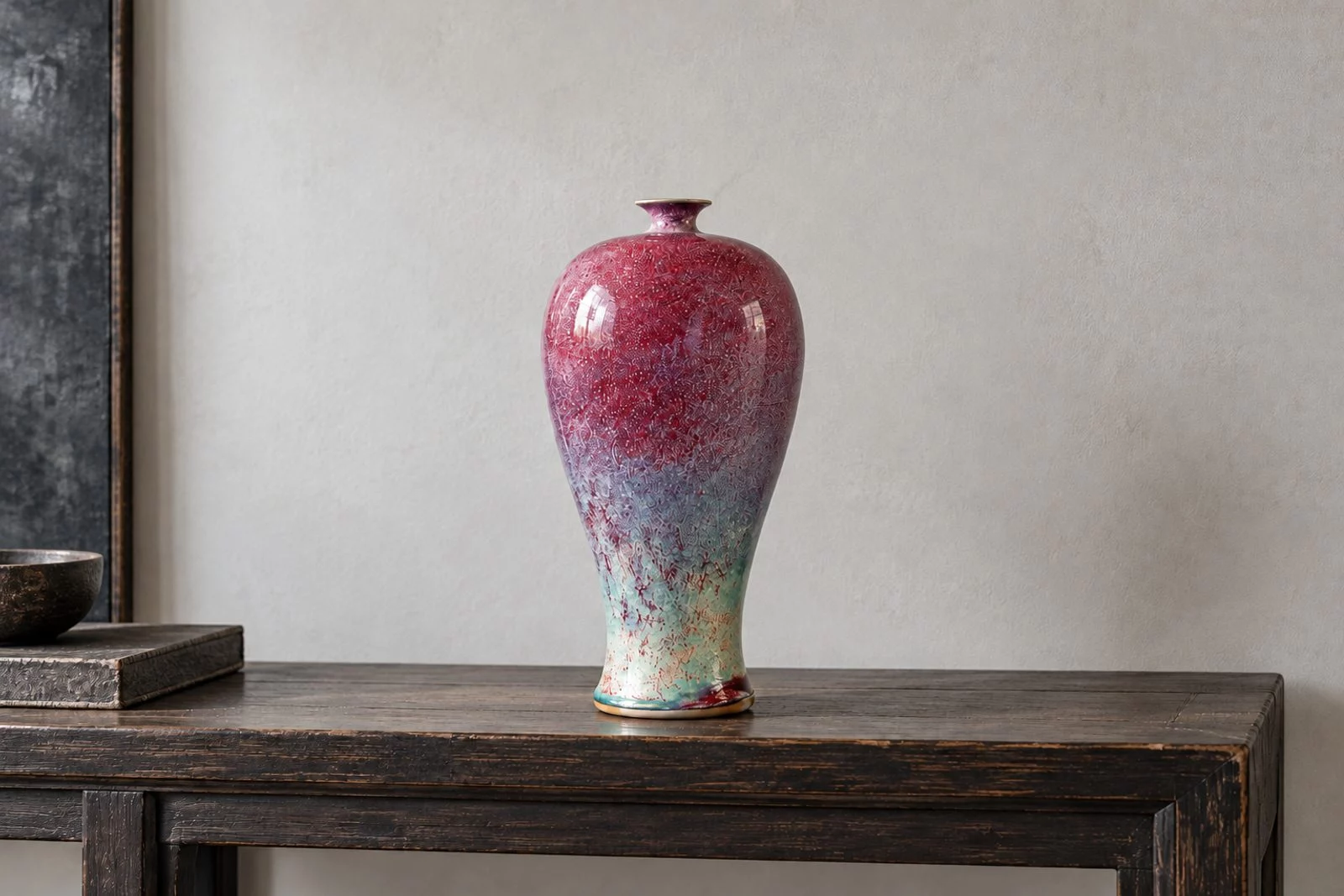
A glaze is not a flat color. Light passes into a celadon or a Ru glaze, scatters off tiny bubbles and particles inside it, and comes back out, which is why those glazes look deep in person and dull in photographs. The same physics makes them change with the light. Warm light pushes a celadon toward green and olive; cool daylight pushes it toward blue-gray. Crackle reads at arm’s length and disappears at five meters. A Jun glaze shows its pooling and purple streaks most under raking light from one side, and looks calmer under even, diffuse light.
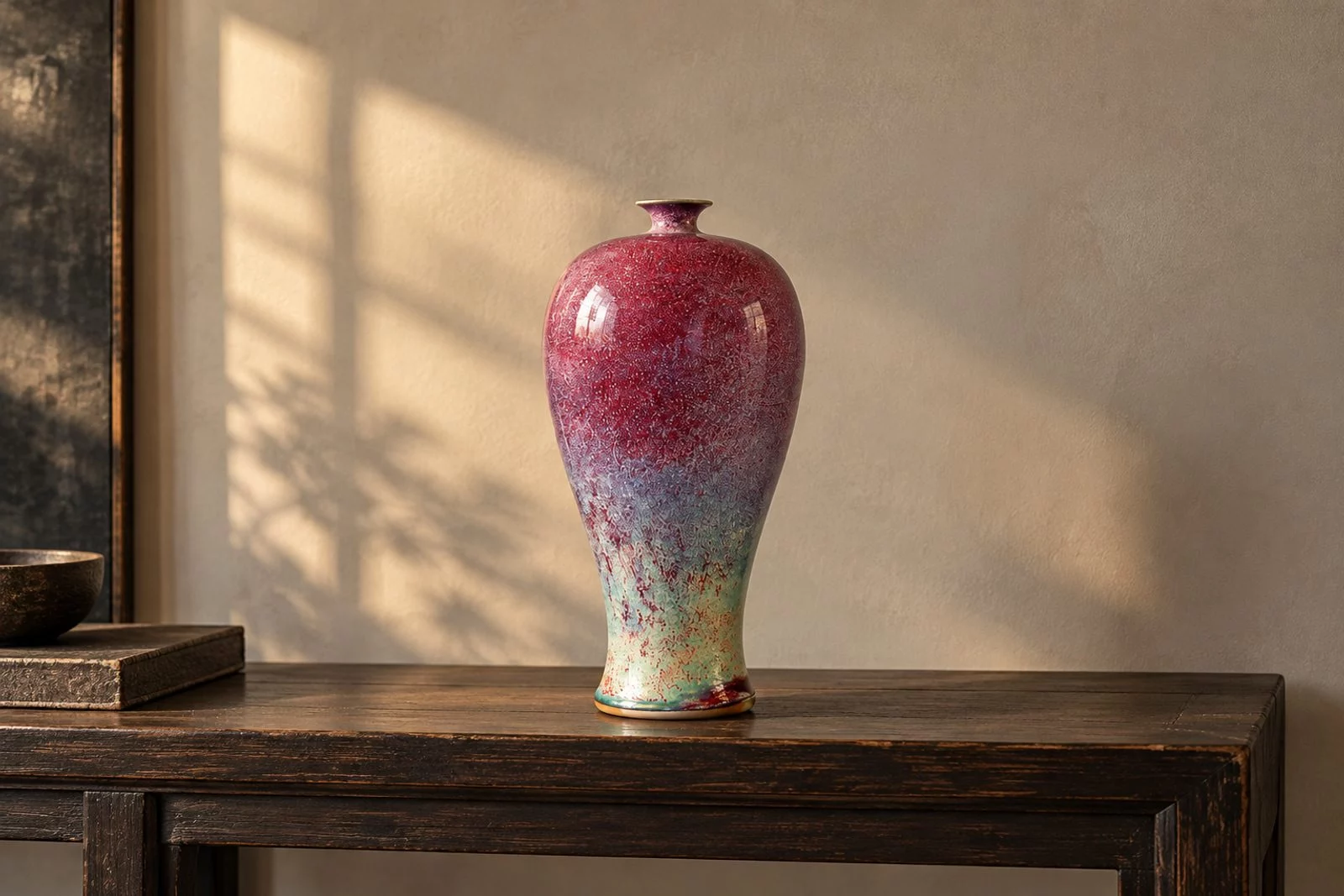
For that reason I’d never approve a glaze for a project from a screen. Ask for glaze tiles or a sample piece, and look at them in the actual room, or under lamps of the color temperature the lighting designer has specified. Our painted enamels and cobalt are steadier, because their color sits in a thin, even layer, but even those read differently against a dark wall and a white one.
The good news is permanence. Once fired, the color in porcelain is part of a glass layer, and it doesn’t fade the way textiles and paper do. The Canadian Conservation Institute’s guidance on ceramics and glass names physical forces as the chief agent of deterioration for ceramics, and doesn’t list light among the main risks. A porcelain vase can sit in a sunny window for decades. The art on the wall beside it can’t.
Surface also includes the parts nobody photographs. An aged surface on a jar in the Ming style, achieved with glaze and firing, looks right on a library shelf and wrong in a crisp contemporary room. A glossy glaze throws back spotlight hot spots; a satin or matte one doesn’t. Our guides on blue and white porcelain and on celadon on porcelain or stoneware go deeper into those two families.
In stock, adapted or made for the room
There are three ways to get decorative porcelain from a maker, and each sets the calendar and the price differently. These are KKCN’s terms; other makers will differ.
| Route | What it means | Minimum (KKCN) | Time to make (KKCN) |
|---|---|---|---|
| In stock | A finished piece from the current range | 1 piece | Ships in 3–7 days |
| Adapted | A stock form with a changed glaze, pattern, size or mark | 50 pieces per style | 30–45 days after sample approval |
| One of a kind | A piece designed and made for one space | Quoted per piece | 45–60 days |
For a single room, stock pieces are the fastest and least risky route, and a designer can see the actual piece before buying. Our Blue and White Chrysanthemum Scroll Jar, the Jun Ware Meiping Vase and the Silk Road Tang Sancai Horse are typical of what designers pick from stock for consoles, shelves and entrance halls.
Adapting a stock form is the route for retail ranges and for projects that repeat a piece across many rooms: the same jar in a hotel’s own blue, a vase shape in a brand’s color, a pattern redrawn to a client’s motif. It needs a sample round, which takes 15 to 30 business days for a new pattern, and a run of 50 or more. Our Al Masa Grand Hotel project in Dubai is this kind of program: hand-painted blue and white vases and miniature tea gift sets with the hotel’s own logo and patterns for the lobby, guest rooms and executive lounges, reordered every year for four years from the same approved samples.
One-of-a-kind pieces are where Jingdezhen’s depth shows: large thrown and sectioned forms, sculpture, glazes developed for a single space. They take 45 to 60 days to make once the design is agreed, before freight, and each is quoted on its own, based on its scale, the complexity of the glaze, the artist’s hours and the firing risk. That last factor is larger than buyers expect. A tall piece or a reactive glaze can be lost in the kiln, and a pair may need several candidates. Allow for that in the project calendar. If the install date is fixed, the commission has to start months earlier than most furniture orders. Our guide to custom porcelain product development explains how a new form goes from drawing to approved sample. The Craftsmanship & Production page shows the workshops where large pieces are made.
Pieces in public spaces
A vase at home is handled by one household. A vase in a hotel lobby is passed by thousands of people, cleaned by a team that changes over the years and occasionally moved for an event. Decorative porcelain survives that well if three things are planned: where it stands, how it’s fixed and how it’s cleaned.
Placement comes first. The Canadian Conservation Institute’s guidance names physical forces, knocks, drops and vibration as the main risk to ceramics, with handles, spouts and molded decoration the most vulnerable parts. Keep tall pieces out of the line of luggage trolleys and service doors, put them on plinths deep enough that a shoulder can’t brush them off, and keep lids on covered jars secured or display them separately.
Fixing is common practice in museums and easy to borrow. The Getty Museum’s seismic mountmaking program describes protection that ranges from simple methods, such as wax and fine ties, to base-isolation systems, and every object on display there gets some level of it. A lobby doesn’t need a shake table, but a dab of museum wax under a vase on a plinth, or a discreet bracket behind a large piece, costs little and prevents most falls. In earthquake regions, ask a mount maker. As optional add-ons, quoted separately, we supply solid timber display stands, weighted stabilizing bases, custom wall-mount hardware for decorative plates and lamp bases with the hole formed in the mold before firing, so the mold already carries the hole and there is no drilling step and no drilling risk. We do not supply wired lamps. Specify them with the piece, so the stand or base is made to fit the foot.
Cleaning is where well-meaning staff do harm. The Canadian Conservation Institute’s notes on caring for ceramics and glass advise lifting a piece with two hands and never by its handles or spout, dusting with a soft brush, cleaning with plain water rather than detergent, and letting the piece air-dry without heat. They also warn that overglaze decoration is particularly vulnerable to handling and cleaning, which matters for painted enamel pieces. Write those lines into the housekeeping handover. Our hotel porcelain supplier page covers lobby and corridor pieces alongside a property’s other porcelain.
Getting a statement piece to site
A floor vase or a sculpture is shipped alone. We wrap floor pieces in custom foam and build a solid-wood frame around each one, sized to its weight and balance so the porcelain never touches the frame. Art Space Milano’s commissions travel by air in custom foam and frames, because for a piece made once, a few days in transit matter more than the freight saving. Larger orders of decorative pieces usually go by sea.
Two things catch designers out. The first is access. A crate that won’t fit through a service entrance, a gallery door or a residential lift has to be opened outside, so send the narrowest door and lift sizes with the brief. The second is the calendar. Count back from the install date: the making time, a week for inspection and packing, freight, customs and delivery to site. For a one-of-a-kind piece shipped by sea, that adds up to several months. Our Packing & Shipping page covers the frames and routes, and our guide to shipping porcelain from China explains freight, customs and cost.
What to send a porcelain maker for a decor brief
A good brief answers the questions the maker would otherwise ask, and it fits on one page. Here is one that would let us quote in a single reply. A designer is furnishing the entrance hall and library of a private residence. The brief asks for a pair of covered jars for a 180 cm console, each about 60 cm tall with its lid, in hand-painted blue and white with a lotus scroll, matched as a pair. It adds three smaller pieces in the same family for the library shelves, at 25, 30 and 35 cm. It includes photos of the console and the shelves with the room’s lighting on, the color temperature of the lamps, and the wall color. It gives the install date and the delivery address, with the narrowest door on the route to the hall. It asks for glaze or color samples under that lighting before production, and for the pieces to be packed and labeled by room.
That brief takes an hour to write. It tells the maker the scale, the number, the surface, the light, the date and the access, which are the six things that decide whether the pieces work. My team replies to briefs within one to two business days with options, a timeline and a priced quotation.
Quick answers
What is decorative Chinese porcelain? Porcelain made to be displayed rather than used: jars, vases, plates and chargers for walls or stands, sculpture and display sets. Most is made in Jingdezhen in a handful of surface families, chiefly blue and white, celadon and other Song-style glazes, painted enamels and modern monochromes.
How do I choose the right size of vase for a room? Start from the place, not the catalog: the furniture beside it, the art above it and the ceiling. Then make a full-size card silhouette and tape it in place. Most designers who test a size this way end up choosing a larger piece.
Can handmade porcelain vases be matched as a pair? Yes, within a range. Pieces from the same painter, body and firing come out very close, and the acceptable variation can be approved on the sample. Reactive glazes such as Jun vary by nature, so a pair is chosen from several candidates fired at the same time.
How do you clean decorative porcelain? Dust with a soft brush and, where needed, clean with plain lukewarm water, then let it air-dry. Conservators advise against detergents and against lifting a piece by its handles or spout. Painted enamel decoration needs the gentlest handling.
Where to start
Measure the place before you choose the piece, decide between one, a pair and a set, and look at the glaze under the room’s light. Then choose the route, stock, adapted or one of a kind, and work the timeline back from the install date. Our workshop page shows how a Jingdezhen porcelain manufacturer makes large and one-of-a-kind pieces, and our collections show the families to start from.
Lin Wan leads foreign trade at KKCN in Jingdezhen, coordinating buyers’ requirements, samples, orders and after-sales across Europe, North America, the Middle East and Southeast Asia. Ten years in ceramic export, working in English and Chinese.