
To check a ceramic supplier’s lead and cadmium report, match the report to the exact pieces you are buying, confirm the lab, the standard and the date, and verify the report number with the lab itself. A report proves only that the samples described on it passed; lead tested ceramic tableware is tableware whose own glaze and decoration were in the sample.
Glazes and enamels can contain lead and cadmium, and in a poorly made or poorly fired glaze, small amounts can leach into acidic food and drink. That is why importers in the US, Canada and the EU are asked for test reports, and why a supplier’s PDF deserves more than a glance. This guide walks through what the test measures, which standard applies where, how to read a report line by line, and the questions that separate a useful report from a decorative one.
What the test actually measures
A lead and cadmium release test does not measure how much of either metal is in the glaze. It measures how much comes out. The lab fills or immerses the piece in a weak acid solution, usually 4% acetic acid, leaves it for 24 hours at room temperature, then measures the lead and cadmium in the liquid. The result is compared with a limit for that type of piece, because a plate, a small cup and a large pitcher hold food differently and are judged differently.
Two things follow from that. First, the result belongs to the surface that touched the acid, so a white interior and a painted rim are different questions. Second, the result depends on the firing as much as the recipe: a glaze that is fully matured in the kiln holds its metals far more tightly than one that was underfired. A good report is evidence of both, but only for the batch it describes.
Which standard for which market
The standard on the report should match where the pieces will be sold. For the United States, the usual method is ASTM C738 for the food-contact surface, with ASTM C927 used for decoration on the lip and rim, where the mouth touches. California adds Proposition 65, which sets its own levels for warnings. Canada applies the Glazed Ceramics and Glassware Regulations, SOR/2016-175. In the European Union, ceramic food-contact articles fall under Directive 84/500/EEC, and German buyers often ask for testing under the LFGB, Germany’s food and feed code; an EU importer will also need a Declaration of Compliance for the lines it sells.
A report written to one market’s standard is not automatically valid in another. If you sell in more than one market, ask for a report that covers each, or one that tests to both methods.
Reading a report, line by line
Most reports from a recognized lab follow the same layout. These are the lines to read before the result itself.
| On the report | What to check |
|---|---|
| Report number and issue date | It can be verified with the lab, and it is recent enough for your buyer; a report several years old says little about this year’s glaze. |
| Applicant and manufacturer | The supplier you are buying from is named, not another factory. |
| Sample description | The product type, color, glaze and decoration match your pieces, ideally with a photo of the sample. |
| Test method | The standard matches your market (see above), and rim decoration is tested separately if your pieces have it. |
| Results and limits | Each sample’s result is listed against the limit for its category, with a pass or fail for each. |
| Lab name and signature | An accredited lab, a named signatory, and a way to verify the report on the lab’s own portal or by email. |
The sample description is where most reports fall short. A report for “white porcelain cup” does not cover a cup with a painted enamel band, and a report for a celadon line does not cover a famille rose gift set. If the description doesn’t match, the report doesn’t apply.
Questions that tell you more than the PDF
A few direct questions usually settle whether a report is useful. Which of the pieces on my list does this report cover, and which does it not? Is the decoration at the rim covered, or only the interior? Was the sample taken from production, or made for the test? When will the next test be done, and will a new color or enamel be tested before my order ships? A supplier who answers these plainly, and names the report for each line, is a supplier whose reports you can rely on.
Be cautious with documents that make absolute claims without a test behind them. “Lead-free” printed on a certificate with no sample description, method or result is a marketing statement, not evidence. So is a report from a different factory, or a report on raw glaze powder rather than on fired pieces.
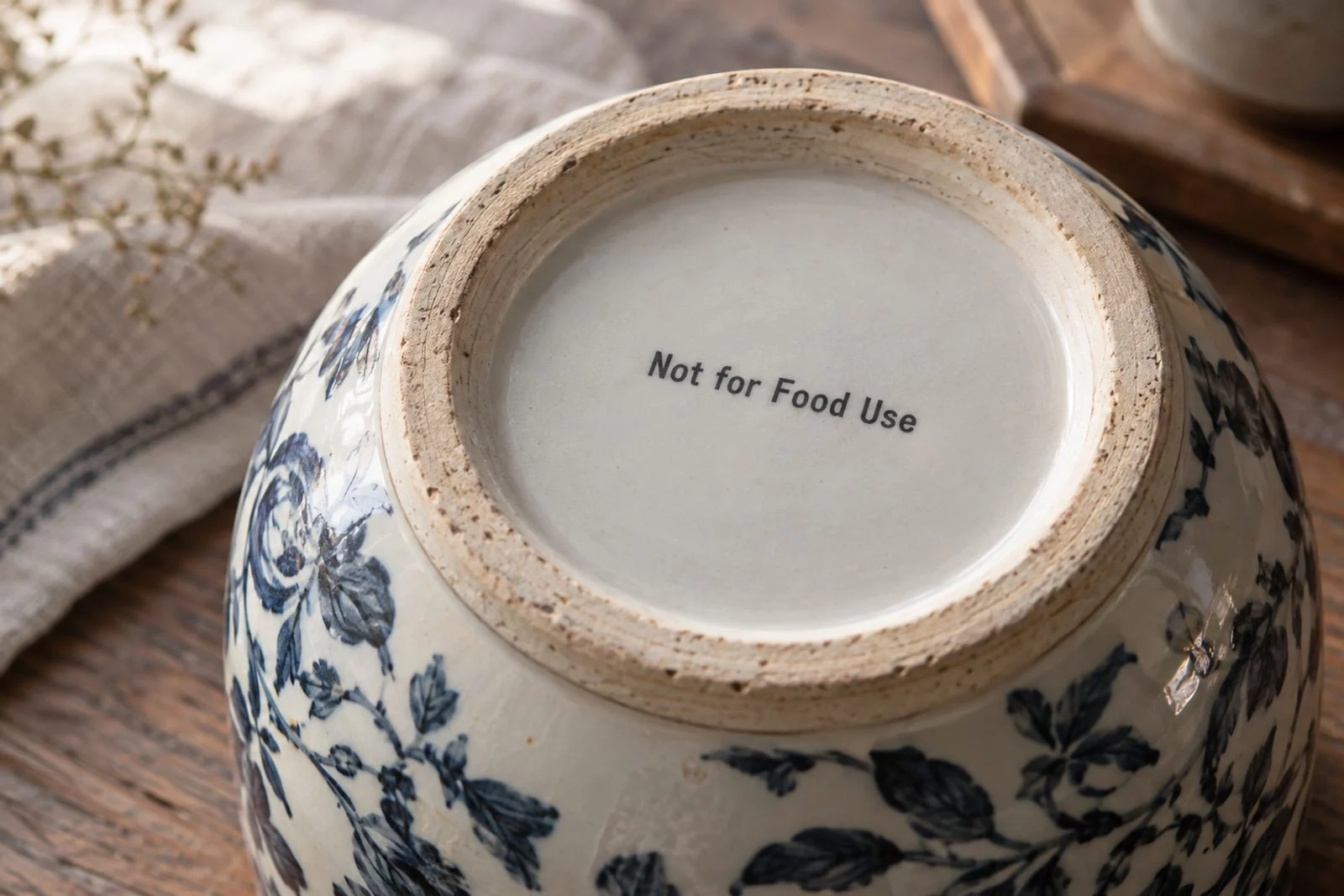
Display pieces are a separate case. Low-fired glazes such as Tang sancai, and many decorative finishes, are made for the shelf and should be labeled and sold for display. They don’t need a food-contact report, and they shouldn’t be sold with one implied.
How KKCN handles reports
Daily-use glazes are tested for lead and cadmium release to LFGB and ASTM C738 limits (SGS reports SGS-CER-2026-0418-14567 and LFGB-20260318-036). Each report names the product lines and batches it covers, so when you send your list, we tell you which report applies to which pieces, and which pieces it doesn’t cover. The six documents are listed by number, with their dates and scope, on Quality Control, and stamped scans come with the order batch.
If your range includes a glaze color or enamel that isn’t covered yet, say so with the first brief. Testing a new color takes time, so it is best planned alongside the sample rather than after production. How samples and timing work.
Send your list and your market.
Tell us which pieces you plan to sell and where. Lin Wan replies within 1–2 business days with the report that covers each line, and what would need testing for the rest.