Resources
Buyer guides from Jingdezhen
Ten guide collections on sourcing, craft and selling Chinese porcelain, written by our export team.
Browse all guides ↗ Resources
Buyer guides from Jingdezhen
Ten guide collections on sourcing, craft and selling Chinese porcelain, written by our export team.
Browse all guides ↗Home » Products » Imperial Wucai & Painted Porcelain Collection » Famille Rose
KKCN collection
Famille rose porcelain is painted in soft, shaded enamels over the glaze and fixed in a second, lower firing. KKCN paints it in its own Jingdezhen workshops, mostly as tea ware and gift sets. The grid holds a flying-apsara tea set on a tray and a mottled pink gaiwan, both in stock as pictured and made to order.
Famille Rose · Imperial Wucai & Painted Porcelain Collection
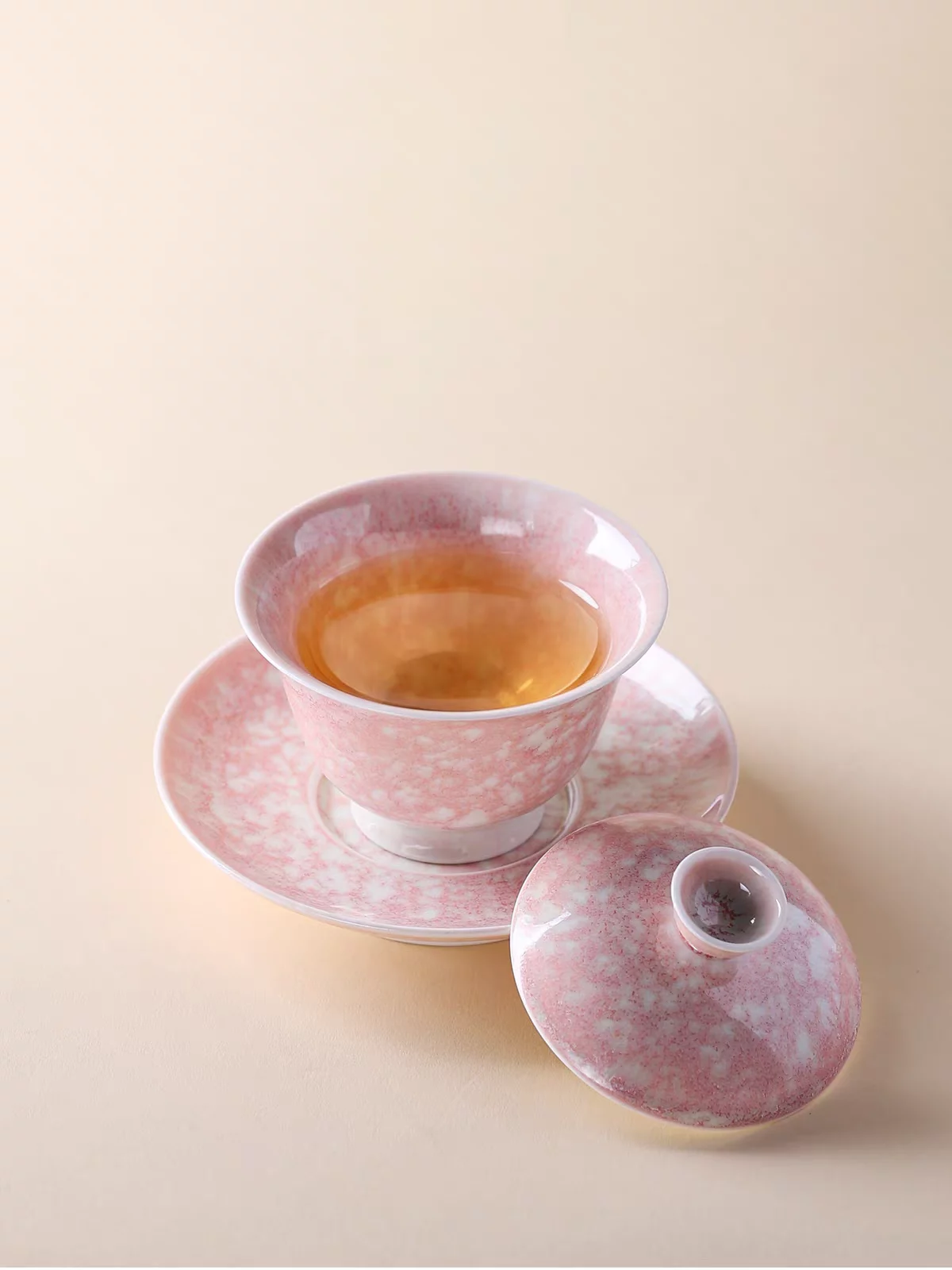
Pink enamel is dabbed onto this gaiwan by hand and blended into a soft mottle, so there is no picture at all, only color moving from rose to white. It comes as bowl, lid and saucer from our Jingdezhen factory, singly or by the case, for a tea table or a gift.
Famille Rose · Imperial Wucai & Painted Porcelain Collection
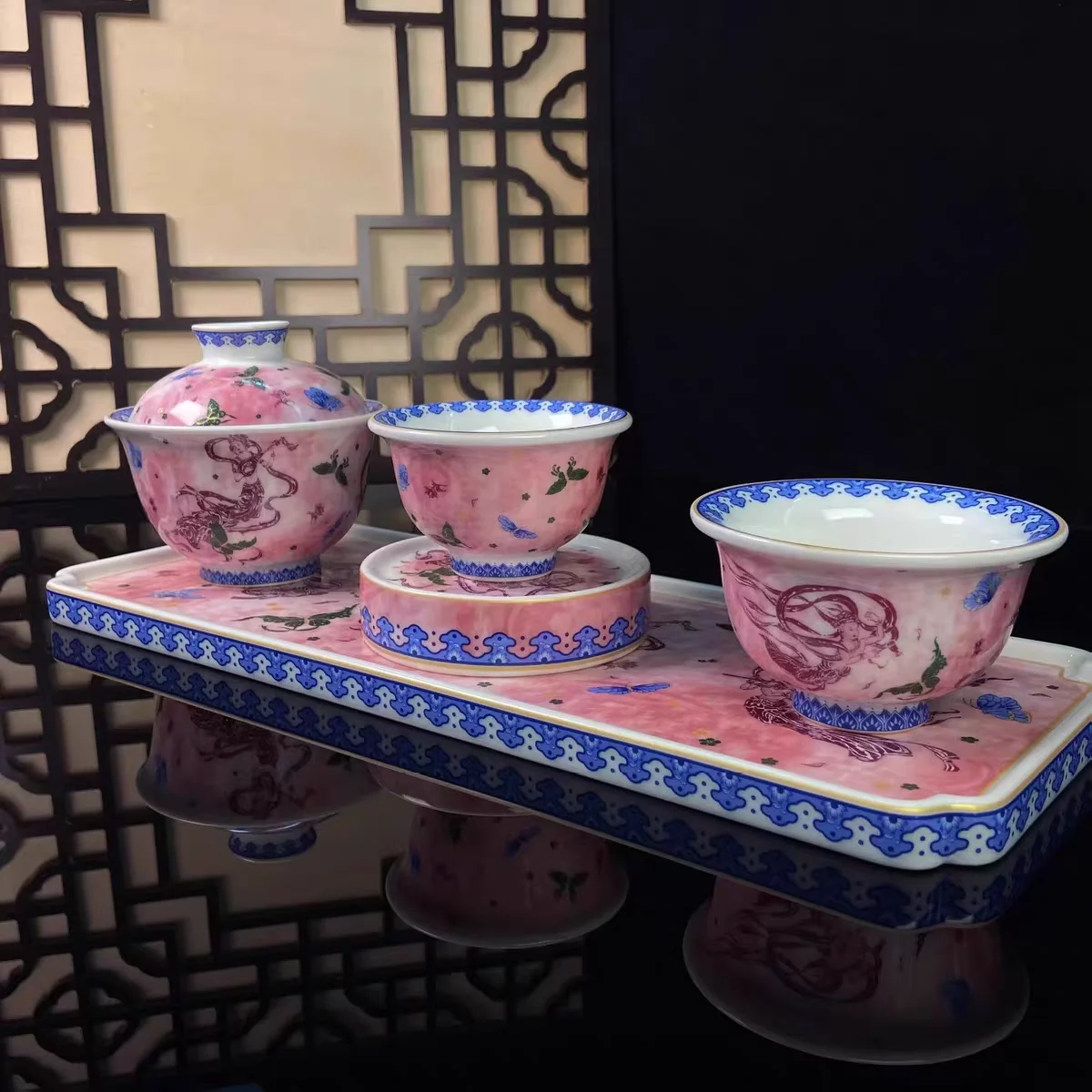
Flying apsaras and butterflies drift across a clouded rose-pink ground on every piece of this tea set, framed by blue cloud-head borders. Painted in famille rose at our Jingdezhen factory, it arrives on its own tray with a gaiwan and two cups, ready to give as one gift.
In Chinese it is fencai, "powdered colors", and the name describes what happens on the brush. The painter draws the outline first in a fine dark line. Then, wherever a petal or a cloud is meant to shade, a layer of opaque white enamel goes down, and the color is painted over it. While the color is still wet, a clean brush pulls it thinner toward one edge. In the kiln the white softens everything above it into a pastel, and the pulled edge becomes a gradient: deep rose at the heart of the flower, nearly white at its tip.
Before this, Chinese enamels were transparent. In the earlier palette that French collectors later called famille verte, a leaf was one green and a flower one red, laid flat and bold. Opaque white let the painters model form the way an oil painter does, and the new pink that came with it gave the family its French name.
The two references show the technique from opposite ends. On the flying apsara tea set, heavenly dancers and butterflies drift across a rose-pink ground that is itself shaded, darker in places and paler in others, like a sky with clouds in it, all held in by blue cloud-head borders. The mottled pink gaiwan leaves the pictures out entirely. Its pink is dabbed on and blended by hand into a soft mottle, so the shading is the whole decoration, with the white foot and rim left plain to frame it.
There is one catch for a buyer. Most enamels look dull and chalky in the pot and show their true color only after the kiln, and a pink can fire a shade warmer or cooler than expected. So the palette is approved on a fired sample, painted on the form you are ordering, never on a color chart. Ordering tea ware as a range.
Famille rose is compared with wucai, falangcai and doucai in our guide to Chinese porcelain decoration techniques.
Who makes it
KKCN paints its famille rose at the Doufunong workshops in Jingdezhen, on porcelain first fired at about 1,300 °C, then refired at about 780–850 °C to fix the enamels. Li Qiusheng's team checks every painted piece against the approved sample and pulls any that fall outside its color range before packing.
Custom orders
Process
Choose a reference or send your own design.
Approve a fired sample or photos before production.
Inspected, packed and shipped from Jingdezhen.
FAQ
Both are Qing dynasty overglaze palettes, named by French collectors in the nineteenth century. Famille verte, the "green family", came first, under the Kangxi emperor: transparent enamels led by strong greens, laid as flat areas of color. Famille rose followed in the 1720s and added opaque white and a rose pink, so colors could be shaded and softened. A famille verte peony is one red; a famille rose peony fades from deep rose to white.
Close, but not to a printed swatch. Fired enamel is colored glass, and its shade depends on the mix and the kiln as much as on the recipe. KKCN paints test pieces in a few pinks around your target, fires them and sends them to you, and the one you approve becomes the standard for the run. Expect a range a little wider than a printed color, the way a brand red on a ceramic mug differs from the same red on paper.
Yes, and much of it is. A cup and saucer, a gaiwan or a small tea set can go into a gift box made in your colors with a story card printed in your language, explaining the technique to the person who opens it. The sample is made as the full unit, box and card included, so you approve exactly what the recipient will see. Famille rose can be mixed with other painted pieces in one order from 10 pieces.
Rose medallion is one export style within famille rose, painted in Canton in the nineteenth century, with panels of figures alternating with birds and flowers around a central medallion. Famille rose is the whole family of shaded enamels, from palace cups to modern tea sets.
At least two. The porcelain is fired at about 1,300 °C, and the enamels are fixed later at 780–850 °C. A design with many layers of color may go back into the enamel kiln more than once.
Order minimums, samples and shipping are covered on Samples & Quotations and Packing & Shipping. Technique names on this page are defined in our Chinese porcelain glossary.
Send a photo, a sketch or a size, and we will tell you which reference comes closest or quote it as a custom piece.
Product inquiry
Share the PP numbers, quantity, destination and any customization. We reply within 1–2 business days.