Resources
Buyer guides from Jingdezhen
Ten guide collections on sourcing, craft and selling Chinese porcelain, written by our export team.
Browse all guides ↗ Resources
Buyer guides from Jingdezhen
Ten guide collections on sourcing, craft and selling Chinese porcelain, written by our export team.
Browse all guides ↗Home » Products » Blue & White Porcelain Series » Underglaze Red
KKCN collection
Underglaze red porcelain is painted in copper on the raw clay and turns red only in a low-oxygen kiln at about 1,300 °C. KKCN fires it in its own Jingdezhen workshops, on its own or beside cobalt blue. The grid holds a lion cup and a blue-and-red lotus gaiwan, both in stock as pictured and made to order.
Blue & White Porcelain Series · Underglaze Red
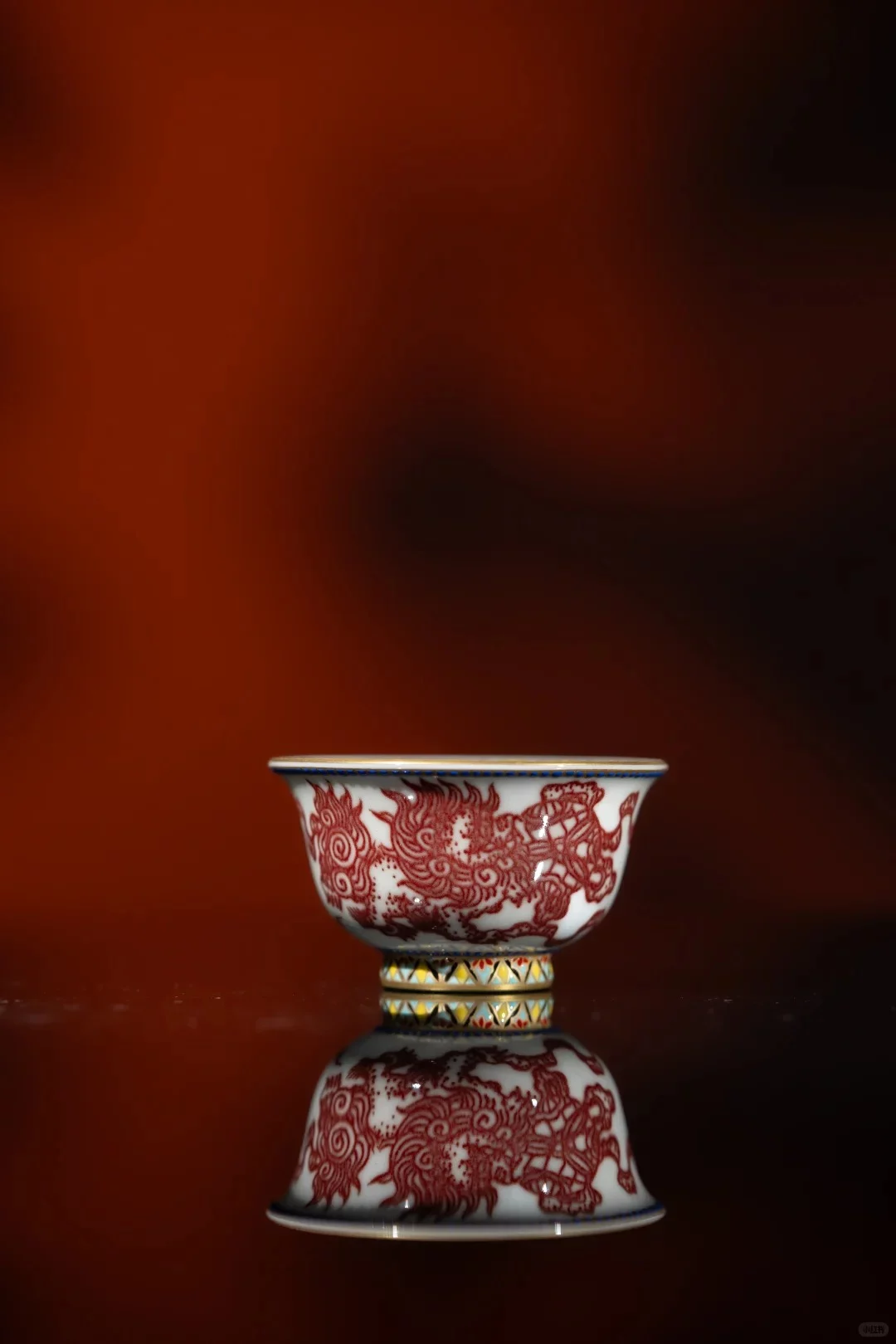
Two copper-red lions with curling manes chase a ribboned ball around this small footed tea cup, painted under the glaze and fired in reduction at our Jingdezhen factory. Collectors buy it singly, and festival gift buyers take it in pairs.
Blue & White Porcelain Series · Underglaze Red
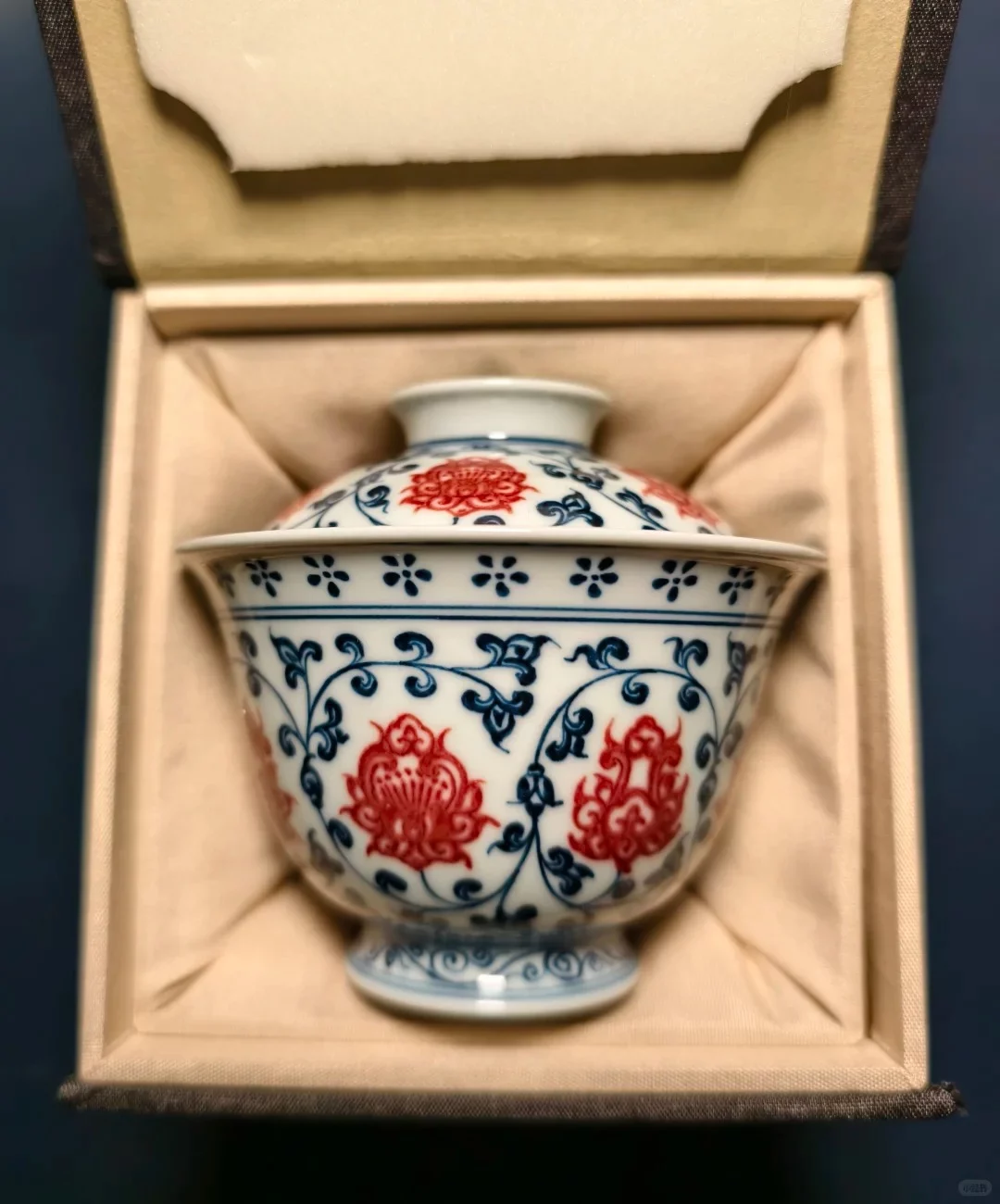
Copper red and cobalt blue are painted side by side under this gaiwan's glaze and fired once, as red lotus flowers on blue scrolling stems. We make it in our Jingdezhen ceramic factory and ship it in a lined presentation box for tea gifts.
In Chinese it is youlihong, "red within the glaze." The copper goes onto the raw clay exactly as cobalt does, under the same clear glaze, into the same kiln. That is where the resemblance ends.
Cobalt stays where the brush puts it. Copper does not. At full heat some of it turns to vapor and drifts up into the glaze, so a hairline stroke can fade to nothing or blur into a pink haze, while a heavy one can come out dark and liverish. Painters learn to load copper more thickly than blue and to give it shapes with some body to them: a lion's mane, a lotus petal, a full round flower. On the lion cup the lions are solid red forms, and the fine detail is built from dots and small spirals that hold together in the kiln better than a long thin line would. (The colored band around its foot is enamel, added afterward in a second, lighter firing.)
Then there is the kiln itself. Copper needs its oxygen cut off at the right moment, and the right moment is not quite the same at the front of a kiln as at the back. The same brushful of copper can fire soft peach-pink on one shelf and deep cherry on another. That narrow window is why underglaze red stayed rarer than blue for six centuries, and why Jingdezhen painters, once cobalt proved reliable, mostly kept red for pieces that deserved the risk.
Putting both colors on one piece is harder still. On the blue-and-red lotus gaiwan, cobalt scrolls and copper-red lotus flowers are painted side by side and fired together. Cobalt tolerates almost any firing, so the kiln is run for the copper, and the blue comes along.
What this means for an order is simple enough. With red, you approve a range rather than a single swatch: the lightest and the deepest red you will accept, both on fired samples. Every piece is sorted against them before it is packed.
Our porcelain decoration guide explains why copper red is harder to fire than cobalt, and what that means for an order.
Who makes it
Copper red is painted at KKCN's Doufunong workshops in Jingdezhen and fired in reduction at about 1,300 °C, in the same kilns as the cobalt line. Before a run, a sample is painted at the real line weight and fired, so you see the red your order will get.
Custom orders
Process
Choose a reference or send your own design.
Approve a fired sample or photos before production.
Inspected, packed and shipped from Jingdezhen.
FAQ
Three things move it: how much copper is on the brush, where the piece sits in the kiln, and exactly when the oxygen is cut back. A thick stroke near the hottest part of the kiln fires deeper than a thin one near the door. Nobody can make every piece identical, so a run is held between the palest and deepest reds you approve on fired samples, and pieces outside that range are not shipped.
Yes, and the lotus gaiwan is an example. Both colors are painted on the raw clay before glazing and come out of one firing. The painter loads the copper more heavily than the cobalt, and the firing is set for the copper, because cobalt keeps its blue across a much wider range of conditions. A fired sample shows you both colors together before the run starts.
It is one of the best. Red is the color of celebration in China, worn at weddings and hung at Lunar New Year, and a red-decorated tea set reads as a gift before the box is even opened. The motifs carry meaning too: lions stand for protection and good fortune, and the lotus for purity. The lotus gaiwan is shown in a fabric-lined presentation box, and gift boxing can be added to any order.
Yes. Copper turns red only when the kiln is starved of oxygen at the right moment. With too much air the same copper fires green or gray. That narrow window is why underglaze red is harder to get right than blue, and why we approve it as a range.
No. Underglaze red is copper painted on the raw clay and fired under the glaze at full heat. Iron red is an enamel painted on top of the glaze and fixed in a second, cooler firing. Iron red is brighter and more even, while copper red is softer and sits deeper in the glaze.
Order minimums, samples and shipping are covered on Samples & Quotations and Packing & Shipping. Technique names on this page are defined in our Chinese porcelain glossary.
Send a photo, a sketch or a size, and we will tell you which reference comes closest or quote it as a custom piece.
Product inquiry
Share the PP numbers, quantity, destination and any customization. We reply within 1–2 business days.