Resources
Buyer guides from Jingdezhen
Ten guide collections on sourcing, craft and selling Chinese porcelain, written by our export team.
Browse all guides ↗ Resources
Buyer guides from Jingdezhen
Ten guide collections on sourcing, craft and selling Chinese porcelain, written by our export team.
Browse all guides ↗Home » Products » Imperial Wucai & Painted Porcelain Collection » Doucai
KKCN collection
Doucai porcelain is drawn first in fine cobalt line under the glaze, fired, then filled with red, green, yellow and purple enamels and fired again. It is the most precise of Jingdezhen’s painted styles and suits small tea ware. The grid holds two gaiwan tea sets, one with children at play and one with a lotus scroll, both in stock and made to order.
Doucai · Imperial Wucai & Painted Porcelain Collection
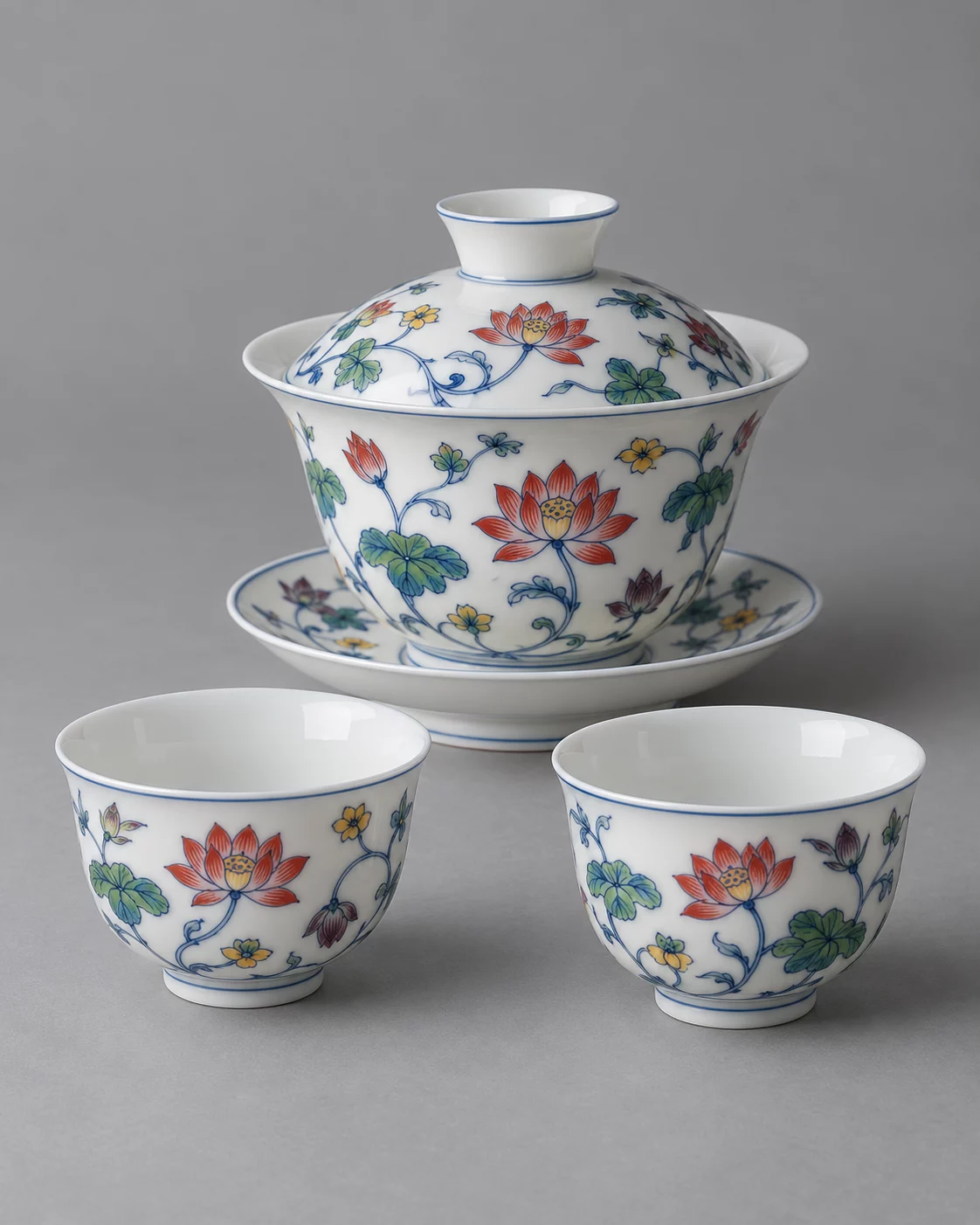
A gaiwan on its saucer and two rounded cups make up this doucai set, painted with red-orange lotus, yellow seed pods and aubergine buds on blue stems. As a Jingdezhen porcelain supplier, we sell it for two-guest tea service and as a gift for tea drinkers.
Doucai · Imperial Wucai & Painted Porcelain Collection
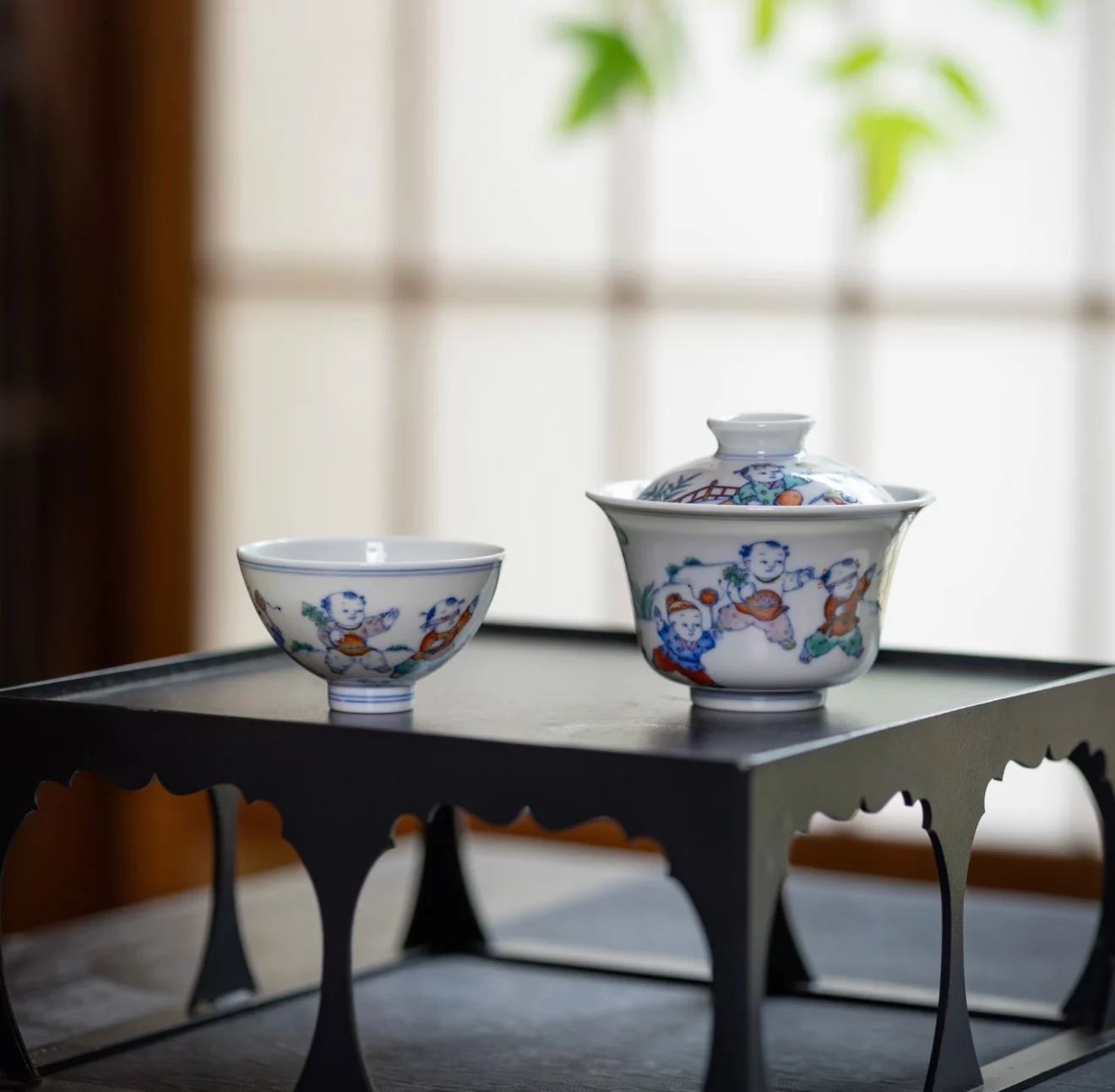
Small boys run and play among bamboo and rocks around this doucai gaiwan and its tall-footed cup, every figure drawn in fine blue line and filled with bright enamel. Painted at our Jingdezhen factory, it goes to tea houses and to families marking a birth or a birthday.
Doucai reached its peak in the reign of the Chenghua emperor, from 1465 to 1487, when the imperial kiln at Jingdezhen made small cups so finely painted that collectors have fought over them ever since. The name is usually translated as "contending colors" or "joined colors", and both fit: the blue line and the enamel that fills it have to meet exactly.
The work is done in two stages, often by two painters. First the whole design is drawn in thin cobalt line on the unfired porcelain, sometimes with a little blue wash, and the piece is glazed and fired at about 1,300 °C. Only then does the second painter fill each shape with enamel, staying inside a line that can no longer be changed. A second, lower firing fixes the color. Outline and fill are separate skills, and a good doucai piece needs both.
That is also why doucai is fine-lined and why it belongs on small things. The blue outline carries the whole drawing, and the enamels over it are thin and clear enough to let it show through. Held in the hand at a tea table, a doucai cup rewards close looking in a way a large jar seen across a lobby cannot.
The two sets here show the range. On the children at play set, small boys carry branches, fruit and a rattle or lantern on a stick among bamboo and rocks, an old wish for a large and happy family. The lotus scroll set follows the Chenghua palace style, with red-orange lotus flowers, yellow seed pods and aubergine buds strung along blue stems.
How doucai's underglaze outlines and overglaze fills come together is explained in our porcelain decoration guide.
Who makes it
Doucai is painted in Jingdezhen, including heritage studios working under KKCN's quality control. The cobalt outline is drawn on raw porcelain and fired at about 1,300 °C, then the enamels are filled in and fixed at about 780–850 °C. Li Qiusheng's team checks every piece for outline registration and enamel color against the approved sample.
Custom orders
Process
Choose a reference or send your own design.
Approve a fired sample or photos before production.
Inspected, packed and shipped from Jingdezhen.
FAQ
Both combine underglaze blue with overglaze enamels, but they use the blue differently. In doucai the blue is a fine outline around the whole design, and the enamels fill it neatly, like color inside a drawing. In classic wucai the blue is one color among several, laid in broader areas next to red, green and yellow, and the effect is bolder and less exact. Doucai suits small, close-up pieces; wucai suits a jar seen from across a room.
Because the line does the drawing. Every shape in a doucai design is set by the cobalt outline before any color goes on, and that outline is fired under the glaze, so it cannot be corrected later. Painters use a very fine brush and a steady, even pressure to keep it thin. The enamels are then laid thinly enough that the line still shows through them.
Yes. Qing painters revived doucai on bowls, jars and dishes, and the method works at any size. On a larger piece the line weight and the motif are redrawn so the design does not look thin from a distance, and a painted sample is fired at full size first. Larger doucai pieces take more painting hours than wucai of the same size, which shows in the quote.
A small Chenghua cup painted with a rooster, a hen and chicks, made at the imperial kiln in Jingdezhen between 1465 and 1487. One sold at Sotheby's Hong Kong in 2014 for about HK$281 million, a record for Chinese porcelain at the time. We paint the motif on new cups as new work.
Our reference sets have one or two cups. Most buyers order two to six to match the guests at a tea table, and a pitcher or tray can complete the service.
Order minimums, samples and shipping are covered on Samples & Quotations and Packing & Shipping. Technique names on this page are defined in our Chinese porcelain glossary.
Send a photo, a sketch or a size, and we will tell you which reference comes closest or quote it as a custom piece.
Product inquiry
Share the PP numbers, quantity, destination and any customization. We reply within 1–2 business days.