By Lin Wan, Foreign-Trade Lead at KKCN, Jingdezhen
We once sent a small shared-container shipment of hand-glazed decorative vases to an interior studio in Berlin. Somewhere between Jingdezhen and Germany, at a transshipment hub, a forklift tine went through one outer carton and cracked one of the signature vases inside. Nothing had gone wrong at sea, and nothing had gone wrong in our warehouse. The damage happened in the few seconds it took a stranger to move a pallet. Because we keep finished reserve pieces from each production batch, we found an identical vase from the same firing, packed it in one of our export crates and sent it by expedited air freight. It reached the studio before the container did, and the designer finished the installation on schedule.
That shipment holds most of what matters about shipping porcelain from China. The risk sits at the hand-offs, not on the ocean. The cost is set by volume and handling more than by weight. And the remedy depends on what the porcelain factory kept back before the cargo ever left. Our largest single order, about 48,000 cups and small plates for a hotel project, left Jingdezhen in one 40-foot high-cube container. A box like that is rated for about 28 tonnes of cargo, and our porcelain, wrapped and boxed, filled the space long before it came near that weight. You pay to move air and padding as much as porcelain, and almost every cost that follows the unit price, from freight to duty to breakage, behaves differently from the way it does for heavy or unbreakable goods.
This guide follows an order from the kiln to the shelf through each point where money or risk changes hands. It covers how freight is really charged, which trade term leaves you in control, where porcelain actually breaks, the customs codes and duties that decide what a piece costs in Europe or the United States, and how to turn a factory’s unit price into a landed cost per sellable piece. I’ve written it for buyers comparing a porcelain factory in China with what they pay at home, and for anyone holding a quote who wants to know what it leaves out.
Where I quote KKCN’s own terms and transit times, I say so. Other manufacturers set theirs differently, and freight rates and duties change, so treat every rate here as an example to check, not a quote.
Porcelain ships by volume, not weight
Sea freight for anything less than a full container is priced per cubic meter, or per tonne when the cargo is heavy for its size. Porcelain almost never is. A packed carton of cups or plates is mostly bubble wrap, foam, pulp and cardboard, so the cubic meter is the number that sets the bill. Air and express work the same way through volumetric weight. DHL Express, for example, calculates volumetric weight as length times width times height in centimeters divided by 5,000, and charges whichever is higher, the volumetric or the actual weight. For light, bulky cartons such as tea ware, the volumetric figure usually wins.
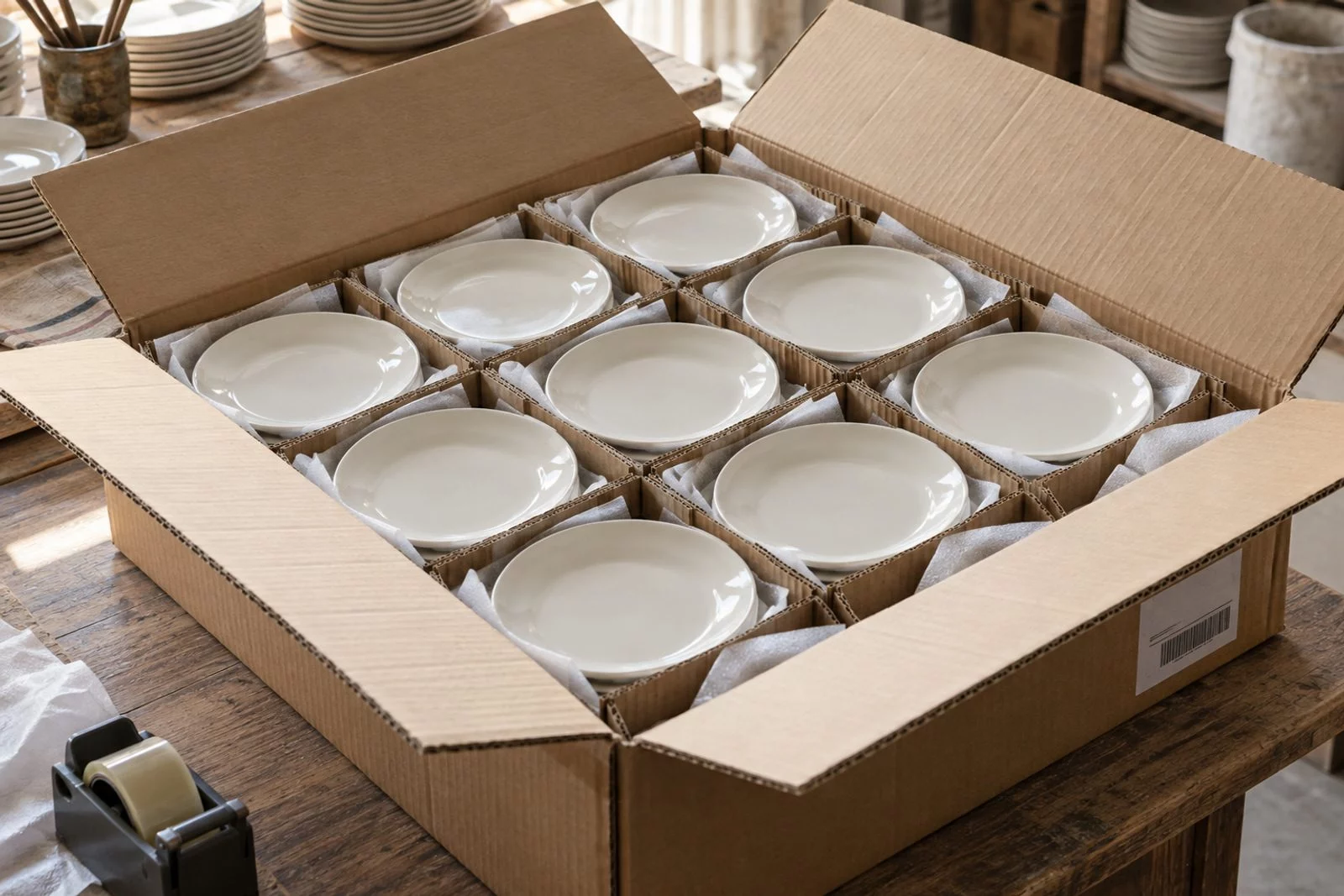
Here is what that means for one real export carton. Our standard carton for 27 cm (10.5 in) white hospitality dinner plates holds 12 plates, measures 64 × 64 × 16 cm and weighs 13.2 kg gross. That is about 0.066 cubic meters, or roughly 180 plates to the cubic meter. At sea, a cubic meter of those cartons weighs about 200 kg, far below the tonne that would make weight the charging unit, so you pay by volume. By air or express, the carton’s volumetric weight at DHL’s divisor is 65,536 ÷ 5,000 = 13.1 kg, almost exactly its real weight. Dinner plates are among the densest things we pack, and even they only come out level. A carton of cups, bowls or vases, with more air and padding around each piece, is charged on its volume.
The 48,000-piece container gives a second way to see it. A 40-foot high-cube container has about 76 cubic meters inside, so even if every centimeter had been used, each cup or small plate took up at least 1.6 liters of space. Real loads leave gaps for pallets and the door, so the true figure was higher.
Two practical consequences follow. First, packing is part of the freight bill. A carton designed around the piece, with a fixed count and no loose space, costs less to ship than a generous one, and it protects better because nothing moves inside it. That is why we settle units per carton and carton size with the sample, together with the six layers of protection on our Packing & Shipping page. Second, a supplier’s quote is only comparable when you know the carton. Ask every supplier for the carton dimensions, gross weight and pieces per carton for each item. If one maker packs 36 cups to a carton and another packs 24 in a carton of the same size, the second pays half as much again in freight per cup at the same unit price.
Where the porcelain changes hands
A trade term decides who books each leg of the journey, who pays for it and, just as important, the point at which the risk of loss or damage passes from seller to buyer. Choose it before you compare freight prices, because a quote on one term can’t be compared with a quote on another. The International Chamber of Commerce publishes the rules as Incoterms 2020, and four of them cover nearly every porcelain order we ship. KKCN quotes EXW, FOB, CIF and DDP.
| Term | Main freight booked by | Risk passes to the buyer | Suits |
|---|---|---|---|
| EXW (Ex Works) | Buyer | When the goods are made available at the seller’s premises | Buyers with their own China logistics |
| FOB (Free on Board) | Buyer | When the goods are on board the ship at the port of loading | Importers with a nominated forwarder |
| CIF | Seller | When the goods are on board at the port of loading | Buyers who want one price to their port |
| DDP (Delivered Duty Paid) | Seller | On delivery at the named place, duties paid | First-time importers, retailers, online sellers |
The row most buyers misread is CIF. Under CIF the seller books and pays the sea freight to your port, so it feels as if the shipment stays the seller’s responsibility until it arrives. It doesn’t. Under the Incoterms rules, risk passes to the buyer once the goods are on board in China, exactly as under FOB. What changes is who chooses and pays the carrier. If cargo is damaged at sea, the buyer is the one who has to make the claim. Hotel and project buyers often choose CIF to their nearest port, as our Al Masa Grand Hotel client in Dubai does, because it gives them one price to a port they know and leaves the final leg to their own team.
FOB is the term most experienced importers use. Our German client Living Oriental, a home brand with stores in Munich, Berlin and Frankfurt, has shipped FOB Shanghai with its own forwarder for six years. The buyer’s forwarder books the space, which usually gets a better rate than a factory can, and the buyer controls the schedule. FOB has one weakness that the ICC itself points out. In its note on choosing between FCA and FOB, it describes FOB as a rule for sea or inland waterway transport, port to port, and calls FCA (Free Carrier) the appropriate rule when goods travel in containers or on pallets, because the seller hands containerized cargo to the carrier at a terminal long before it goes on board. In practice many porcelain shipments still move on FOB, and most do arrive safely. But if you ship full containers regularly and your forwarder is comfortable with FCA, it describes the hand-over more honestly. Ask your supplier whether they will quote it.
DDP sits at the other end. The seller handles the whole journey, including import clearance and duty, and the buyer receives the goods at the door. Our US museum-store client East Art Gallery takes DDP deliveries every quarter, which lets a small buying team receive porcelain like any domestic delivery. DDP is the simplest term for a first import, but it is also the one where you see least. The duty, the broker and the freight are inside one number, so ask the supplier to show what that number assumes, especially the duty rate. Our own DDP quotations are built for each order. They include the import duty that applies to those goods and that destination on the quote date, with the US Section 301 tariffs or the EU anti-dumping duty counted in where they apply, and the quote states the rate it assumes. The importer of record is your designated local entity or our nominated freight forwarder, as local customs rules require. Duties on Chinese ceramics have changed more than once in 2026, so agree in the contract what happens if a rate changes before the goods arrive, and check the duty rate behind any DDP price before you compare it with anything else.
EXW is the term I’d steer most buyers away from on a porcelain order. Under EXW the buyer is responsible for export clearance in China as well as everything after it, and that needs a Chinese export declaration in someone’s name. We hold our own customs-declaration qualification, so in practice we handle the export papers for EXW buyers who ask, but FOB or FCA says the same thing more cleanly. Our Packing & Shipping page sets out what we handle and what you handle under each term.
Express, air, LCL or a full container
The route follows three things: how much you’re shipping, what it’s worth and how soon it has to arrive. These are KKCN’s typical transit times from dispatch. Production comes first, and our current lead times by order type are on Samples & Quotations.
| Route | Transit from KKCN (typical) | Fits | Watch |
|---|---|---|---|
| Express (DHL, FedEx, UPS) | 3–7 business days | Samples, trial orders, urgent top-ups | Volumetric weight; parcel handling |
| Air freight | 7–10 days | Seasonal launches, high-value pieces, opening dates | Volumetric weight; airport hand-offs |
| Sea, shared container (LCL) | 30–45 days door to door | Orders below a full container | Extra handling at consolidation |
| Sea, full container (FCL) | 30–45 days door to door | Container-scale orders and replenishment | Loading plan; using the space |
Express is the default for samples and for small, regular orders. Ceramic Home MY, an online seller in Malaysia, began with a 50-piece mixed trial from our stock and now restocks every month by expedited DHL, because for its volume the speed is worth more than the saving at sea. Air freight earns its cost when a date matters more than the money, such as a launch, a trade fair or an opening. When a restaurant client’s opening date was at risk, we split the order: a small allotment went by air so the kitchen could open, and the rest followed by sea. I wrote about that case in our hotel tableware buying guide.
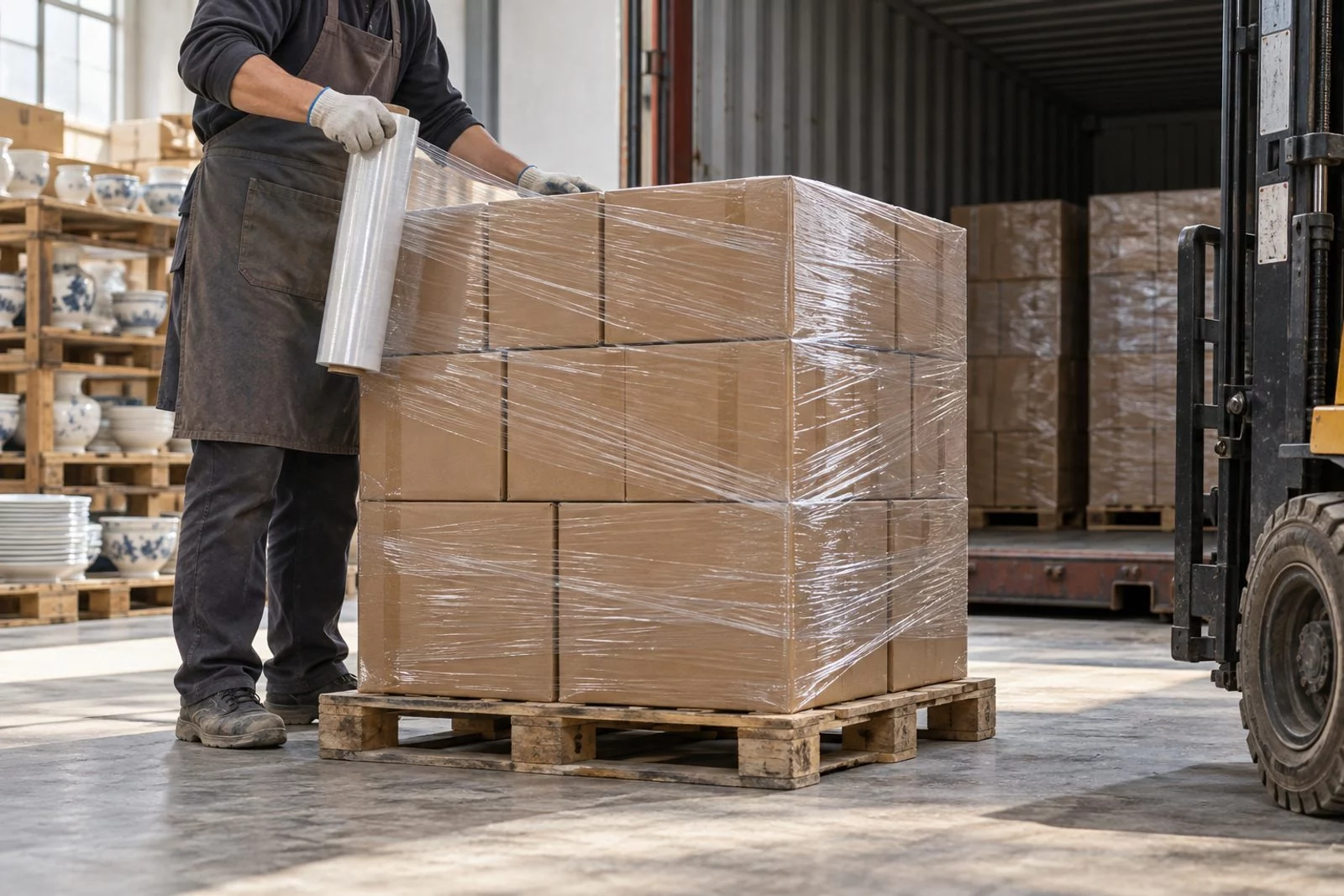
Sea freight carries almost everything else. A shared container, called LCL for “less than container load,” lets you ship a few cubic meters without paying for a whole box. The tradeoff is handling. LCL cartons are taken to a consolidation warehouse, stacked with other people’s cargo, loaded, and unloaded again at a warehouse at the other end. Every one of those moves is a chance for a carton to be dropped or crushed, so LCL porcelain needs stronger cartons and pallets than a full container sealed at our warehouse. Once an LCL shipment reaches around half a container, ask your forwarder to price a full one as well. Depending on the route and the season, the full box can work out cheaper per piece, and nobody opens it between our door and yours.
The cheapest route per cubic meter isn’t always the cheapest per sellable piece. A route with more hand-offs breaks more, and a broken cup has cost you its unit price, its freight and its duty.
Where porcelain actually breaks
Buyers picture breakage at sea, in a storm. In our experience it happens on land, at the points where cargo changes hands or changes vehicle. A sealed container rides the ocean well. The risks are the truck to the port, the forklift at a consolidation warehouse, transshipment at a hub port, the unloading at destination, and above all the parcel network, where each carton is sorted, conveyed and dropped many times on its own.
Jingdezhen is inland, so every order we ship starts on a truck. FOB Shanghai or Shenzhen is our standard basis, at the quoted price; if you prefer Ningbo or Xiamen, we accept the same price and charge only the inland difference, shown as a separate line on the quotation. Trucking from Jingdezhen takes 2–3 working days to Shanghai and 3–4 to Shenzhen, loading included, depending on highway conditions and customs inspections. A full container is loaded and sealed at our warehouse, so it reaches the port as one unit. LCL cartons go to a consolidation warehouse near the port and are handled again there, which is where the Berlin carton began its unlucky journey.
The parcel network deserves its own warning, because it’s where porcelain bought from a factory often ends up after a retailer’s warehouse. The International Safe Transit Association’s Procedure 3A, a standard test for packages shipped by parcel delivery, simulates that journey with a series of drops from different angles plus vibration, for packages up to 70 kg. A carton that survives a container crossing may not survive that. If you sell online or reship single units, the protection has to be inside each unit box, not only in the export carton around it. Our ceramic packaging guide by sales channel sets out what to ask for in each case.
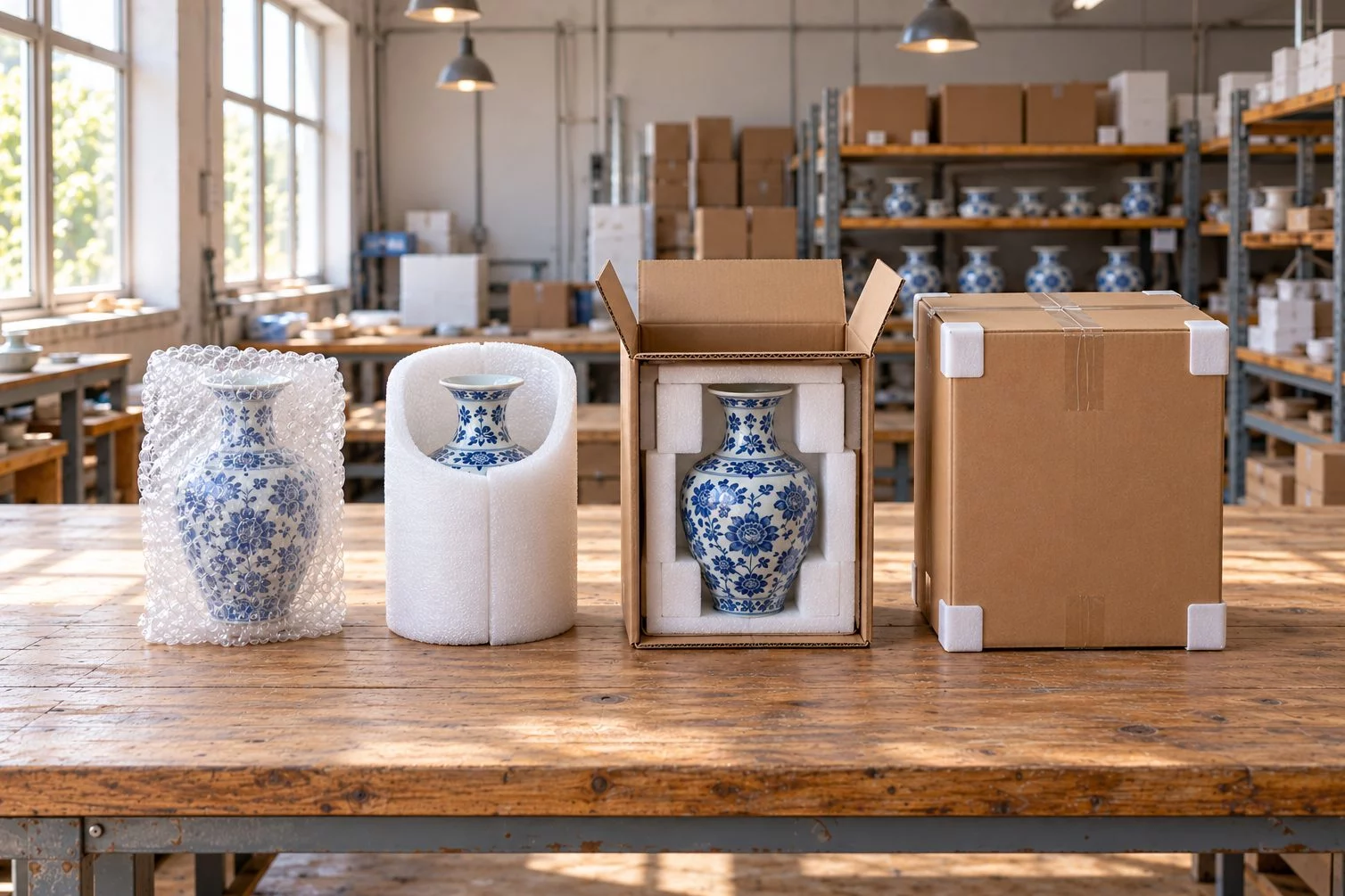
The fix is designed in before production. At KKCN, packing is approved together with the sample, so the bubble bag, the foam wrap, the molded-pulp insert that keeps pieces apart, the box, the five-layer export carton and the pallet are written into the same standard as the glaze. Rims, spouts, handles and knobs get extra padding, because those are where a drop lands first. Lids travel apart from their bodies. Large pieces go into solid-wood frames. Before a carton is sealed, the inspection team checks the inner protection, the count per carton, the marks and labels, moisture protection for sea routes, and the carton count against the packing list. We track damage claims on every shipment. Last year about 1.1% of our properly packed FCL and LCL shipments had a formal breakage claim (KKCN production and sales records, 2025–2026). That figure doesn’t include damage from repacking or onward handling after delivery, which is where the parcel network takes over.
When something does arrive broken, the clock matters more than the argument. Photograph the cartons before you open them, then every layer as you unpack, and keep the shipping label. Our own terms ask for photos and the label within 48 hours of delivery, and our After-Sales page sets out what happens next.
The border: codes, papers and duty
Customs treats porcelain like any other goods. Your broker classifies each item under the Harmonized System, declares its value, and the duty follows from the code and the origin. For porcelain the codes that matter are three headings in chapter 69: 6911 for tableware, kitchenware and other household articles of porcelain or china; 6912 for the same articles in other ceramics, such as stoneware and earthenware; and 6913 for statuettes and other ornamental ceramic articles. A teacup and a lidded jar from the same kiln can fall under different headings. That matters more than most buyers expect, because the duty on them can be very different. Classification is your broker’s decision, based on what the piece is and how it’s used, and a supplier who suggests describing a dinner plate as a decorative item is offering you a customs problem, not a saving. Our guide to importing ceramic tableware from China covers what the importer sets up in each market before the first container.
Europe. Ceramic tableware and kitchenware from China has carried an EU anti-dumping duty for more than a decade, on top of the normal customs duty, which is 12% for porcelain tableware under 6911 10 00. Until early 2026 the anti-dumping rate depended on the manufacturer, from 13.1% to 36.1%. After an expiry review and a partial interim review, the European Commission replaced those company rates with a single country-wide rate of 79%, in Implementing Regulation (EU) 2026/274, published on February 6, 2026, which amends Regulation (EU) 2025/1981. The measure covers ceramic tableware and kitchenware, whether porcelain, stoneware or earthenware, under CN codes 6911 10 00 and ex 6912 00. Ornamental pieces classified under 6913 sit outside it. For an EU buyer of everyday porcelain tableware made in China, duty can now come close to the price of the piece itself. I’d rather say so here than let a buyer find out from the customs bill. Article 1 of that regulation sets a single country-wide rate of 79%: there is no company-by-company schedule, so it is the rate for every Chinese manufacturer, KKCN included. We quote it on your HS line with the quotation.
United States. US imports from China pay the normal duty for their heading plus Section 301 tariffs, which have covered a large share of Chinese goods since 2018 and 2019. For porcelain tableware under HTS 6911.10, that older layer is List 4A at 7.5%, which is the rate our DDP desk applies. The layers on top of those changed several times in 2025 and 2026. Tariffs imposed under the International Emergency Economic Powers Act ended in February 2026 after the Supreme Court ruled that the act doesn’t authorize tariffs, as DLA Piper summarized at the time. A temporary 10% surcharge under Section 122 then ran from February 24 to July 24, 2026, and on July 24 it was replaced by a 12.5% Section 301 tariff on products of China from USTR’s forced-labor investigations (Federal Register 2026-15181). As of November 2026, a porcelain plate from China therefore pays a stack: its base rate plus 7.5% plus 12.5%, so 26% in all on a 6% household line. Each layer can still move, and the 12.5% layer is being challenged at the Court of International Trade, which has heard the case but not yet ruled. So we quote that stacked figure per shipment at the rate in force on the day, and your customs broker should confirm the same total before the goods ship. Ocean shipments to the United States also need an Importer Security Filing, the “10+2,” which CBP requires no later than 24 hours before the cargo is loaded onto the vessel abroad. Your broker or forwarder files it, but they need the supplier’s details in time, so make sure they have them before the booking.
The papers. Whichever market, your broker needs a commercial invoice, a packing list and usually a certificate of origin. We issue six documents for every order from the same company that made and packed the goods: commercial invoice, packing list, sales contract, certificate of origin, export customs declaration and the inspection report for the batch. Tableware headed for the EU or US often needs its test reports in the same file, and our guide to lead and cadmium reports explains what a broker or buyer will look for in one. Check that the description, quantity and value match across every document. A mismatch between the invoice and the packing list holds more shipments than any missing certificate. Our guide to importing porcelain from China walks a first import through the whole route.
From unit price to landed cost per sellable piece
The figure that tells you whether a porcelain supplier is competitive is what one sellable piece costs on your shelf, after freight, duty, fees and breakage. Unit price is only the first line.
Here is a worked example using the plate carton above: 12 plates in 0.066 cubic meters. The unit price is a round $5.00 FOB, chosen to keep the arithmetic easy, not a KKCN price. Freight is shown at two illustrative sea rates per cubic meter, to show how much the rate moves the total. They are examples, not quotes, so ask your forwarder for the real figure on your route.
| Line | How it’s worked out | At $120/m³ | At $300/m³ |
|---|---|---|---|
| Unit price, FOB | From the quote (example) | $5.00 | $5.00 |
| Sea freight to destination port | Rate × 0.066 m³ ÷ 12 plates | $0.66 | $1.64 |
| Cargo cover, if your term leaves it to you | Your forwarder’s quote | Ask your forwarder | Ask your forwarder |
| Destination port, broker and delivery charges | Per-shipment fees ÷ plates in the shipment | Ask your broker | Ask your broker |
| Duty | Customs value × the rate for your market and heading | See below | See below |
| Breakage allowance | Cost so far × your own damage rate | From your records | From your records |
The duty line is where markets part ways. In the EU the customs value is normally the cost of the goods plus freight to the EU border, so on the cheaper freight above that’s $5.66. Normal duty of 12% plus the 79% anti-dumping duty adds about $5.15, or $6.04 at the higher freight rate, before VAT, which is charged on top and usually recovered by a VAT-registered business. The duty alone is now worth more than the plate. In the United States, duty is assessed on the transaction value, usually without the ocean freight, at whatever combined rate your broker confirms. A buyer comparing a Chinese porcelain manufacturer with a European one needs this line in the comparison, or the cheaper quote may not be the cheaper plate.
Three habits make the comparison fair. Ask every supplier for the same term, so you’re not comparing an FOB price with a DDP one. Ask for carton data with every quote, so you can work out freight per piece yourself. And price breakage honestly. Use your own damage rate from past shipments, counted in pieces rather than shipments. Under our terms, transit damage up to 3% of an order is replaced at equal value in the next order, so for us the allowance mostly covers the wait. Either way, a supplier with better packing may cost a little more per piece and save you more than that in replacements.
The calendar from kiln to shelf
Plan backward from the date the pieces have to be on the shelf. The two slowest stages are production and the sea, and both get squeezed in the same months.
| Stage | KKCN typical time | What can stretch it |
|---|---|---|
| Production, in stock | Ships within 3–7 days | Stock levels on the item |
| Production, regular / custom | 15–25 days / 30–45 days | August–December adds 5–10 days |
| Truck to Shanghai or Shenzhen, export clearance | 2–3 working days to Shanghai, 3–4 to Shenzhen | Highway and customs inspections |
| Sea freight | 30–45 days door to door | Routing, transshipment |
| Import clearance and delivery | Depends on broker and port | Missing documents, inspections |
August to December is our busiest season, as it is across much of China’s export industry, because buyers are filling holiday shelves. We book peak capacity about three months ahead, with existing clients first. A 15% rush fee buys priority scheduling and cuts production time by about 30%, but nothing shortens the ocean. Chinese New Year is the other pinch. Factories wind down in the weeks before it and restart slowly after, and the schedule moves every year with the lunar calendar. Our sourcing guide gives the pattern we follow.
The habit that saves the most time costs nothing: send the shipping details with the order, not after production. The consignee, the delivery address, the forwarder’s contact, the term and any carton-marking rules all go into the packing plan before the cartons are made.
Large pieces, mixed orders and samples
Some shipments need their own plan.
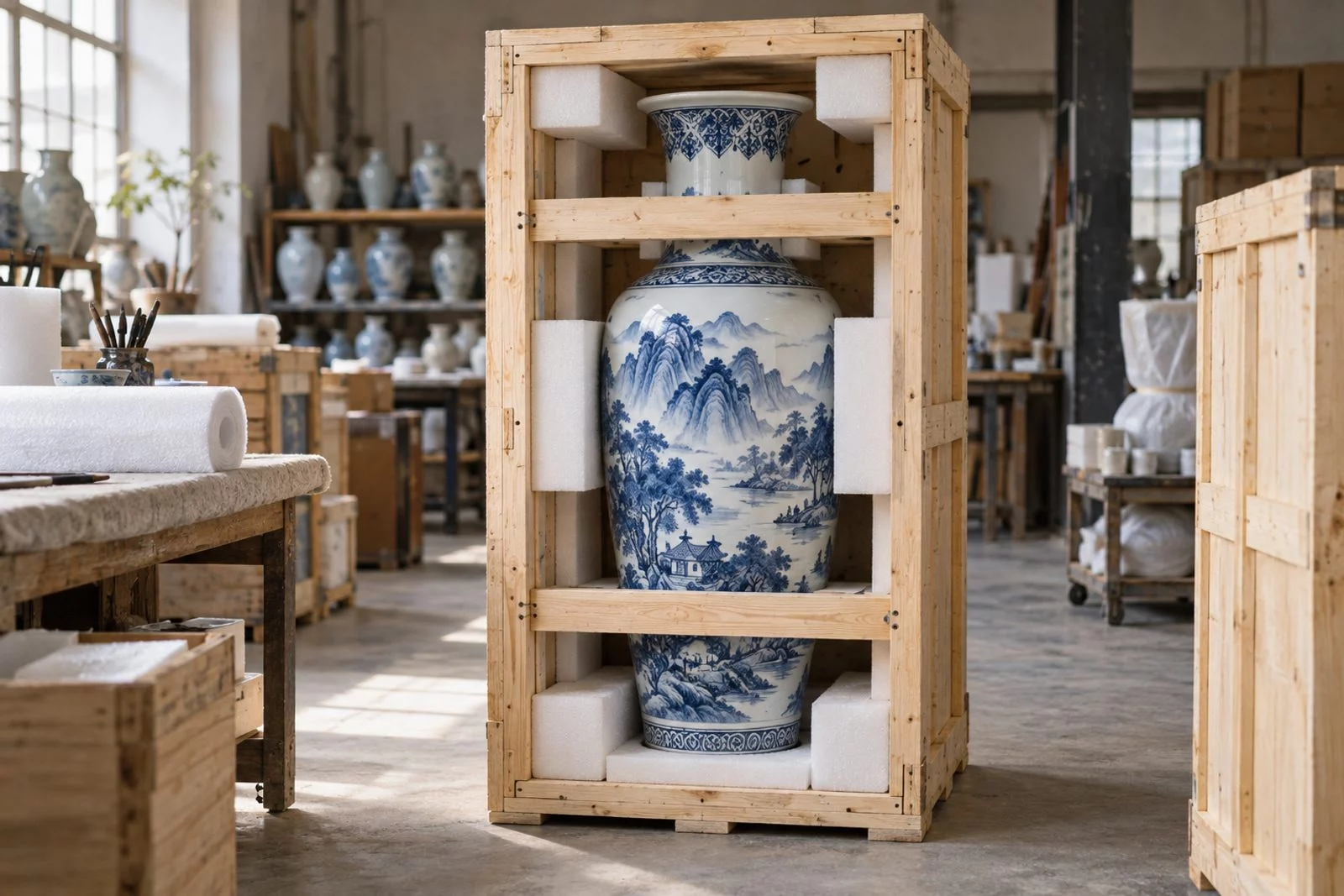
Large pieces. A floor vase or a sculpture travels alone. We wrap pieces up to 130 cm in custom foam and build a solid-wood frame around each one, sized to its weight and balance so the porcelain never touches the frame. A framed piece is heavy and bulky, so freight per piece is high whichever route you choose. Art Space Milano, which commissions one-of-a-kind pieces from us for villas and galleries, ships them by air in custom foam and frames, because for a piece priced individually, a few days in transit is worth more than the freight saving. Check access at the destination too. A crate that can’t fit through a gallery door or a residential lift has to be opened on the pavement.
Mixed orders. Many orders combine pieces from different workshops: tea ware painted in Jingdezhen, a high-white figure on a body from Dehua, gift boxes from Chaozhou. At KKCN every piece returns to our Jingdezhen headquarters for final inspection and packing, so the order leaves from one warehouse on one packing list. That matters at the border, where one supplier, one invoice and one packing list clear more easily than three. If you’re buying from several suppliers yourself, a forwarder can consolidate them in China, but each one packs to its own standard.
Samples. Samples go by express, and they’re no longer duty-free in many cases. The United States ended duty-free de minimis entry for goods from China in 2025, and then for most shipments from all countries from August 29, 2025. CBP then made the suspension indefinite by interim final rules effective June 24, 2026 (Federal Register 2026-12670). So even a small sample parcel may carry duty and a broker’s fee. Budget for it, and keep the sample invoice accurate.
Quick answers
How long does shipping porcelain from China take? From KKCN’s warehouse, express takes 3 to 7 business days, air freight 7 to 10 days and sea freight 30 to 45 days door to door (22 to 40 at sea, plus 5 to 10 for customs and delivery). Add production time first: in-stock pieces ship within a week, and custom orders take 30 to 45 days to make.
Is it cheaper to ship porcelain by sea or by air? By sea, for anything beyond a few cartons, because porcelain is charged by volume and air rates are many times higher per cubic meter. Air makes sense for samples, small high-value orders and fixed dates.
What is the HS code for porcelain? Porcelain tableware and kitchenware fall under heading 6911, other ceramic tableware such as stoneware under 6912, and ornamental pieces under 6913. The national subheading and the final classification are your customs broker’s decision.
Who handles customs under DDP? The seller arranges import clearance and pays the duty, and the goods are delivered to your address. A DDP price should state the duty rate it assumes and the date of the quote, especially for the EU and the United States, where rates on Chinese ceramics have changed recently.
Where to start
Ask for carton data and a quote on the term you’ll actually use. Work out the freight and duty per sellable piece before you compare suppliers, and get the current duty rate from a broker. Then send your shipping details with the order, so the packing plan, the route and the documents are settled before production starts. Our Packing & Shipping page shows how we pack and ship from Jingdezhen, and Samples & Quotations has the current lead times and minimums for a first order.
Lin Wan leads foreign trade at KKCN in Jingdezhen, coordinating buyers’ requirements, samples, orders and after-sales across Europe, North America, the Middle East and Southeast Asia. Ten years in ceramic export, working in English and Chinese.