Resources
Buyer guides from Jingdezhen
Ten guide collections on sourcing, craft and selling Chinese porcelain, written by our export team.
Browse all guides ↗ Resources
Buyer guides from Jingdezhen
Ten guide collections on sourcing, craft and selling Chinese porcelain, written by our export team.
Browse all guides ↗Home » Products » Imperial Wucai & Painted Porcelain Collection » Falangcai
KKCN collection
Falangcai porcelain is covered in dense, finely brushed enamel, often on a solid colored ground, and fixed in a second firing. It is painted in Jingdezhen for limited editions and ceremonial gifts. The grid holds a peony panel cup and two lotus dinner services, one on turquoise and one on yellow, all in stock as pictured and made to order.
Falangcai · Imperial Wucai & Painted Porcelain Collection
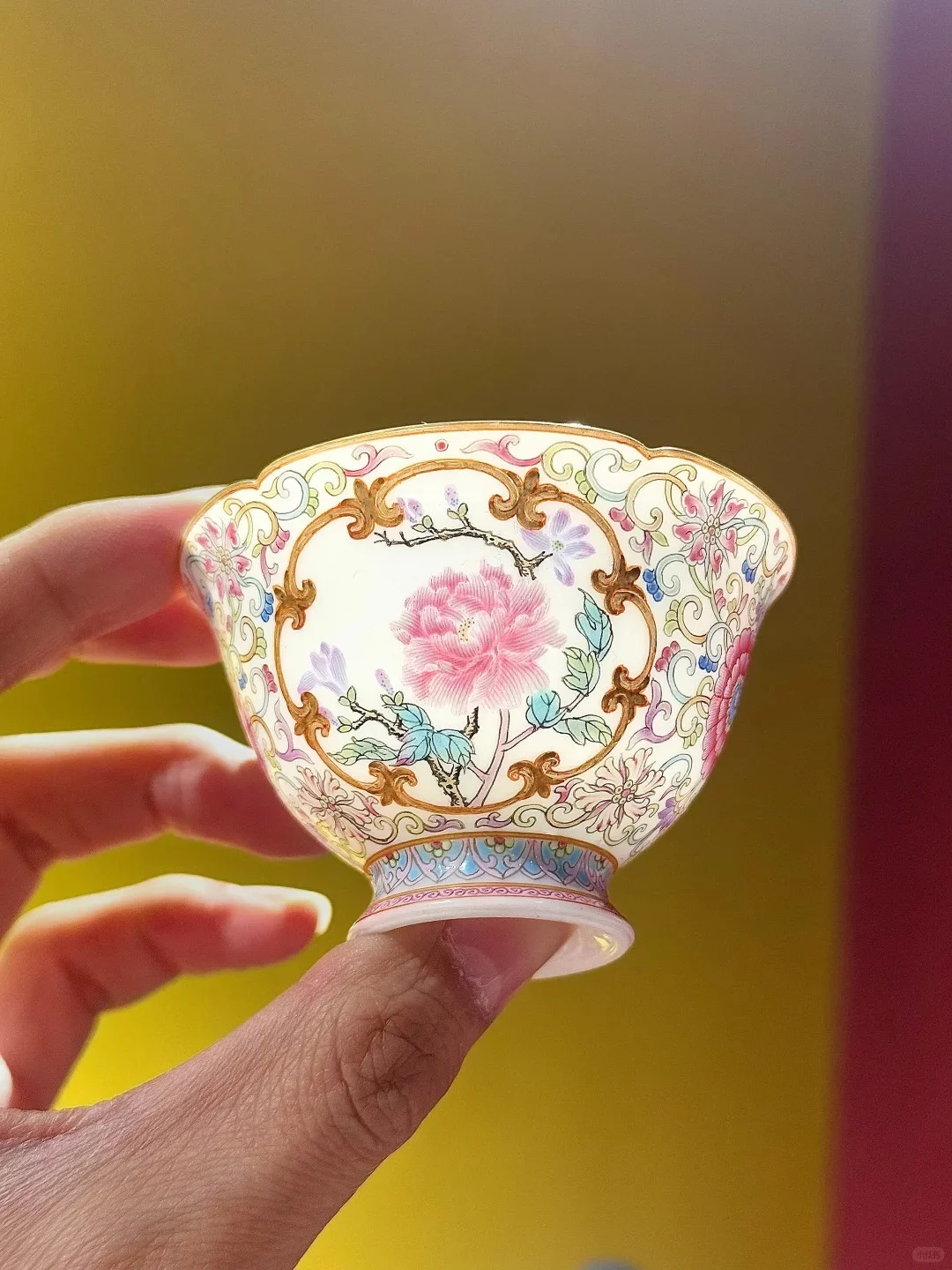
This falangcai tea cup has a lobed rim and a tall foot, its pink peony set in a framed white panel against dense floral scrolls. KKCN, a Jingdezhen ceramic supplier with its own enamel painters, boxes it singly for collectors and tea gift programs.
Falangcai · Imperial Wucai & Painted Porcelain Collection
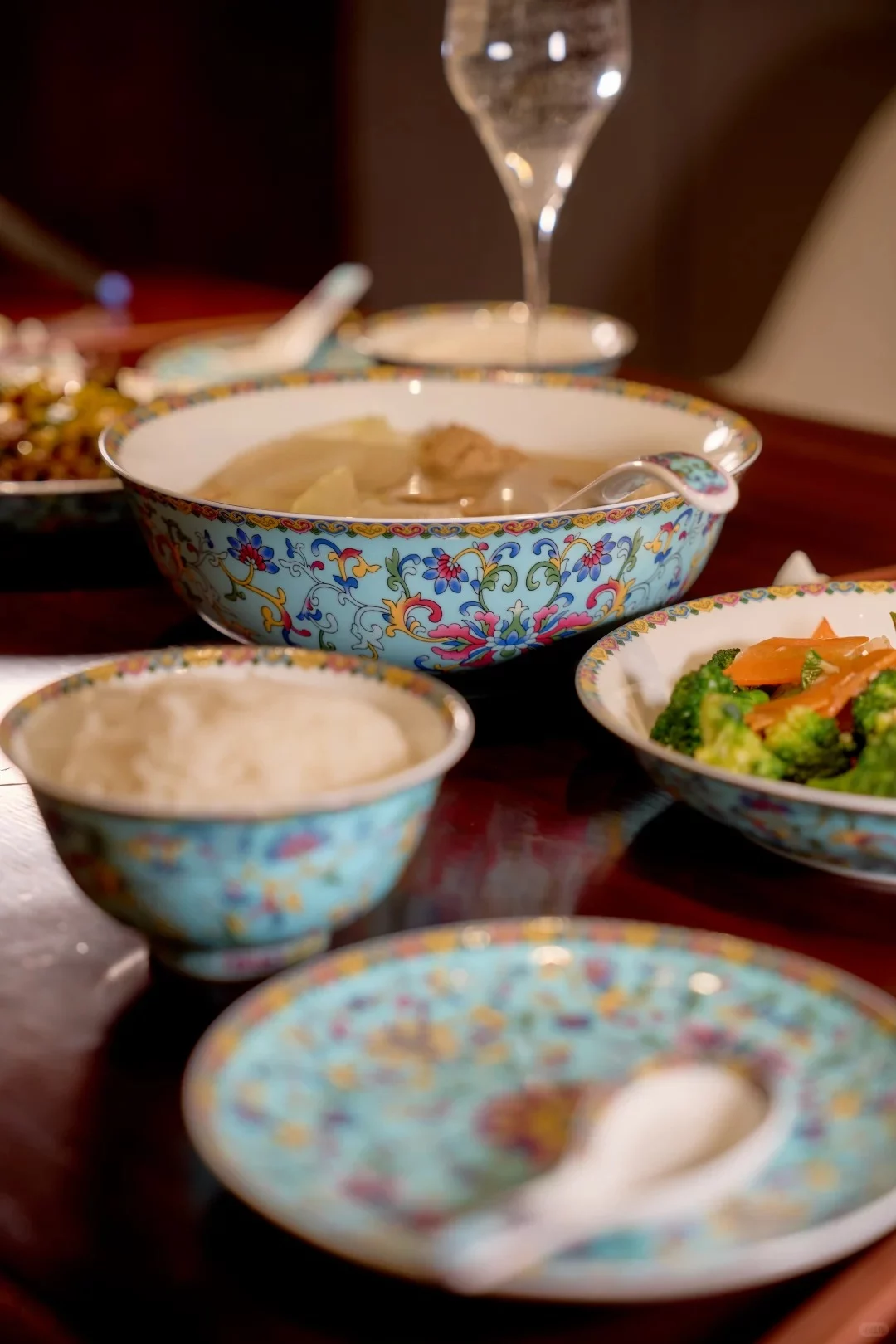
A serving bowl with its ladle, rice bowls, deep plates and spoons make up this falangcai dinner service, each wrapped in turquoise enamel and lotus scrolls. Painted in our Jingdezhen factory, it goes to ceremonial gift programs and private dining rooms, boxed by the place setting.
Falangcai · Imperial Wucai & Painted Porcelain Collection
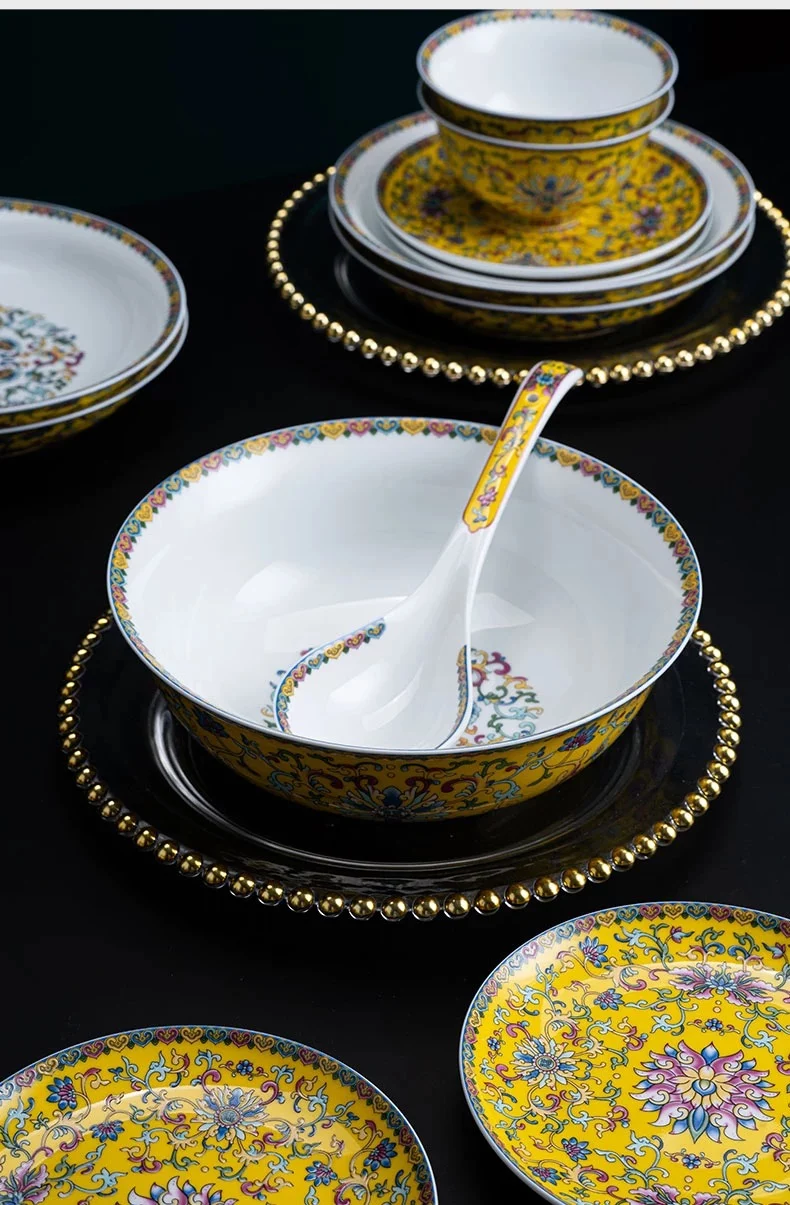
A single lotus opens at the bottom of the large bowl in this yellow-ground service, and lotus scrolls run around every plate and bowl beneath a cloud-head rim. It is enameled by hand at our Jingdezhen porcelain factory, and gift programs order it as a full service.
The name means "foreign colors". Falang was the Chinese word for the painted enamels on copper that arrived from Europe in the seventeenth century, and the Kangxi emperor liked them enough to set up workshops in Beijing to make his own. His enamelers then tried the same colors on white porcelain sent up from Jingdezhen. The result was small, costly work for the court, painted as carefully as a jewel box.
What sets it apart today is density. Where famille rose leaves open white around a flower, falangcai tends to fill the surface: a solid colored ground, scrolls packed edge to edge, hairline strokes and several greens in a single leaf. On the peony panel cup, the dense floral ground is broken by one framed white panel, and the pink peony inside it reads like a picture seen through a window. A turquoise band runs around the tall foot.
The two dinner services carry the same idea across a whole table. Both are painted with lotus scrolls and finished with a cloud-head border at the rim, and the ground color does most of the talking. The turquoise service is cool and bright, with the insides of the bowls left white. The yellow-ground service is warmer and more formal, with a lotus medallion waiting at the bottom of the bowl.
Every motif is drawn out in advance, and every stroke is still freehand. So a falangcai order starts on paper: the drawing is agreed first, then a painted sample, and changes are marked on the drawing before the next one. For a gift program, send the brief three to four months ahead of the date the pieces have to be in hand.
Where falangcai sits among the painted styles, and how its enamels are fired, is set out in our porcelain decoration guide.
Who makes it
Falangcai is painted in Jingdezhen, partly in heritage studios working under KKCN's quality control, on porcelain first fired at about 1,300 °C and refired at about 780–850 °C. Li Qiusheng's team examines each piece at close range against the approved sample, and He Jiang and the master artisans review every one-of-a-kind piece.
Custom orders
Process
Choose a reference or send your own design.
Approve a fired sample or photos before production.
Inspected, packed and shipped from Jingdezhen.
FAQ
Look at how much white is left. Famille rose usually sets a soft, shaded motif on an open white surface. Falangcai tends to cover the piece, with a solid ground in turquoise, yellow or pink and fine scrolls filling the gaps, and it often adds a short poem and a seal mark beside the picture. Falangcai also takes more hours at the brush, which shows in the price.
Usually not. Services like these are bought for banquets, private dining rooms, ceremonial gifts and display cabinets, where they come out for an occasion and go back behind glass. The enamel sits on top of the glaze, so they are washed by hand rather than in a dishwasher. If a service will see daily use, ask about a simpler pattern; test reports for daily-use pieces are listed on Quality Control.
Yes. A limited run is painted from a drawing made for you, kept confidential and never painted for another client. Editions start from 50 pieces per style, and a single one-of-a-kind piece is quoted on its own. The approved piece and its drawing stay at KKCN's Jingdezhen headquarters for the whole edition, so a piece painted at the end matches one from the start.
Yes. Any form we make in white porcelain can be painted in falangcai. A new teapot shape needs its own mold, and a new mold or original pattern takes 30–45 days.
Wash it by hand in warm water with a mild soap and dry it with a soft cloth. Overglaze enamel sits on top of the glaze, so abrasive pads and long dishwasher cycles will dull it over time.
Order minimums, samples and shipping are covered on Samples & Quotations and Packing & Shipping. Technique names on this page are defined in our Chinese porcelain glossary.
Send a photo, a sketch or a size, and we will tell you which reference comes closest or quote it as a custom piece.
Product inquiry
Share the PP numbers, quantity, destination and any customization. We reply within 1–2 business days.