Resources
Buyer guides from Jingdezhen
Ten guide collections on sourcing, craft and selling Chinese porcelain, written by our export team.
Browse all guides ↗ Resources
Buyer guides from Jingdezhen
Ten guide collections on sourcing, craft and selling Chinese porcelain, written by our export team.
Browse all guides ↗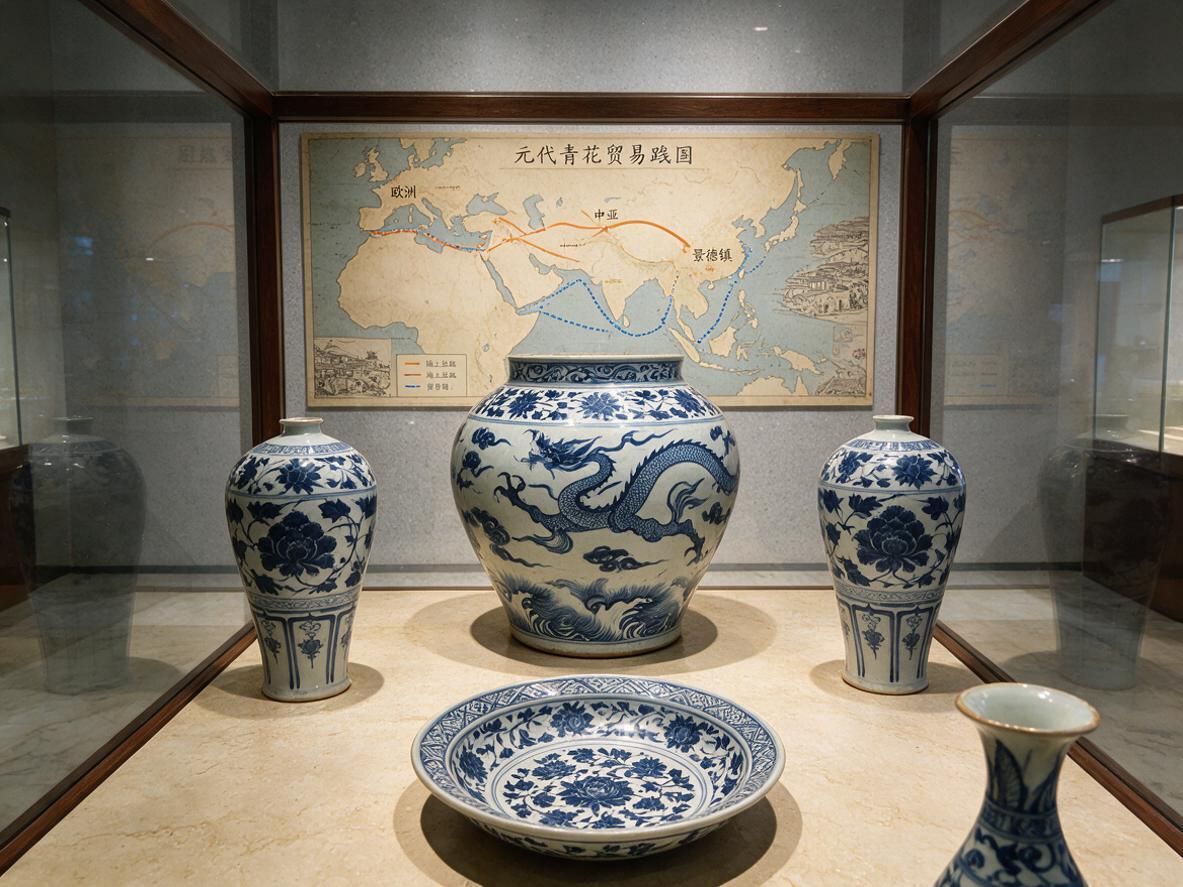
Under Mongol rule
From 1271 to 1368, a porcelain bureau at Jingdezhen, a stronger body and imported cobalt produced the great painted jars and dishes that reached palaces from Delhi to Istanbul.
1271 to 1368
Kublai Khan ruled China from Dadu, today’s Beijing, at the center of an empire whose roads ran overland to Persia and whose ships sailed from Quanzhou into the Indian Ocean. In 1278 the court set up the Fuliang Porcelain Bureau at Jingdezhen to oversee wares for official use. Jingdezhen potters were by then adding kaolin to their porcelain stone, a change told in full on our history overview, and the stronger body took larger forms. Cobalt shipped from Persia gave painters a blue that held through the high firing, and they filled jars and dishes with stacked bands: lotus panels, waves, dragons, fish among water weeds, and scenes from the plays staged in Yuan cities. Longquan celadon and qingbai still filled most cargoes, but blue and white was the ware that changed what the world expected of Chinese porcelain.
Dates · 1271–1368 | Centers · Jingdezhen, Longquan and the port of Quanzhou | Signature · underglaze cobalt, copper red, shufu white, large export dishes
Four new directions
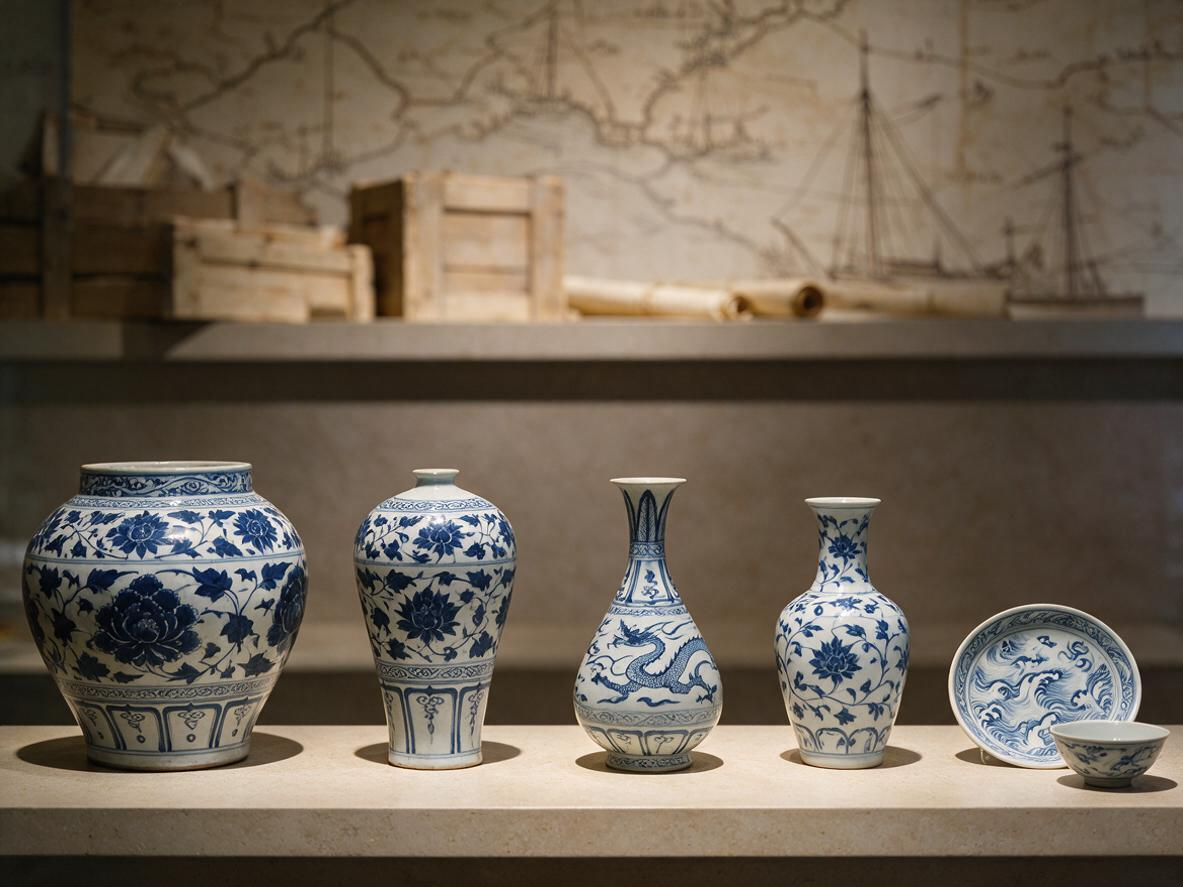
All four began at Jingdezhen within about seventy years, and the Ming imperial kiln took up every one.
01
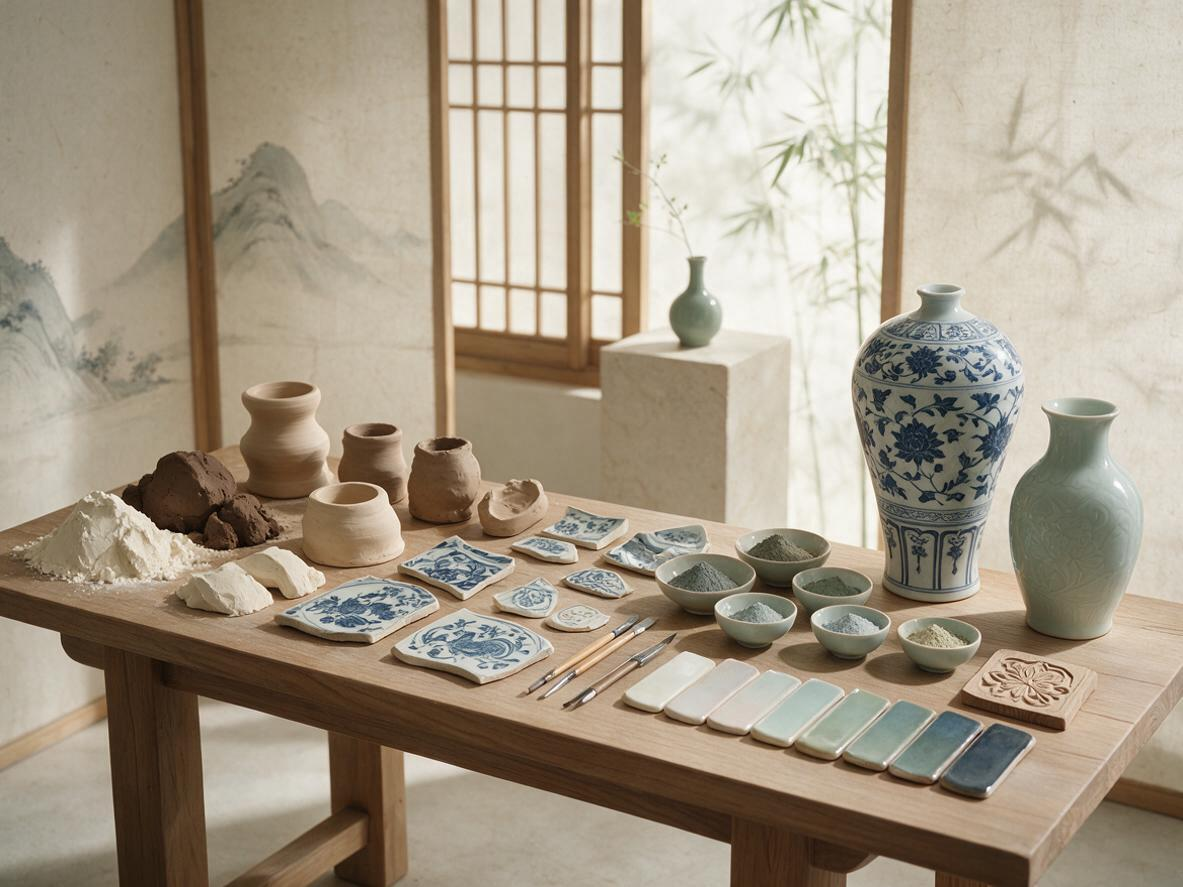
Painters brushed imported cobalt onto the raw porcelain and fired it once under clear glaze. Its iron left dark specks wherever the brush paused, a mark Qing painters later imitated with deliberate dots.
02
Copper painted under the glaze needed a reducing flame and exact heat to stay red instead of fading to gray. Yuan potters made it work, sometimes on the same jars and dishes as cobalt.
03
Shufu ware, named for the military Privy Council that ordered it, had an opaque, egg-white glaze with the characters shu and fu molded inside. Its smooth white set the standard for the court white of the early Ming.
04
For buyers in Persia and the Middle East, Jingdezhen made dishes 40 to 46 centimeters across, wide enough to serve a whole table. Painted bands in rings around the well held the design together at that scale.
In the galleries
Look for dark iron specks in the blue, panels stacked from neck to foot, and the sheer width of the dishes.
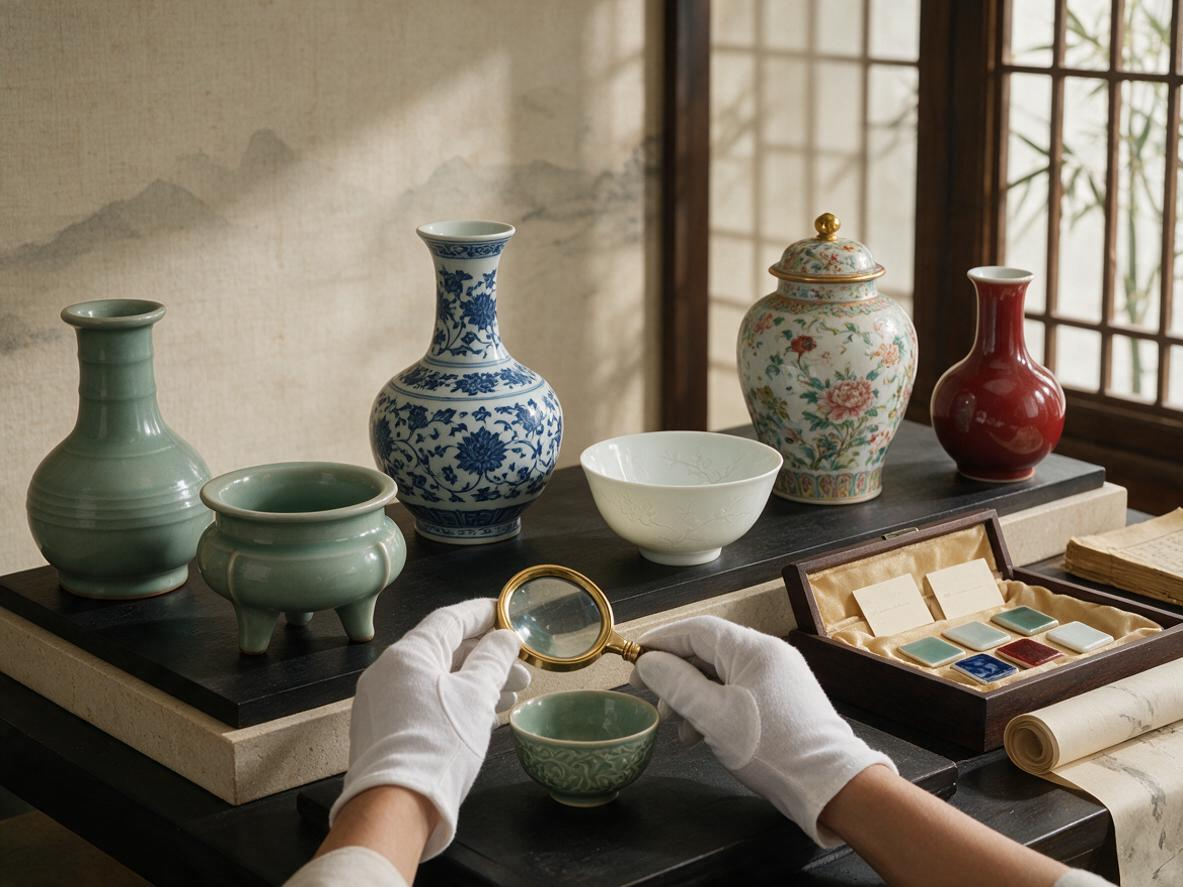
A wide dish painted in deep cobalt with a carp among water weeds in the well and a wave border on the rim. Dishes this size were made for communal meals in Persia and the Middle East. Mid-14th century.
A broad-shouldered jar with a slender dragon chasing through clouds, framed by bands of lotus panels at shoulder and foot. Yuan painters filled every zone and left little white ground. Mid-14th century.
A small bowl under an opaque, egg-white glaze, with flowers and the characters shu and fu molded faintly inside. Made for the Privy Council, it shows the white porcelain the Yuan court ordered. 14th century.
Yuan blue and white was painted for only a few decades before 1368, yet it set the look of Chinese porcelain for centuries. These are the features specialists use to tell it apart.
Our Blue & White Porcelain Series is painted the same way today, cobalt on raw clay, fired once at 1,280–1,330 °C.
| Feature | What to look for |
|---|---|
| Cobalt | Imported cobalt that fires a deep violet-blue, with dark specks where the pigment gathered |
| Layout | The surface divided into bands, with a main scene between borders of waves, petals and scrolls |
| Motifs | Dragons, phoenixes, fish among water plants, peony and lotus scrolls, and scenes from plays |
| Forms | Large dishes over 40 cm across, meiping vases and big guan jars, many made for the Middle East |
| Base | Unglazed, often showing orange-red patches where iron in the body burned in the kiln |
| Shufu ware | A matte, egg-white glaze, some pieces molded with the characters shu fu |
Carried forward
Blue and white is our flagship export series, and every piece in the Blue & White Porcelain Series is painted by hand in our Doufunong workshops. Our porcelain body is still blended from kaolin and porcelain stone, sourced from the Yaoli and Gaoling Village areas. Painting still comes before the glaze, as it did under the Yuan, and our glazing and decoration page shows the order of work.
Painting cobalt under the glaze in our Doufunong workshops.
01
PP-023 is a wide-rim plate painted in cobalt with a pavilion, pine and bamboo inside a flowering-branch rim. Like a Yuan dish, it is built in zones: well, rim and edge band. It ships from stock.
02
Copper painted under the glaze and fired in reduction at Doufunong, alone or beside cobalt on one piece. A copper-red lion cup and a blue-and-red lotus gaiwan are in stock today.
03
Commission a jar, vase or dish in your own motif. Our designers redraw it for the form you order, and the cobalt tone is approved on a painted sample before the run.
Yuan questions
Song before, Ming after
Later era
Imperial blue and white, Doucai and export to Europe, 1368–1644.
All eight eras
The full timeline, with Yuan as chapter five.
Commission in cobalt
Send the motif, the form and the size, from a tea cup to a dish wide enough for a banquet table. Lin Wan replies within 1–2 business days with the painting route, the sample plan and a price. hejiang@knockingcn.com · WhatsApp +86 197 1171 3584