Resources
Buyer guides from Jingdezhen
Ten guide collections on sourcing, craft and selling Chinese porcelain, written by our export team.
Browse all guides ↗ Resources
Buyer guides from Jingdezhen
Ten guide collections on sourcing, craft and selling Chinese porcelain, written by our export team.
Browse all guides ↗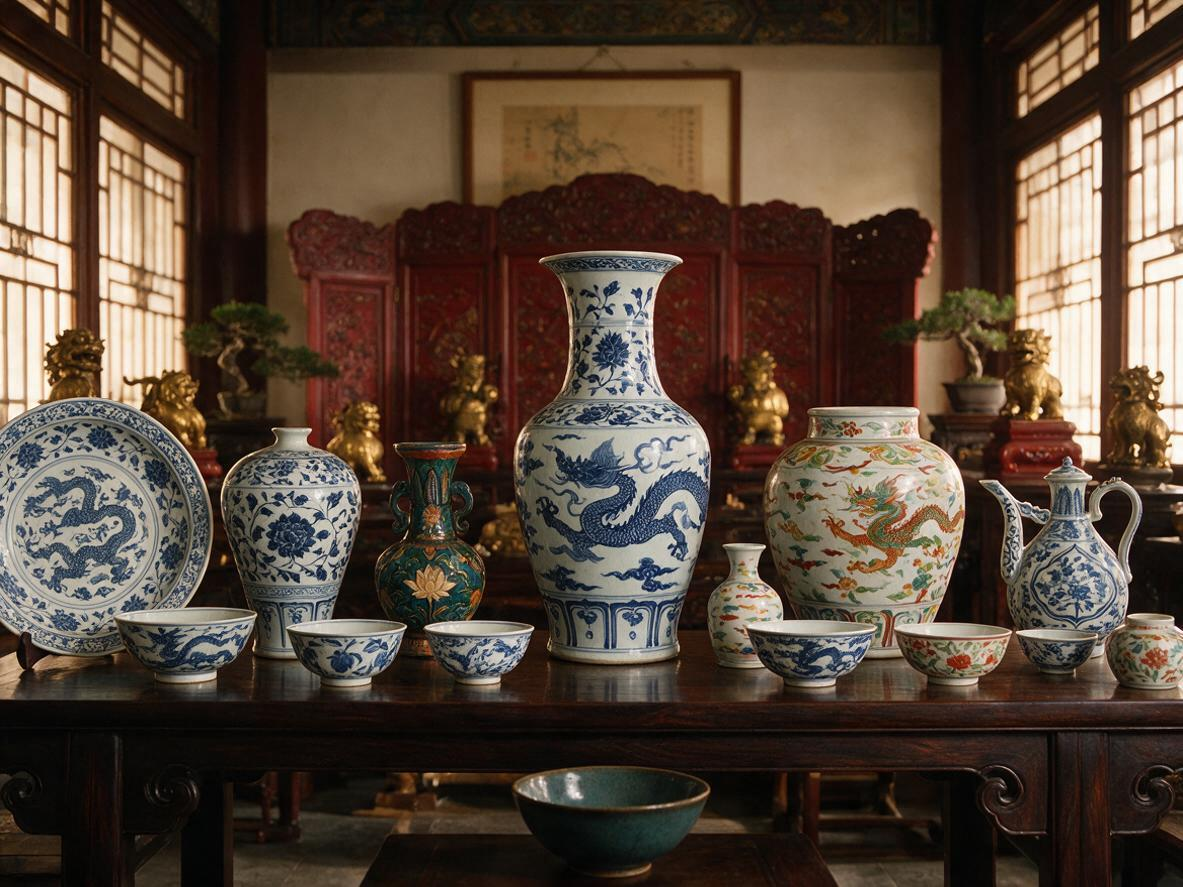
Court orders, global cargoes
From 1368 to 1644, Jingdezhen made the court's porcelain to patterns sent from the palace, painted Chenghua's delicate enamel cups and filled the ships that carried Chinese porcelain to Lisbon and Amsterdam.
Ming · 1368–1644
1368 to 1644
The Ming founder Zhu Yuanzhang took the throne in 1368, and early in the dynasty the court set up an imperial kiln in Jingdezhen, a story our history overview tells. Around it grew a city of private kilns where every worker was trained to one task: some mixed clay, some threw, some painted only rims, some fired. In 1637 the scholar Song Yingxing wrote that a single cup passed through seventy-two hands before it was finished. The court sent designs and inspectors, and imperial rejects were smashed and buried on the kiln site, where archaeologists still recover them. Blue and white became the dynasty’s signature, joined by copper red, monochrome glazes and enamel painted over the glaze. From the 1550s, Portuguese and then Dutch traders opened a sea route that brought Jingdezhen porcelain to European tables.
Dates · 1368–1644 | Centers · the imperial and private kilns of Jingdezhen; trade through Macau | Signature · imperial blue and white, sweet white, Doucai, Wucai, kraak export ware
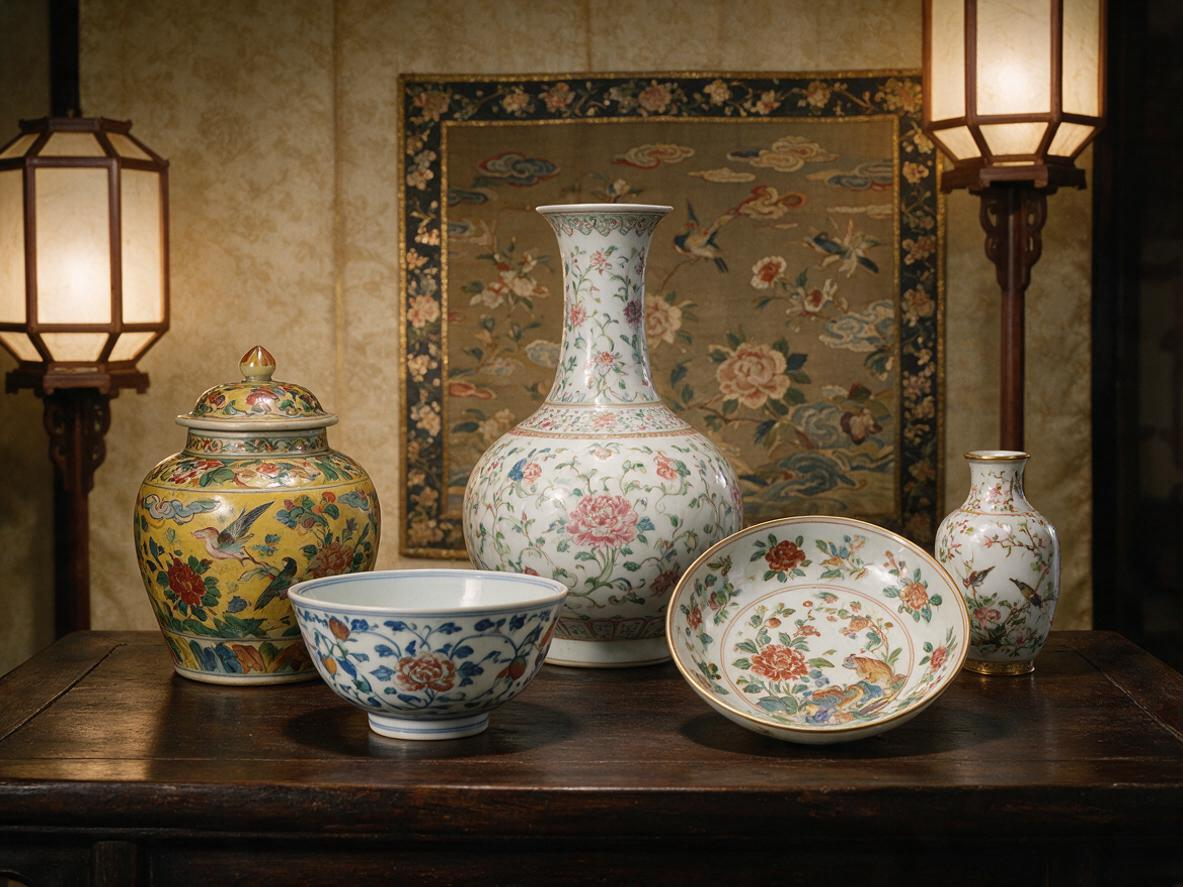
Four Ming refinements
Each belongs to a reign, which is still how collectors date Ming porcelain.
01
Under the Yongle emperor (1403–1424), Jingdezhen made a porcelain so thin and warm in tone it was called tianbai, sweet white. Faint designs, seen only against the light, were incised beneath the glaze, a technique called anhua.
02
In the Xuande reign (1426–1435), potters fired a deep monochrome copper red for altar vessels and painted imported cobalt in rich, dark-spotted blues. Many collectors rank Xuande blue and white as the finest the dynasty made.
03
The Chenghua court (1465–1487) favored small, delicate pieces, including wine cups with hens and chicks outlined in blue under the glaze and colored over it. Qing emperors had these chicken cups copied, and collectors count them among the rarest Ming porcelain.
04
After the Portuguese settled at Macau in 1557, Jingdezhen began painting blue and white for European buyers. When the Dutch auctioned a captured Portuguese cargo in Amsterdam in 1604, demand across northern Europe took off.
Dated by reign
Ming pieces are read reign by reign: by the shape, the tone of the blue and the mark on the base.
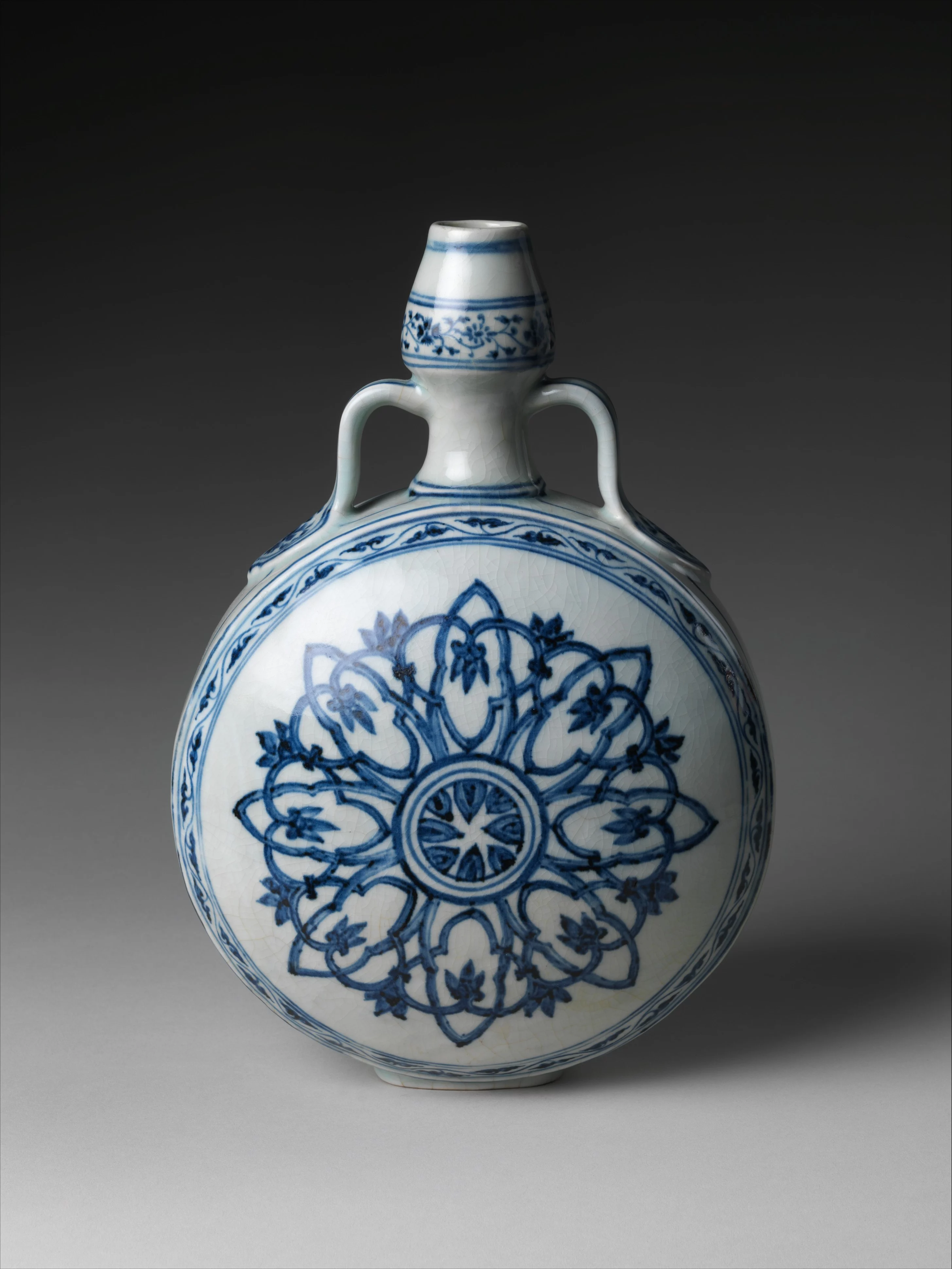
A flat, round-bodied flask with two loop handles, painted in dark-spotted cobalt. Its shape follows metal flasks from the Islamic world, a reminder of the envoys and sea voyages of the Yongle court. 1403–1424.
Image: The Metropolitan Museum of Art, public domain (CC0).
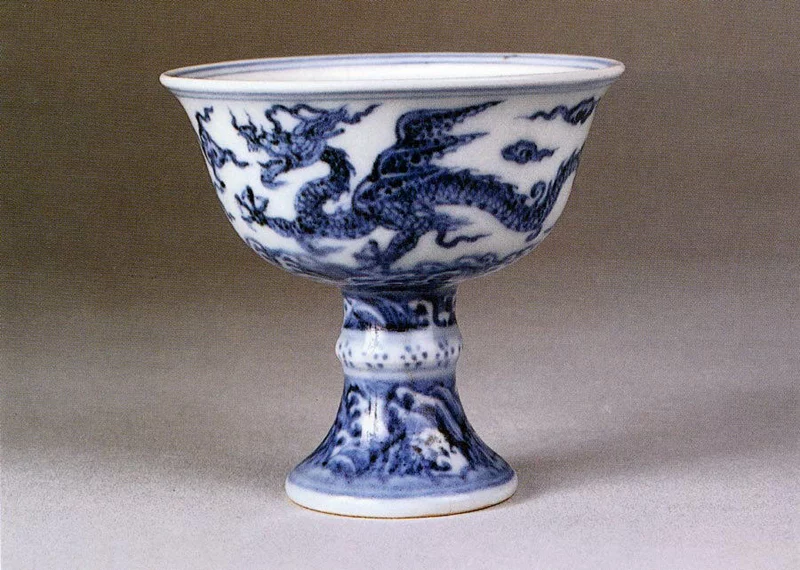
A cup on a tall hollow foot, painted in cobalt with dragons among waves and marked with the six-character reign mark. Xuande pieces were among the first to carry a reign mark as a regular practice. 1426–1435.
Image: The Metropolitan Museum of Art, public domain (CC0).
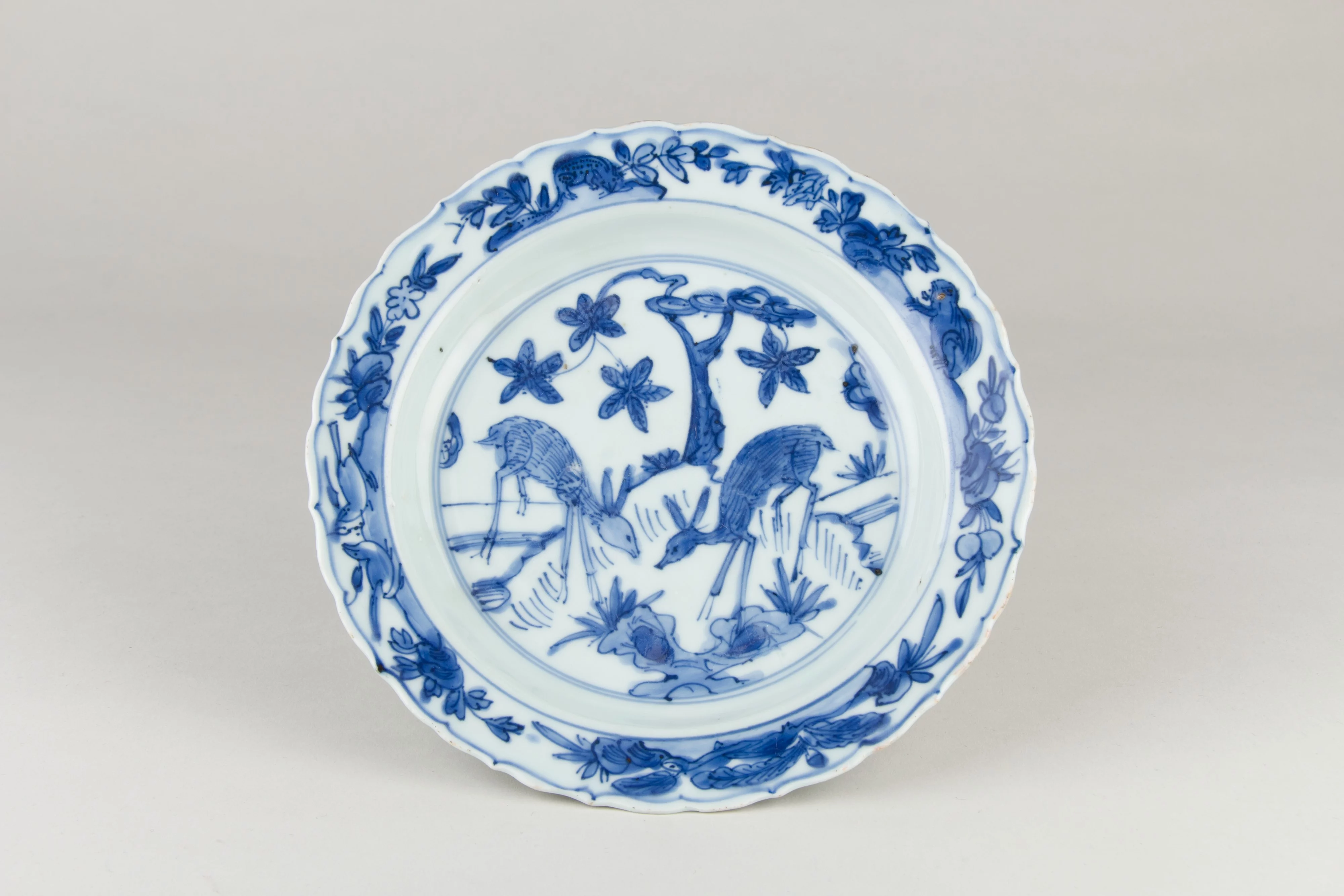
A thin dish with a deer in a landscape at the center and a border of radiating panels filled with flowers and symbols. Painted for Portuguese and Dutch buyers, it set the layout Europe came to expect. 1573–1620.
Image: The Metropolitan Museum of Art, public domain (CC0).
Ming porcelain is read reign by reign, and the blue is often the first clue. The mark comes last, because later potters copied Ming marks freely.
How each painted style is made today is in our guide to Chinese porcelain decoration techniques.
| Reign | What to look for |
|---|---|
| Yongle, 1403–1424 | Thin sweet-white porcelain, faint anhua decoration, dark-spotted imported cobalt; marks are rare |
| Xuande, 1426–1435 | Rich, heaped cobalt, copper-red monochromes and the six-character reign mark used regularly |
| Chenghua, 1465–1487 | Small, delicate pieces in a soft, even blue, and the first doucai cups |
| Jiajing, 1522–1566 | Bright purplish blue and bold wucai enamels, often with Daoist motifs |
| Wanli, 1573–1620 | Kraak ware for Europe, with paneled borders, and blues ranging from vivid to grayish |
Carried forward
Our Imperial Wucai & Painted Porcelain Collection paints Wucai and Doucai to commission in our Jingdezhen workshops: the cobalt outline is fired first, and the enamels are fixed in a second firing at about 780–850 °C. The imperial kiln’s reject heap has a modern equivalent at our final selection table, where every piece outside the signed range is pulled and never packed.
Outlining in cobalt before the glaze, Doufunong.
01
Jars, vases, tea ware and hotel tableware, painted by hand in cobalt and fired once at about 1,300 °C. The chrysanthemum scroll jar (PP-022) and the flower scroll dish (PP-024) are in stock today.
02
Bold Wucai color over a cobalt outline, or the finer Doucai fill, painted to your commission. Fully hand-painted work takes 45–60 days, and He Jiang reviews high-end handmade pieces before they ship.
03
PP-016 is a flared tea cup painted in copper red with lions among scrolling clouds and fired once in reduction at our Doufunong kilns. A single cup ships from stock.
Common Ming questions
Yuan before, Qing after
All eight eras
Where Ming sits among all eight eras.
Commission a Ming piece
Send a museum photo of the Ming piece you admire, or name the reign whose style you want, with the quantity and destination. Lin Wan replies within 1–2 business days with the painting route, the sample plan and a price. hejiang@knockingcn.com · WhatsApp +86 197 1171 3584