
Resources
Buyer guides from Jingdezhen
Ten guide collections on sourcing, craft and selling Chinese porcelain, written by our export team.
Browse all guides ↗ Resources
Buyer guides from Jingdezhen
Ten guide collections on sourcing, craft and selling Chinese porcelain, written by our export team.
Browse all guides ↗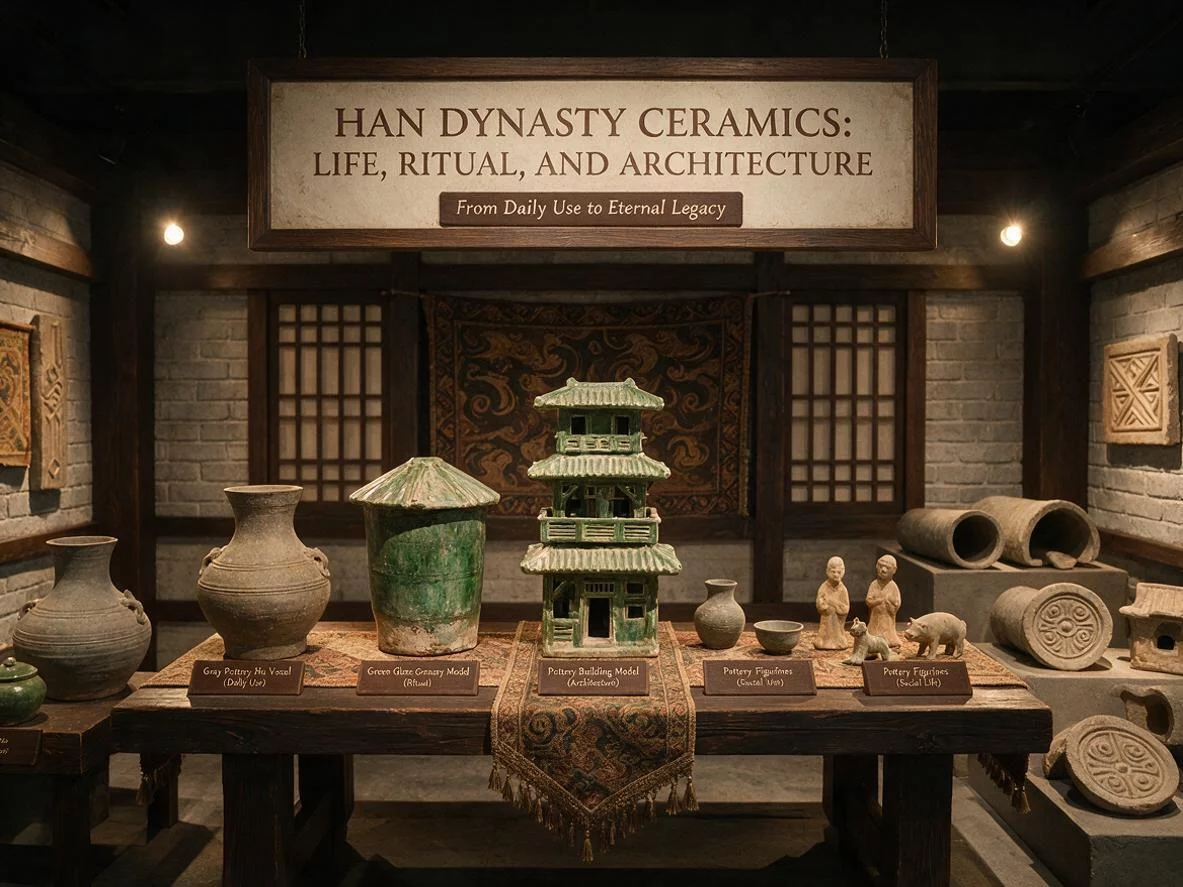
Lead glaze, then celadon
Four centuries in which potters glazed earthenware for burial, molded roof tiles for palaces and, by the end, fired the first true celadon in Zhejiang. The celadon our Jingdezhen factory makes today descends from that last step.
206 BCE to 220 CE
Han tombs were furnished as households for the dead, and potters supplied the furniture. Earthenware granaries, wells, stoves, watchtowers, pigsties and houses of several stories went into the ground, many covered in a lead glaze that fired green from copper or amber from iron. Burial has since turned many of those greens a silvery, iridescent gray. Above ground, Han builders roofed palaces with molded tile ends carrying animals and auspicious characters, and lined tombs with stamped pictorial bricks. The imperial mausoleums near Xi’an held thousands of small painted figures. The greater change came late. In the Eastern Han, kilns around Shangyu in Zhejiang fired an iron-bearing glaze in a reducing flame at close to 1,300 °C and produced a hard gray-green ware with the glaze fused to the body: the first mature celadon, and the ancestor of every celadon since.
Dates · 206 BCE–220 CE | Centers · Chang’an and Luoyang, Shangyu in Zhejiang | Signature · green lead glaze, tomb models, early celadon
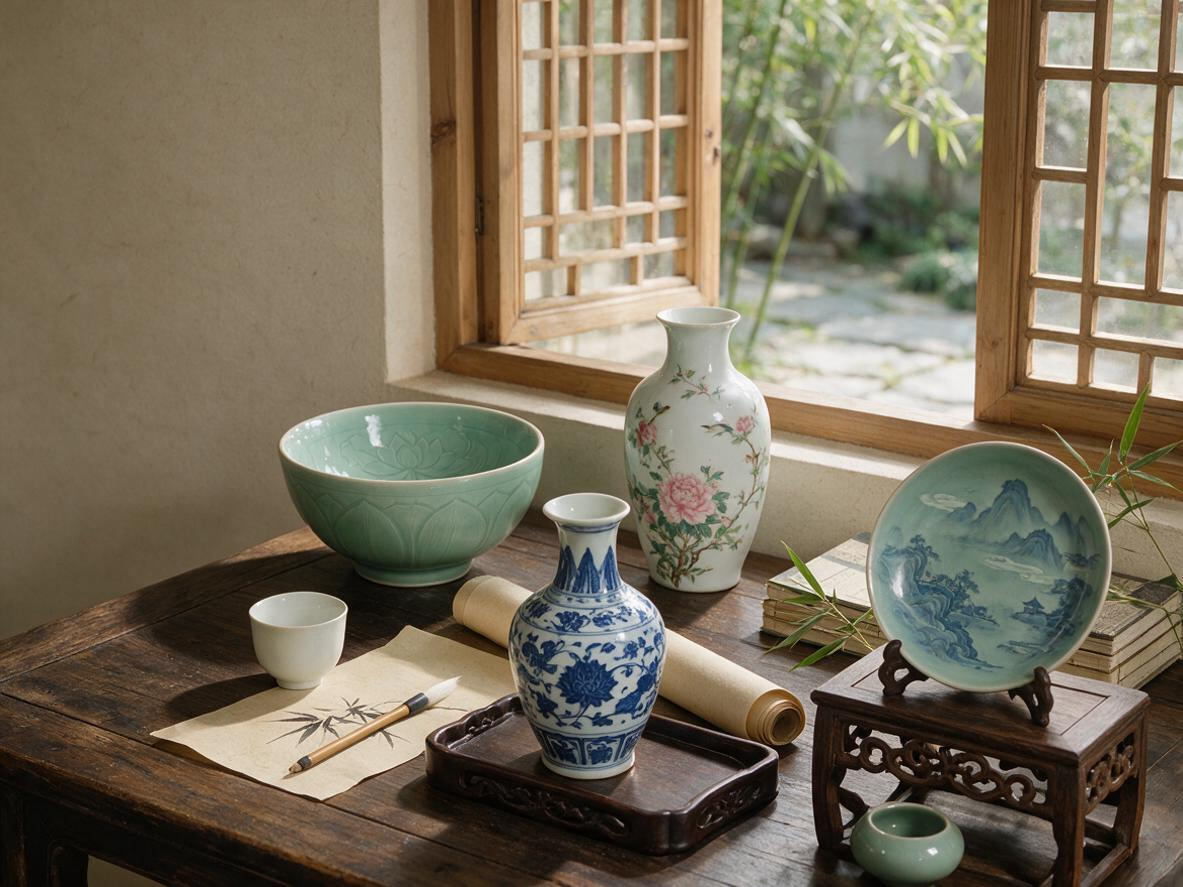
What Han potters added
01
A glaze fluxed with lead melts at a low heat, around 800 °C, and takes color easily: copper for green, iron for amber. Han potters spread it over earthenware vessels and models, the first glazed ware made in quantity.
02
Tile ends, bricks and figures were pressed from molds, so one design could repeat across a palace roof or a whole tomb. Workshops joined molded parts to hand-modeled detail, a method potters still rely on.
03
Han potters built in miniature what carpenters built in timber: houses, towers and courtyards with bracketed eaves, often several stories high. These models are now among the best records of Han architecture.
04
Late Eastern Han kilns in Zhejiang starved the fire of oxygen near 1,300 °C, turning iron in the glaze gray-green and fusing glaze to body. The result, early Yue celadon, opened the high-fired green tradition.
Three pieces to know
Look at the glaze where it pooled under the eaves: deep green in places, silvery where burial has weathered it. The tiers, balconies and tiny figures were modeled separately and joined before firing.
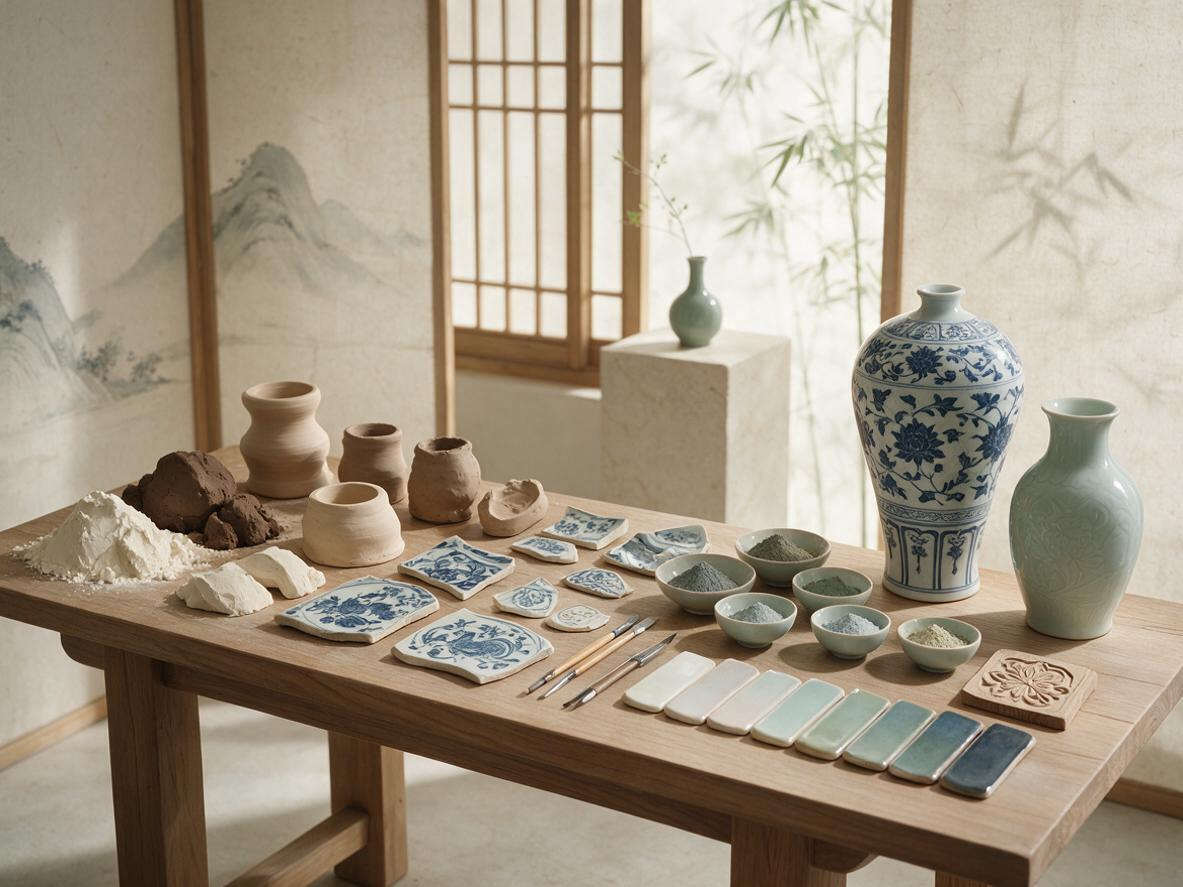
Look at the four characters around the central boss, pressed from a mold and fired gray. Tile ends like this capped the rafters of Han palaces and wished the household lasting joy.
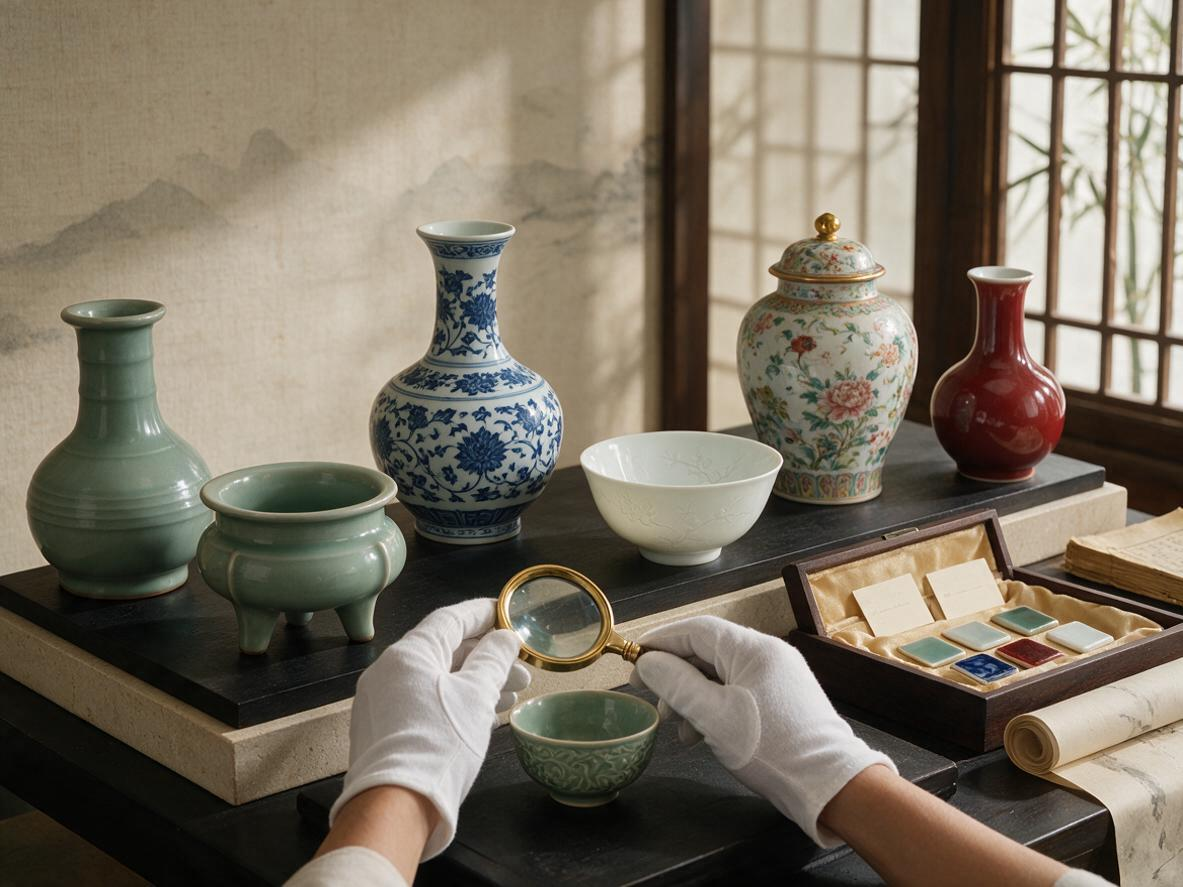
Look at the thin gray-green glaze on the shoulder, fused to a hard gray body and pooling darker in the incised lines. This is celadon at its beginning, nearly eight centuries before the Song.
Han ceramics were made largely for tombs, as stand-ins for the things a household would need in the next life. These are the features that set them apart.
| Feature | What to look for |
|---|---|
| Body | Gray or red earthenware, often molded, with high-fired stoneware in the southeast |
| Glaze | Lead glaze colored green by copper or amber by iron, often weathered to a silvery sheen |
| Forms | Models of houses, towers, granaries, wells, pigsties, animals and figures, and hu jars shaped like bronzes |
| Decoration | Molded friezes of hunting scenes, animals and mountains in bands around jars |
| Proto-celadon | A thin greenish ash glaze on stoneware jars from the Yue region, an early step toward celadon |
Carried forward
Both of Han’s glazes are still fired today, and both reach buyers through KKCN. The high-fired line that began at Shangyu runs through Song celadon to our Celadon Legacy Series, thrown, glazed and fired in Jingdezhen in a reducing flame, the same way iron still turns green. The low-fired lead glaze that colored Han tomb models became Tang Sancai, which we make and fire in-house and inspect at our headquarters. Firing is where the two part ways: around 1,300 °C for celadon, far lower for a lead glaze.
A natural-gas kiln at work in our Doufunong workshop.
01
Song-style jade glazes, Ru, Ge and Jun among them, fired in our own kilns: the Celadon Legacy Series carries the Shangyu line into tea rooms, hotel lounges and homes.
02
Why iron fires green only when the kiln is starved of oxygen, and how each order’s firing curve and atmosphere are recorded so the next run matches the first.
03
Tang Sancai horses, jars and dishes keep the Han palette of amber and green, glazed by our own kiln team and inspected one by one in Jingdezhen.
Han ceramics questions
Before and after Han
Commission in green
A granary jar, a tile-end roundel or a watchtower silhouette can become a vase, a tea caddy or a display piece. Tell us whether you see it in jade celadon or in amber and green. Lin Wan replies within 1–2 business days with the route and a sample plan.