Resources
Buyer guides from Jingdezhen
Ten guide collections on sourcing, craft and selling Chinese porcelain, written by our export team.
Browse all guides ↗ Resources
Buyer guides from Jingdezhen
Ten guide collections on sourcing, craft and selling Chinese porcelain, written by our export team.
Browse all guides ↗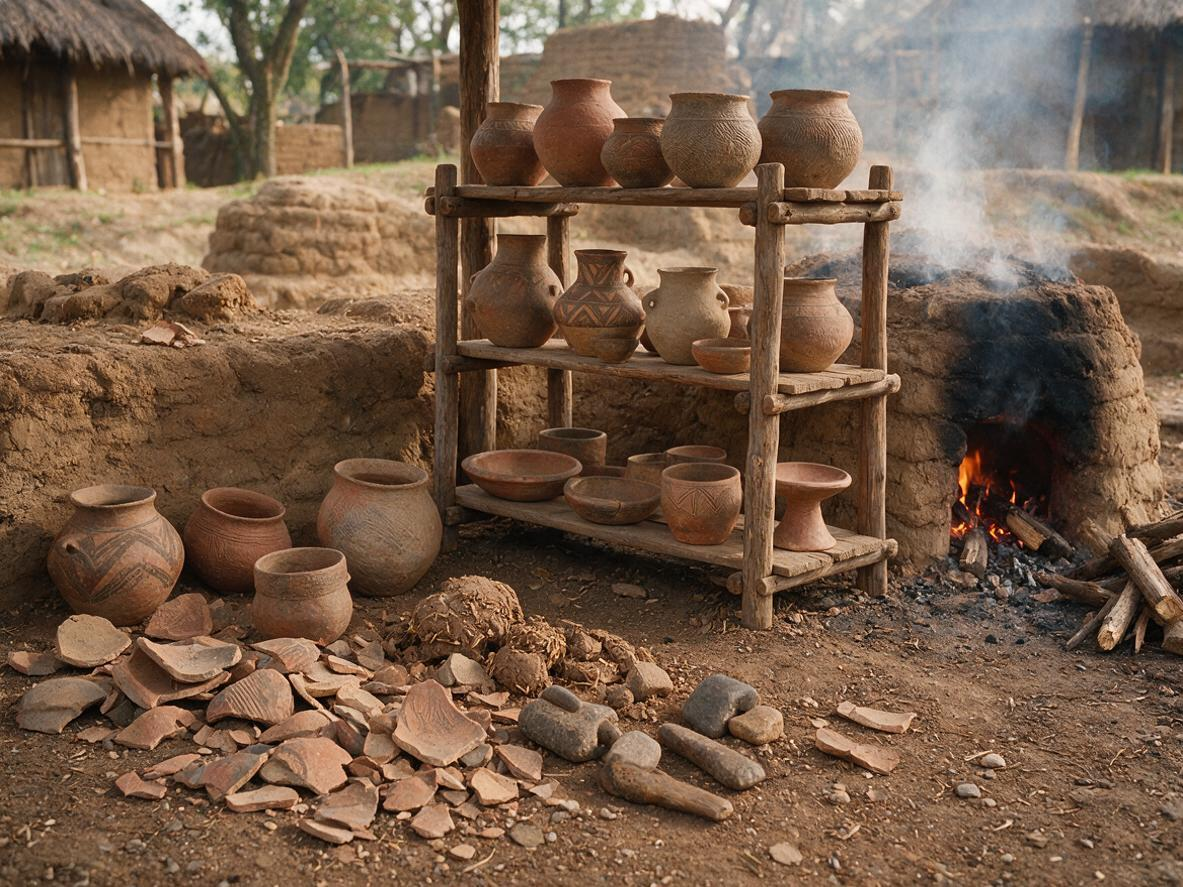
Clay before porcelain
Twenty thousand years of hand-built pots, painted jars, wheel-thrown black cups and the first glazed stoneware, all made before porcelain had a name.
Early Pottery · before 206 BCE
Neolithic to Qin
Some of the oldest pottery found anywhere comes from Xianrendong Cave in Wannian County, Jiangxi, the province Jingdezhen belongs to. Its sherds, dated to about 20,000 years ago, come from cooking pots shaped by hand from local clay and fired in an open hearth. Over the following millennia, farming villages along the Yellow and Yangtze rivers turned pottery into a regional language. Yangshao potters painted red bowls with fish and human faces. Majiayao potters in Gansu swept spirals across tall storage jars. Longshan potters in Shandong threw black cups on a fast wheel, with walls thinner than a millimeter. By the Shang dynasty, kilns in the south fired hot enough to melt a thin glaze onto hard stoneware, the first step toward porcelain. The era closes with the Qin terracotta army: thousands of life-size figures, molded, modeled and fired for one emperor’s tomb.
Dates · before 206 BCE | Centers · Jiangxi caves, the Yellow River and Yangtze valleys | Signature · painted red ware, eggshell black ware, proto-porcelain
What they worked out
01
Potters learned which local clays held a shape, survived a cooking fire or fired pale. Shang workshops at Anyang made a white pottery from clay rich in kaolin, the mineral at the heart of later porcelain.
02
Longshan potters in Shandong threw cups on a fast-turning wheel and pared the walls so thin that the type is called eggshell ware. Coiling, slab building and paddling carried on alongside it for everyday pots.
03
Before glaze, decoration came from mineral paint in red and black, cord marks pressed into wet clay, and surfaces burnished smooth with a stone. Majiayao jars carry painted spirals that still read clearly.
04
Open bonfires gave way to closed kilns that held their heat. By the Shang dynasty, southern kilns reached about 1,200 °C, hot enough to fuse wood ash into a thin glaze on a hard stoneware body.
Three pieces to know
Look at the spirals, brushed in black and red mineral paint around the shoulder where the jar is widest. The lower half is left plain, the usual arrangement on these storage jars.
Look at the rim and the stem: black, burnished and thrown so thin the cup weighs almost nothing. It remains one of the thinnest-walled vessels made anywhere in the ancient world.
Look at the olive-green skin on the shoulder, where wood ash melted into glaze in a high-fired kiln. The body is gray stoneware, not white porcelain, but the glazed, hard-fired body starts here.
Before glaze and before porcelain, Chinese potters worked with local clay fired in open pits and simple kilns. These are the features specialists look for first.
| Feature | What to look for |
|---|---|
| Body | Low-fired earthenware in red, gray or black, porous and unglazed |
| Painted pottery | Yangshao culture vessels painted in black and red pigments with spirals, fish and net patterns, about 5000–3000 BCE |
| Black pottery | Longshan culture ware with walls as thin as an eggshell, thrown on a wheel and burnished, about 3000–1900 BCE |
| Forms | Storage jars, basins and three-legged cooking vessels such as the ding and li |
| First glaze | High-fired stoneware with a thin ash glaze, called proto-porcelain, from the Shang and Zhou periods |
Carried forward
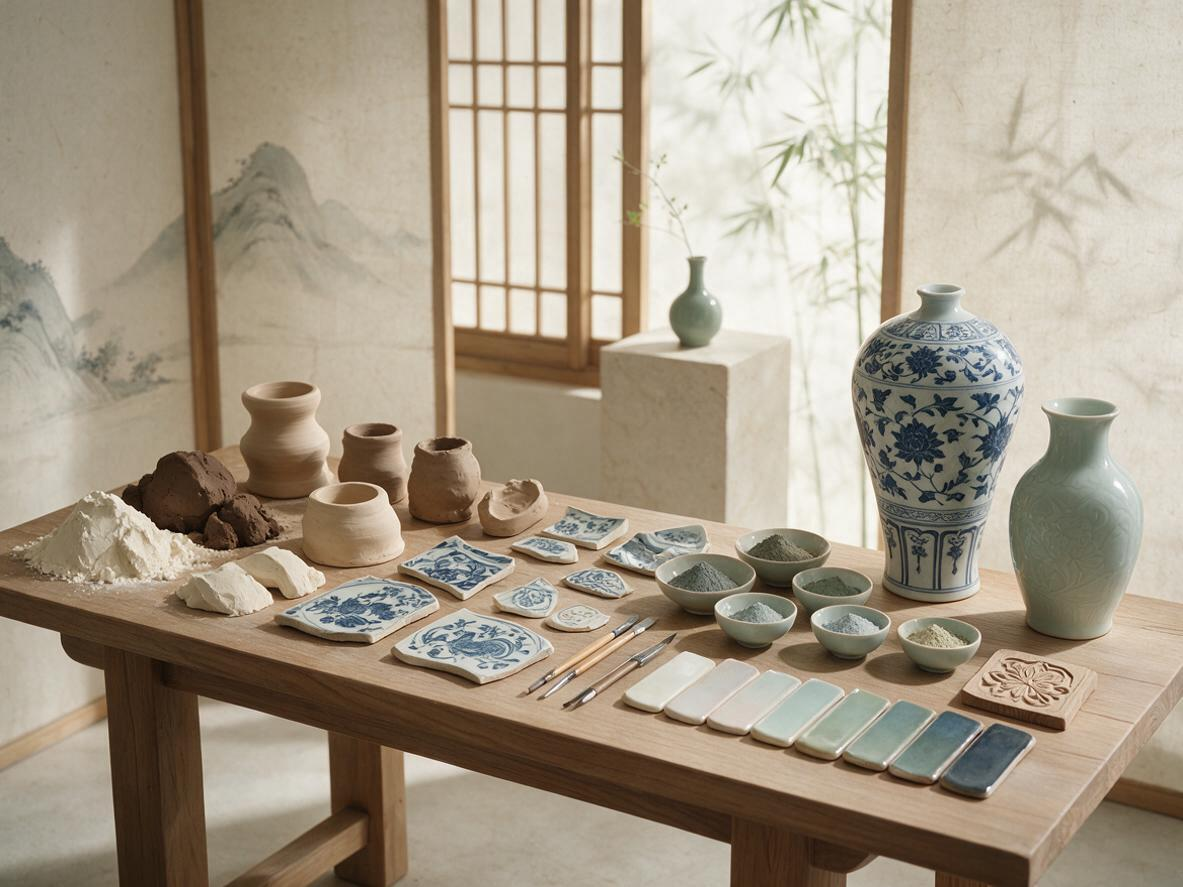
Every early lesson is still at work in our Doufunong workshops, in the same province where China’s oldest sherds were found. The body is still chosen for the piece it must become: our porcelain is blended from kaolin and porcelain stone sourced from the Yaoli and Gaoling Village areas. Round forms still rise on the wheel, as the Longshan cups did, and are trimmed by hand once leather-hard. The fire that first hardened clay in a cave hearth now runs in four natural-gas kilns at about 1,300 °C.
Porcelain clay being prepared in our Doufunong workshop.
01
Kaolin for strength, porcelain stone for glow: how each porcelain body is checked, blended and wedged by hand in our workshops before it reaches the wheel.
02
Round forms are thrown by hand in our Doufunong workshops; angular and complex shapes are cast or carved. Your quotation names the route for every piece.
03
Prefer a heavier, earthier body than porcelain? Our stoneware and earthenware lines come from heritage kiln partners, then are inspected and packed at our Jingdezhen headquarters.
Early pottery questions
Keep exploring
All eight eras
Eight chapters, from cave pottery to today.
Start from the past
A Majiayao spiral, the profile of a stem cup or a cord-marked texture can become a tea set, a vase or a gift line. Send a photo and the quantity. Our designers redraw the form for porcelain, and Lin Wan replies within 1–2 business days.