By Lin Wan, Foreign-Trade Lead at KKCN, Jingdezhen
Put three quotes for “bone china” side by side and the prices can differ by a factor of three. Sometimes that’s the brand, the decoration or the order size. Often it’s the material: one maker’s bone china may be nearly half bone ash, another’s very little. Bone china suppliers use the same two words for very different bodies, and the label isn’t policed the same way everywhere. This guide explains what bone china should contain, where it’s made and by whom, and how to check what you’re actually being offered.
Who wrote this. KKCN is a porcelain factory in Jingdezhen. We make porcelain, not bone china, so we have no product of our own to steer you toward here. The makers named below come from our supplier lists.
What should count as bone china
Bone china is a translucent, vitrified ceramic whose body includes bone ash, made from calcined animal bone, alongside kaolin and feldspathic stone. The traditional British definition, as summarized in standard references, is a translucent body containing at least 30% phosphate derived from calcined animal bone or calcium phosphate. Other countries set their own thresholds, and some sources cite figures as low as 25% and as high as 36%.
In practice, the label is used loosely. Noritake’s own Australian site has noted that the industry has no single enforced minimum, so ware with very different bone content can be sold under the same name. Some makers also sell mineral-based bodies developed to imitate bone china’s whiteness and translucency without animal bone; Zibo’s Huaguang, for example, has promoted a patented synthetic bone china. Those bodies can be excellent, but they are a different material, and in some markets the name may matter for labeling. The safe course is to ask every supplier for the bone ash content in writing.
Why it matters: bone ash gives the body its whiteness, translucency and strength at thin walls. Higher bone content generally means a whiter, more translucent piece, and well-made bone china is often more chip-resistant than its delicate look suggests, which is why hotels use it in lounges and fine dining.
Where bone china is made
Britain is where bone china was developed, and Stoke-on-Trent still makes it. Steelite, which bought the Stoke bone china maker William Edwards in 2020, now offers bone china alongside its hotel porcelain, and heritage names such as Royal Doulton and Wedgwood belong to Fiskars Group.
Japan turned bone china into an industrial product for hotels. Narumi says it was the first Japanese company to mass-produce bone china, in 1965, and launched its first hotel collection in 1975; NIKKO has made bone china since 1978; Noritake makes it in Japan and Sri Lanka.
Thailand and the Gulf have large hospitality plants that include bone china. Royal Porcelain’s Royal Bone China line uses 45% bone ash, according to the company’s trade-fair profile, and RAK Porcelain makes bone china in its Ras Al Khaimah plant.
China is now the world’s largest producer of bone china. Tangshan in Hebei is the best-known center; its makers have been reported to have combined capacity of more than 100 million pieces a year. Zibo and Linyi in Shandong, home to Huaguang and Yinfeng, Chaozhou in Guangdong and Shenzhen, where Stechcol has made bone china since 1989, are the other main centers. Our Chaozhou factory guide covers that city.
India has a growing bone china industry; Clay Craft in Jaipur makes both bone china and porcelain.
| Region | Known for | Makers on our lists |
|---|---|---|
| UK | Heritage patterns, fine dining | Steelite (William Edwards), Fiskars brands |
| Japan | Hotel and restaurant bone china | Narumi, NIKKO, Noritake |
| Thailand and UAE | Hospitality volume | Royal Porcelain, RAK Porcelain |
| China | Scale, price range from economy to premium | Tangshan makers, Huaguang, Yinfeng, Stechcol |
| India | Growing capacity | Clay Craft |
Bone china or porcelain for your range?
The choice isn’t simply good versus better. Each body suits different uses.
Bone china is whiter and more translucent, and it can be made thinner while staying strong, so it suits fine dining, hotel lounges, afternoon tea and premium gift sets. It generally costs more, and the price climbs with bone content. Because it contains animal bone, it isn’t suitable for buyers who sell to vegan customers, and some buyers selling into markets with religious dietary rules ask for the bone source in writing. If your customers ask those questions, a high-white porcelain may be the better answer.
Hard-paste porcelain, the kind made in Jingdezhen, Dehua and most hotelware plants, is fired at high temperature to a dense, vitrified body. It’s heavier at the same wall thickness, but it takes high-fired glazes, reactive and celadon finishes, and hand painting in a way bone china usually doesn’t. For colored glazes, handmade forms or a large decorative range, porcelain gives you far more choice.
Hotel porcelain sits between the two for many restaurants: a vitrified porcelain body with a reinforced rim, built for commercial dishwashers and stacking. Many restaurant groups use it for daily service and keep bone china for the lounge or the tasting menu.
What a bone china quote should include
A complete quote makes comparison possible. Ask every supplier to state:
- Bone ash content as a percentage of the body.
- Weight and wall thickness for the main items, so you can compare like with like.
- Decoration method, and for printed patterns whether the decal is on-glaze or in-glaze.
- Tests already done for your market, with the lab and the date.
- Minimums per shape and per pattern, and whether the pattern can be reordered later.
- Packing, since thin bone china needs more protection than heavier ware.
How to check what you’re buying
Get the bone ash percentage in writing. Put it in the quote and the purchase contract, not just in an email. If a supplier won’t state it, treat that as your answer.
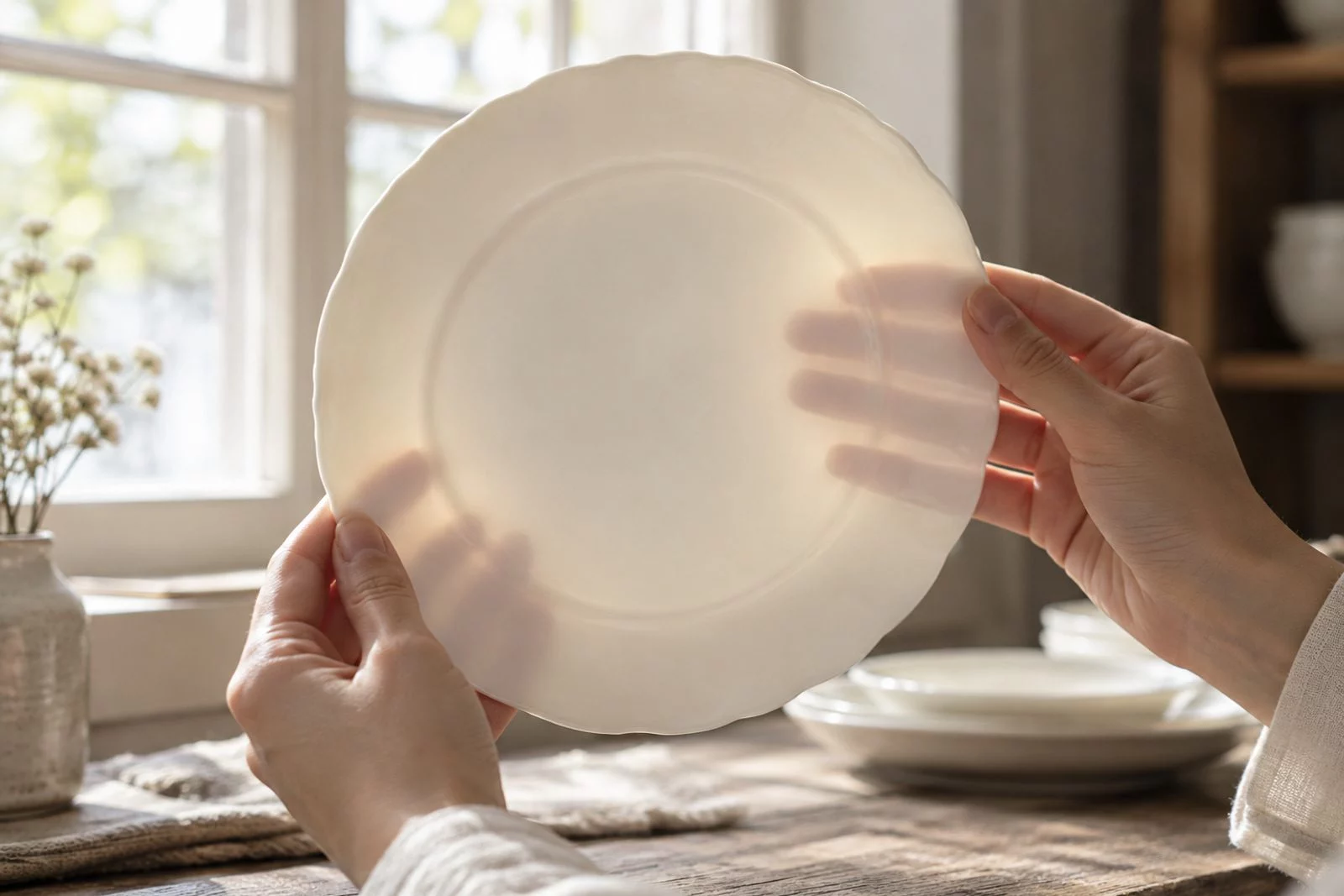
Look through it. Hold a sample plate rim up to a light. Good bone china shows clear translucency at the rim and an even white. Compare samples from each supplier against the same light. This is a quick comparison, not a test.
Test a sample. An accredited lab can analyze the body’s phosphate content if the label matters to your customers or your market. For hotel use, ask for chip-resistance and commercial dishwasher results as well, since a fine body still needs a reinforced rim to survive service.
Compare like with like. When quotes differ widely, line them up by bone content, wall thickness, decoration and test results before you compare prices. The scorecard in our ranking method gives you a structure for it.
Picking a supplier by order
For fine-dining restaurants and hotel lounges, Japanese and British makers set the standard, with Thai and Gulf plants offering hospitality bone china at larger volume. For gift sets and retail ranges at a sharp price, Chinese makers in Tangshan, Zibo and Chaozhou offer the widest choice, and that’s exactly where the written bone content matters most. If your range mixes bone china cups with hand-painted or reactive-glaze porcelain pieces, it’s common to source the two from different specialists and match them by color and form.
For the full lists, see the top ceramic suppliers in the world and Asia beyond China.
Lin Wan leads foreign trade at KKCN in Jingdezhen, coordinating buyers’ requirements, samples, orders and after-sales across Europe, North America, the Middle East and Southeast Asia. Ten years in ceramic export, working in English and Chinese.