By Lin Wan, Foreign-Trade Lead at KKCN, Jingdezhen
A US buyer of ours once tried to place a range of our tea ware with a Canadian retailer. The pieces were right, the price was agreed, and the buyer sent the retailer our lead and cadmium report, tested to German and EU limits. The retailer’s compliance desk refused it. Canada sets its own limits and categories under its Glazed Ceramics and Glassware Regulations, with a rim test for decorated cups, and a European report doesn’t answer them. Nothing was wrong with the cups. What was missing was proof in the form that market asks for, and it was the importer, not the factory, who had to produce it. We fixed it with a bundled report covering California’s Proposition 65 and the Canadian rules, and since then we issue our North American and EU reports to buyers as a pair.
That is the part of importing ceramic tableware from China that freight quotes don’t show. Plates, bowls and cups touch food, so every market you sell in will ask someone to prove the glaze, say who is responsible for the goods, and read the marks on the base. That someone is the importer. When you import ceramic tableware from China, the shipping is the easy half; the harder half is a sequence of responsibilities that has to be settled in the right order, mostly before the goods leave the kiln.
This guide walks that sequence once, from the first sample to the store shelf, for the United States, Canada, the UK, the EU and Australia. It sits between three guides we have already published: our guide to sourcing porcelain from China for choosing the maker, our guide to shipping porcelain from China for freight, codes and duty, and our guide to ceramic tableware compliance for testing and claims. Here the job is to put those pieces in order and show what you personally have to register, prove, mark and pay. Where a step needs more detail, I link to the guide that has it. Your customs broker has the final word on any particular shipment; rules and rates below are dated where they move.
Importing tableware makes you the responsible party
The first thing to settle is who the importer is, because that person carries the duty, the safety obligations and the marking. US Customs and Border Protection puts it plainly in its advice to importers: even when you use a broker, “you, the importer of record, are ultimately responsible” for the entry and for all duties, taxes and fees. A broker files on your behalf; a forwarder moves the cargo; neither takes your place.
Europe frames the same idea through product safety. Under the EU’s General Product Safety Regulation, Regulation (EU) 2023/988, which has applied since December 13, 2024, a consumer product can only be placed on the EU market if an economic operator established in the EU is responsible for it, and an importer has to put its own name and postal and electronic address on the product or its packaging. For tableware, the EU’s food-contact rules add a written declaration of compliance that travels with the goods to retail. Canada, the UK and Australia have their own versions, and the pattern holds: the market wants a resident business that answers for the goods.
There is one common exception, and it matters for a first order. Under a DDP (delivered duty paid) term, the seller arranges customs clearance and pays the duty, so the importer of record is the seller’s side, not yours. For DDP deliveries to the United States, Canada and Mexico, our importer of record is our US partner, named to buyers on request. That removes the customs filing from your desk. It doesn’t remove your obligations as the business selling the goods: your retailer will still ask you for the test report, and your listing still has to match the marks on the piece.
| Market | What the importer registers | What regulators expect to see | Step-by-step guide |
|---|---|---|---|
| United States | IRS number or CBP-assigned number (Form 5106); customs bond for formal entries. Under DDP, the seller’s US importer of record | Lead and cadmium results to FDA action levels; country-of-origin marking | importing ceramic tableware into the US |
| Canada | Business number with an import-export program account; financial security in CARM (non-residents can register too) | Report against SOR/2016-175; bilingual labels on prepackaged goods | importing ceramic tableware into Canada |
| United Kingdom | EORI number starting GB | Declaration of compliance naming the GB importer | importing ceramic tableware into the UK |
| European Union | EORI number; an EU-established business as importer | Declaration of compliance; importer’s name and address on product or package | importing ceramic tableware into the EU |
| Australia | ABN, and a licensed broker, which the Australian Border Force recommends for first-time importers | Whatever the buyer’s contract names, usually an EU or US report or AS 4371 | importing ceramic tableware into Australia and New Zealand |
As a ceramic tableware importer, read that table as a to-do list, not trivia. Every column on it is something that can stop a shipment or a listing.
Decide what you’re importing before you choose who makes it
The second decision is the product itself, and it is more technical than it looks. Three choices change the customs line, the test plan and the marks: the body, the use and the format.
The body comes first. Porcelain tableware is classified under HS heading 6911, stoneware and earthenware tableware under 6912, and ornamental ceramics under 6913, and each has different rates in every market. Porcelain is the denser, whiter, fully vitrified body; stoneware is heavier and often cheaper to make in reactive or speckled glazes; bone china is a porcelain with bone ash in the body, made mainly outside Jingdezhen. We should say plainly that we don’t make bone china. Choosing between porcelain, stoneware and bone china goes through what each body means for weight, chips, freight and price.
The use comes second, and in the United States it can move the rate more than anything else. The US tariff schedule splits porcelain tableware into hotel or restaurant ware and household ware. A 27 cm (10.5 in) porcelain dinner plate entered as hotel ware has a normal rate of 25%; the same plate entered as household ware, valued over $41 a dozen, sits on a 6% line. Neither is a trick: a plate bought for a hotel dining room is hotel ware, and the same plate sold in a homeware shop is household ware. HS codes and paperwork for porcelain walks through those lines. Use also decides whether a piece is tableware at all. A decorative plate made for the wall, rather than for food, is classified and marked differently, and the marking rules for that case are strict.
The format comes third. Open stock (pieces sold one by one) and boxed sets travel, clear and sell differently. Sets have their own tariff lines in the US, need an inner box that survives a drop, and carry barcodes and carton marks the retailer specifies. Importing dinnerware sets covers set sizes, gift boxes and case packs.
Settle all three on paper before you ask for quotes. A supplier can only quote, pack and document what you have defined, and a quote for “white dinner plates” compares nothing with nothing.
Prove the glaze for each market you sell in
Tableware is the one ceramic category where a regulator cares what is in the glaze. Every major market limits how much lead and cadmium a glaze may release into food, and almost every lab measures it the same way, with 24 hours of 4% acetic acid. The numbers, units and categories differ, though, and the differences are large. For a cup or mug, the FDA’s action level for lead is 0.5 µg/mL; the EU’s ceramics directive allows 4.0 mg/L, eight times as much. A mug that passes in Germany can be detained in Long Beach. Ceramic tableware regulations market by market lays out the limits side by side.
Three habits keep this from becoming a problem at the border. Test before production, on the glaze and decoration you are actually buying, not on a sample of something similar. Test for every market you sell in, including the states and provinces your online store ships to; California adds its own Proposition 65 warning benchmarks, which Prop 65 for ceramic sellers explains. And read the report rather than filing it: it should name the piece, the glaze, the lab, the method and the market’s limits. Our guide to checking lead and cadmium reports shows what to look for line by line.
Our own tested daily-use lines carry a report per market: an SGS report to ASTM C738 and C927 for the United States, a bundled report for Proposition 65 and Canada’s SOR/2016-175, an LFGB report for Germany and the EU, and an EU declaration of compliance based on them. The numbers are listed on our Quality Control page, and each report can be verified with the issuing laboratory against its report number. We retest when anything that could change the result changes: a new glaze formulation, a new source for a glaze raw material, a new decal supplier, a change of firing temperature or atmosphere, or a revised body. With none of those, we retest every 12 months.
Decorative pieces are the exception that catches people. A sculpture, a large vase or a display plate isn’t sold for food use, and in the US and Canada a piece that could be mistaken for tableware must say so permanently. Treat that as a design decision at the sample stage, not a sticker at the end.
Register as an importer while the samples are being made
Registration is the step most first-time importers leave too late. None of it is difficult, but some of it takes days or weeks, and a container that arrives before your paperwork does pays storage while you catch up. The right moment is while samples are being made, which in our case takes 3 to 7 working days for stock pieces and 15 to 30 working days for a new shape or pattern.
In the United States, the entry needs an importer number: your IRS business number, or a number CBP assigns when you file CBP Form 5106. Shipments valued over $2,500 go through formal entry, under 19 CFR 143.21, and a formal entry needs a customs bond: a single-transaction bond for one entry, or a continuous bond for all of them, which CBP sets at the greater of $50,000 or 10% of the previous year’s duties, taxes and fees. For ocean freight, your broker or agent also files the Importer Security Filing, the “10+2”, no later than 24 hours before the cargo is loaded on the vessel in China, and that needs your supplier’s details in time. Small shipments are not a way around this anymore: CBP’s suspension of the de minimis exemption, effective June 24, 2026, means even a carton of samples pays duty. The US importer setup takes each of these in order.
In Canada, a commercial importer needs a business number from the Canada Revenue Agency with an import-export program account, and, since the CBSA’s CARM system took over, its own financial security to have goods released before duties are paid. The transition period that let importers rely on a broker’s security ended on May 20, 2025, according to the CBSA. Without it, goods wait until duties and taxes are paid.
In the EU and the UK, the importer needs an EORI number before the first customs declaration; the UK number starts with GB, and a business importing into both needs both. In Australia, the importer needs an ABN, and consignments over AUD 1,000 cleared for home consumption need a full import declaration, with duty, GST and charges paid before release, according to the Australian Border Force.
| Market | Business identity for customs | Security or bond | Pre-arrival filing |
|---|---|---|---|
| US | IRS number or CBP Form 5106 | Customs bond for formal entry (over $2,500) | ISF 24 hours before loading (ocean), by you or your broker |
| Canada | Business number + RM account | Financial security in CARM for release before payment | Advance commercial information, by the carrier |
| UK / EU | EORI (GB for the UK) | Not usually for a first import; ask your broker about deferment | Entry summary declaration, by the carrier |
| Australia | ABN | Not required for a standard import | Cargo report, by the carrier |
In every one of these markets a broker is optional, and for a first entry I would use one.
Pick the trade term that decides who clears customs
The trade term is where the importer question gets answered in contract language. It sets who books the main freight, who pays it, and where the risk passes. For tableware from Jingdezhen, four terms cover nearly every order: EXW, FOB, CIF and DDP. Choosing a trade term for a porcelain order explains each in detail; here is how they look from the importer’s chair.
FOB keeps control with you. The supplier delivers the goods on board at the Chinese port, and your forwarder books the ocean leg and your broker handles your border. Our standard basis is FOB Shanghai or Shenzhen; Ningbo or Xiamen are possible at the same price, with only the inland difference shown as a separate line. FOB suits a buyer who already has a forwarder, or wants one. Working with a freight forwarder lists what to send them before booking.
DDP hands the border to the seller. You get one delivered price, and someone else is the importer of record. For a first order into the United States, Canada or Mexico, that is often the sensible choice, because it lets you learn the product side of importing before you take on the customs side. The price of that simplicity is visibility. A DDP quote should show its parts, and ours list the duty separately: for the US, the normal rate for the HTS line, the 7.5% Section 301 List 4A layer and the 12.5% layer in force since July 24, 2026, each on its own line. If a DDP quote can’t tell you what duty it assumes, you can’t tell whether it will hold.
CIF sits between them: the seller pays freight to your port, and you clear customs. EXW from an inland city like Jingdezhen leaves you to arrange trucking and Chinese export clearance, which is rarely worth it for a first order.
Whatever the term, the payment terms deserve the same care. Our standard is a 30% deposit and the balance before shipment; safe payment terms for porcelain orders compares the options and how to protect the deposit.
Mark it at the factory, not in your warehouse
Every market wants something written on the piece, the box or the carton, and marking goes cheaper and more permanent when it is done in the kiln than with a label gun after arrival.
Country of origin comes first. US law requires every imported article to be marked with its country of origin in a conspicuous place, as legibly, indelibly and permanently as the article allows. We fire or print “Made in China” on the base wherever the form allows it, use a permanent label where it doesn’t, and always mark the cartons and documents as well. Repacking in another country doesn’t change the origin: goods we ship to the third-party warehouse we use in Los Angeles go out as “Made in China · Packed and inspected in Los Angeles”, never “Made in USA” or “Assembled in USA”.
Then come the market-specific marks. In the United States, ornamental ceramicware that could be mistaken for tableware must carry the statement required by 21 CFR 109.16, and Canada has its own permanent bilingual mark for decorative pieces; how decorative porcelain has to be marked covers both. Canada’s Consumer Packaging and Labelling Regulations require the information on a prepackaged product’s label in both English and French, apart from the dealer’s name and address. In the EU, the importer’s name and address go on the product or its packaging under the GPSR. In California, a product that needs a Proposition 65 warning needs it at the point of sale, online included.
| Where the mark goes | What it says | Who needs it |
|---|---|---|
| Base of the piece | “Made in China” (fired, printed or permanent label); for decorative ware, the not-for-food-use statement | Every market; decorative marks in the US and Canada |
| Retail box or sleeve | Product identity, count and the importer’s or dealer’s name and address; bilingual in Canada | Canada (prepackaged goods), EU (GPSR), most retailers |
| Export carton | Origin, item code, count, gross weight, carton number; handling marks | Every shipment; the packing list must match |
| Listing or shelf | Any warning the market requires, such as Prop 65 in California | Seller in that market |
Brief the marks with the sample, in writing, and approve them on the sample. A mark on the base can’t be added after the glaze firing without another firing, and a retail box printed without the importer’s address can mean relabeling a container by hand.
Ship it so the border can count it
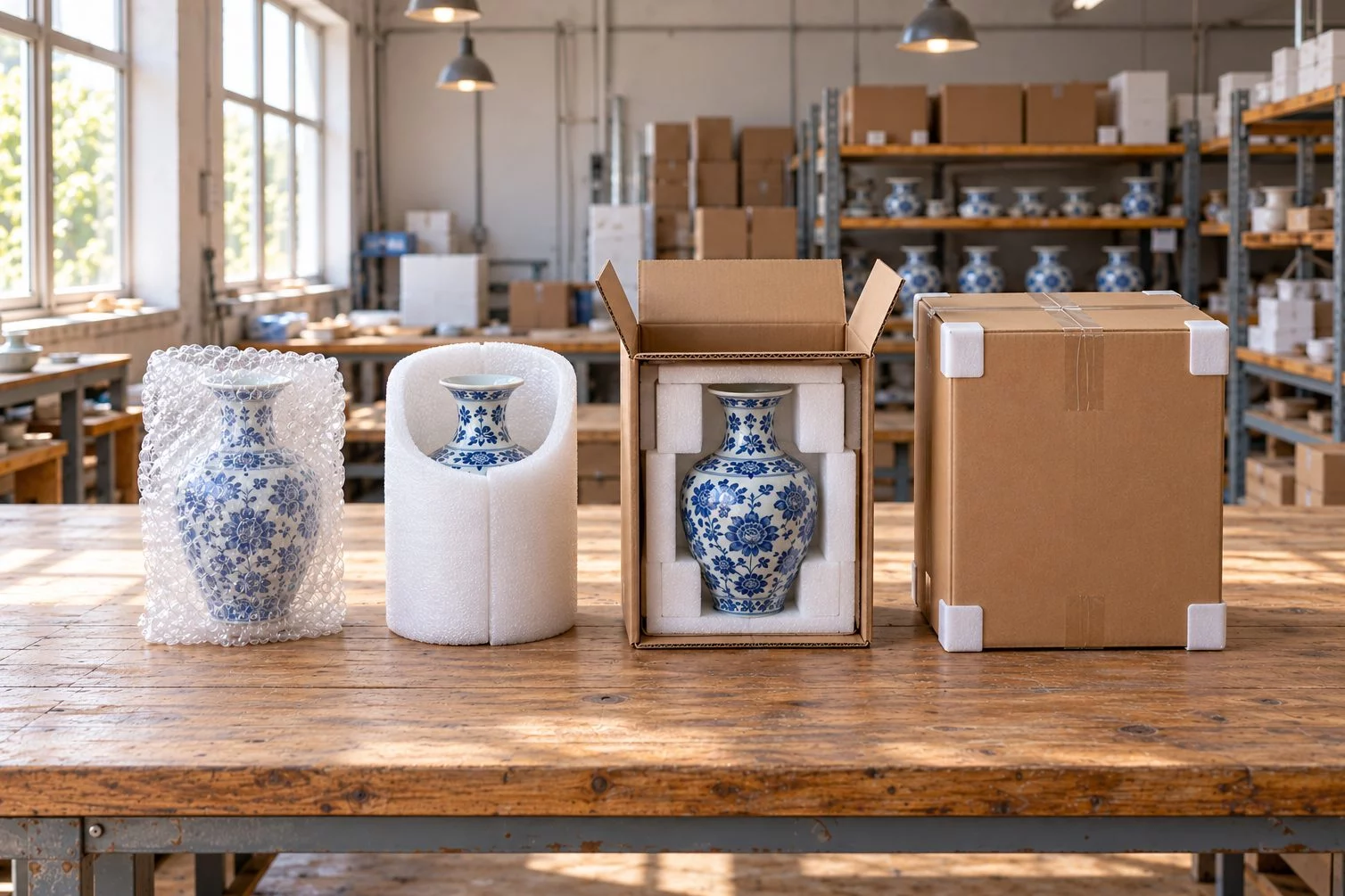
Freight for tableware is priced by volume, breakage happens at handovers rather than at sea, and the choice between express, air, shared container (LCL) and full container is mostly a choice about how often your cartons get handled. Our shipping guide goes through all of that. Two points matter specifically to the importer.
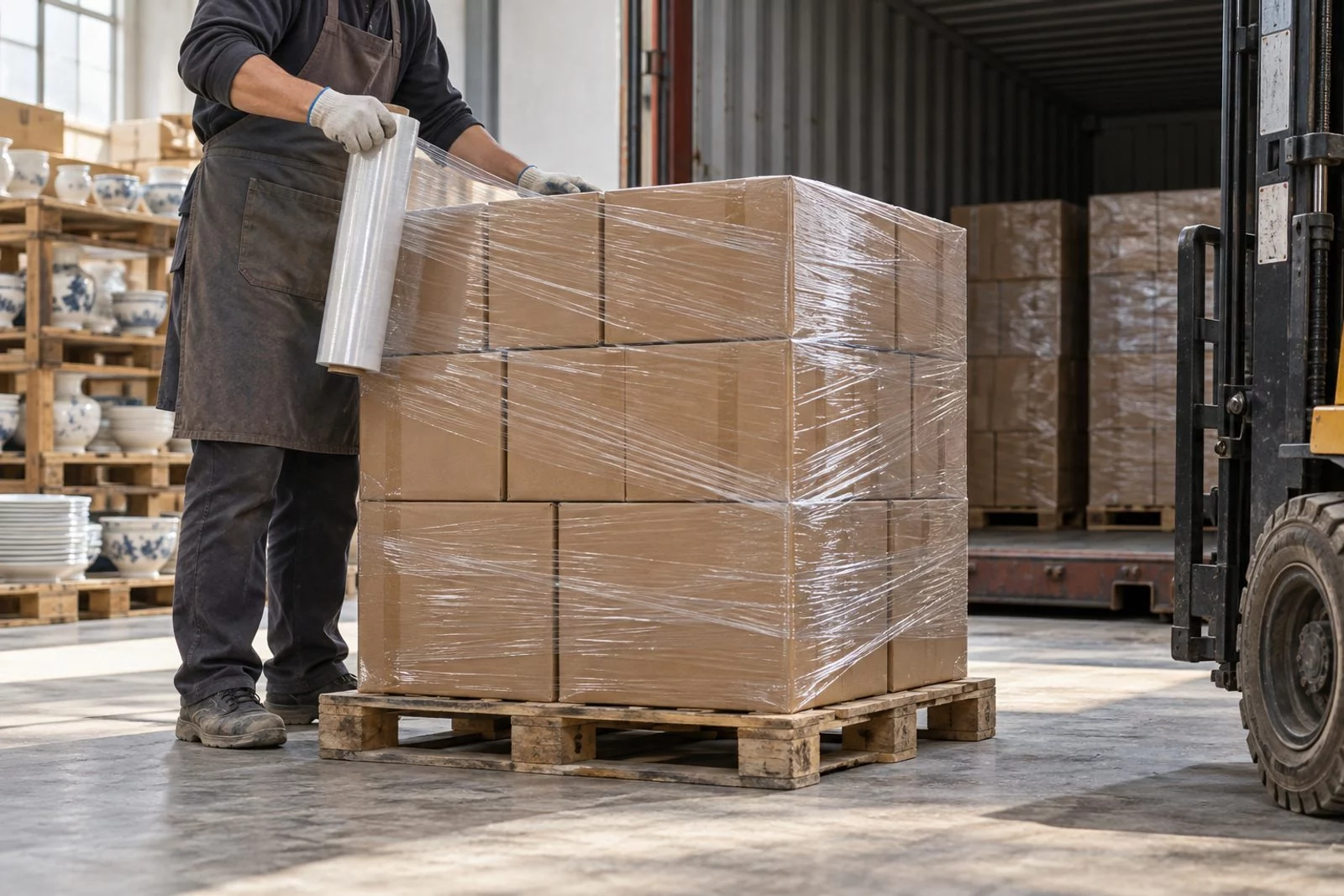
The first is breakage by mode, because it changes how many sellable pieces you actually import. Across our 2025 shipments, breakage per 1,000 pieces was 6 by full container, 18 by LCL, 4 by air and 3 by express (KKCN shipment records, 2025). LCL is the usual route for a first order and also the roughest, because the cargo is unloaded and reloaded at consolidation warehouses on both ends. Shipping a mixed porcelain order by LCL explains how to pack and palletize for it, and sea, air or express for porcelain shows when paying for speed makes sense.
The second is that customs reads documents, not cartons, so the commercial invoice and the packing list must count the same thing in the same unit, line by line. One mixed order we know of was declared as “ceramic articles”, with a packing list that counted cartons and an invoice that counted sets. The two documents couldn’t be matched, and the shipment sat for five days in Rotterdam while a broker reconciled 41 lines. The fix was one line per HS code, in the same unit, on both documents.
At the border: documents, duty and the agencies behind customs
When a tableware shipment arrives, two things are being checked at once: the tariff, by customs, and the product, by whichever agency regulates food-contact goods. Clearing one doesn’t clear the other.
On the customs side, your broker works from the documents. We issue six with every order, all from Jingdezhen Kouci Ceramics Co., Ltd. under our own customs-declaration qualification: the commercial invoice with a suggested HS code on every line, the packing list, the sales contract, the certificate of origin, the export declaration and the inspection report. The broker classifies each line, and the duty follows. As of November 2026 the totals are steep and they differ sharply by market: porcelain tableware into the EU pays the 12% normal rate plus a 79% anti-dumping duty, 91% of the customs value; in the US a household plate on the 6% line pays 26% once both Section 301 layers are added, and hotel ware 45%; in the UK an anti-dumping duty of 13% to 36% sits on top of the normal rate, under an interim review that opened in July 2026. Import duty on Chinese porcelain gives every layer with its official source, and is updated when they move.
On the product side, the United States is where the second check is most visible. Ceramic tableware is subject to FDA review at entry, and the FDA can detain a shipment whose glaze it suspects of releasing lead or cadmium above its action levels, set in its compliance policy guides for lead (CPG Sec. 545.450) and cadmium (CPG Sec. 545.400). For manufacturers with a record of violations, the FDA uses import alerts, which allow “detention without physical examination”. The long-standing ceramicware alert, 52-08, has been deactivated, and the firms it listed now appear on the Red List of Import Alert 99-45. That makes the supplier’s record part of your due diligence, and the test report in your file the fastest answer to a hold. What FDA checks on imported ceramic tableware explains the process, and what to do when customs holds a ceramic shipment covers exams, detentions and who pays for the days in between.
Other markets check the product less at the border and more on the shelf. In the EU and the UK, market surveillance authorities and retailers ask for the declaration of compliance and the test file behind it; the EU declaration of compliance sets out what it must contain.
What a first import costs, and when the money leaves
Buyers who budget a first import on the unit price usually find the money leaves in a different order from the one they planned. Most of it goes out before anything is sold, and some of it, like duty, is paid at the border in a lump. Here is a realistic first order of plain white porcelain into the United States on FOB terms, using our published price ranges at 500 pieces, mid-range:
| Item | Quantity | Example FOB price | Value |
|---|---|---|---|
| 27 cm dinner plate | 500 | $2.75 | $1,375 |
| 23 cm salad plate | 500 | $2.25 | $1,125 |
| 18 cm bread plate | 500 | $1.40 | $700 |
| Decal cup with a one-color logo | 1,000 | $1.90 | $1,900 |
| Order total | $5,100 |
The cash leaves in this order. Samples first: stock samples at 50% of list price, up to three styles, credited in full against a follow-up order over $2,000, so on this order they come back. Then the deposit, 30% or $1,530, by bank transfer at a $35 bank fee. Then the balance of $3,570 before the goods leave Jingdezhen. Freight to your port and the forwarder’s charges follow on your forwarder’s invoice. At the US border, duty is due on the entry: on the dinner plates alone, at the 26% total for their household line, that is $1,375 × 26% = $357.50, and the other lines carry their own rates. A formal entry adds the merchandise processing fee, here the $34.58 minimum, and by sea a harbor maintenance fee of 0.125%, about $6.38 on $5,100. Then come the bond, the broker’s fee and local delivery, which your broker quotes.
The sum per piece, including breakage, is the landed cost, and the landed cost of a porcelain order works one through line by line. The cash calendar is a different question, and the one that decides whether a first order is comfortable: what a first dinnerware import costs sets every payment against the week it falls due.
A realistic calendar for the first order
Importing dinnerware from China takes longer than the sea voyage, mainly because the first order includes decisions that reorders don’t. A first order of stock shapes usually runs like this:
| Stage | Typical time (KKCN figures) | What runs in parallel |
|---|---|---|
| Brief, quote and stock samples | 1–2 weeks (samples ship in 3–7 working days, express 3–7 working days) | Importer registration, broker chosen |
| Approval, deposit, marks and test plan confirmed | About 1 week | Bond arranged; forwarder briefed |
| Production | 15–25 days; 30–45 days for a new pattern or shape | Booking; ISF details sent |
| Inspection, packing, trucking to the port | 2–3 working days to Shanghai, 3–4 to Shenzhen | Documents issued |
| Sea freight, clearance, delivery | 30–45 days door to door; 30–38 to the US West Coast | Duty paid at entry |
That makes 11 to 14 weeks from first email to delivered cartons for stock shapes, and three to four weeks more for a custom pattern. August to December is peak season for both the factories and the shipping lines, and Chinese New Year closes most Chinese factories for two to three weeks in late January or February; ordering around Chinese New Year shows how to plan backward from a shelf date. Our guide to importing porcelain from China covers the same calendar from the order side.
After the first container
The second order is easier, and it is worth planning the first one so that it is. Keep the approved sample and the sample approval sheet; reorders at our factory quote the version code on that sheet, so the reorder matches the first run rather than someone’s memory of it. Keep the test reports matched to each item, and note what triggers a retest.
On the customs side, a regular importer into the US usually moves to a continuous bond, and a line you import many times may be worth a binding ruling, which CBP publishes in its rulings database; the EU’s equivalent, a Binding Tariff Information decision, is valid for three years. HS codes and paperwork for porcelain explains both.
Reorders can also get smaller and faster. In stock, we sell from one piece and mix references from ten, which lets a new range be tested before a container is committed. For North America, 96 of our best-selling references are held in third-party warehouses in Los Angeles and Toronto, with seven-day replenishment and DDP delivery to the US, Canada and Mexico; we have no factory in the Americas, and those pieces are made in Jingdezhen like the rest. For buyers who want to compare more than one maker before committing, how to vet a ceramic supplier in China is the place to start, and a Chinese ceramic supplier worth staying with is the one whose paperwork is as consistent on the tenth order as on the first.
Quick answers
Do I need a license to import ceramic tableware into the US?
No import license is required for ceramic tableware. You need an importer number (your IRS number or a CBP-assigned one), a customs bond for formal entries over $2,500, an ISF for ocean shipments, and test results that show the glaze meets FDA action levels for lead and cadmium.
Do I need FDA approval to import dishes?
The FDA doesn’t pre-approve tableware, and there’s no registration for importing it. It can review and detain a shipment at entry, so the importer should hold a lead and cadmium report for each glaze and decoration before the goods ship.
Can I import a few pieces without a broker?
Yes, but small shipments no longer escape duty in the US: since June 24, 2026, the de minimis exemption is suspended, so the express carrier clears the parcel and bills the duty with a fee. In the US, an importer may file its own entry; for a first formal entry, a licensed broker is usually worth it.
Is ceramic tableware from China tested for lead?
Not automatically. Testing depends on the supplier and on what the buyer asks for. Ask for a report per market, on the exact glaze and decoration you are buying, and check it with the issuing laboratory against its report number.
How long does it take to import ceramic tableware from China?
For stock shapes, 11 to 14 weeks from first contact to delivery by sea is typical, with 30 to 45 days of that on the water and at the border. A custom pattern or shape adds three to four weeks.
Our Packing & Shipping page lists the documents, terms and packing that come with every order.
Sources
- CBP, Importer/Exporter Tips (importer of record responsible even with a broker; broker optional; CBP Form 5106; ISF applies to ocean cargo)
- 19 CFR 143.21(a), informal entry for shipments not exceeding $2,500
- CBP bulletin on continuous bond amounts (greater of $50,000 or 10% of the previous year's duties, taxes and fees)
- CBP, ISF FAQ (24 hours before lading)
- Federal Register 2026-12670, indefinite suspension of de minimis for non-postal shipments, effective June 24, 2026
- CBSA, "CBSA reminds importers to submit financial security before CARM transition measure ends" (February 2025), and CBSA notice relayed by FedEx that the RPP…
- Consumer Packaging and Labelling Regulations, C.R.C., c. 417 (bilingual label information; dealer identity in one language)
- Regulation (EU) 2023/988 (GPSR), Articles 11(3) and 16, applicable from December 13, 2024
- Australian Border Force, Import declaration (over AUD 1,000; duties, taxes and charges before release; brokers for first-time importers)
- 19 U.S.C. 1304, marking of imported articles
- FDA, Lead in Food and Foodwares (import alerts 99-42, 99-45, 52-08 listed; content current as of 01/06/2025)
- FDA Import Alert 99-45, Red List entries "from deactivated import alert 52-08", class 52A foodware, problem LEAD (published 10/09/2026)
Lin Wan leads foreign trade at KKCN in Jingdezhen, coordinating buyers’ requirements, samples, orders and after-sales across Europe, North America, the Middle East and Southeast Asia. Ten years in ceramic export, working in English and Chinese.