By Lin Wan, Foreign-Trade Lead at KKCN, Jingdezhen
A premium tableware brand once brought us a vase that existed only in a drawing. It was tall, tapered, with very thin walls that opened into a wide flared rim. It was beautiful on paper. In the kiln, the upper section sagged and warped under its own weight, even in our stable Jingdezhen porcelain body. Our technical team didn’t tell the client the design was impossible. They proposed hiding subtle ribs inside the body and thickening the rim profile slightly, which kept the silhouette the client had drawn and let the piece survive firing. We fired two prototype sets side by side, one reinforced and one as close to the original intent as the clay would allow, and the client chose the reinforced version for production.
That project is a fair summary of custom porcelain product development. Your design intent meets what clay and fire will allow, and the work is finding the version that keeps the first while respecting the second. In my experience the projects that go smoothly have one thing in common: the buyer decides four things in order, and changes no more than they need to at each step.
| Decision | What you settle | What it mostly affects |
|---|---|---|
| Form | How much of the shape is new: none, some, or all | Tooling cost, sample time, risk in the kiln |
| Surface | Glaze, color and decoration method | Unit price, color consistency, number of sample rounds |
| Identity | Logo, base mark, packaging | Minimums, durability of the mark, retail presentation |
| Standard | What is written down and signed before bulk | Whether the first run, and every reorder, matches the sample |
The rest of this guide takes those four decisions in order and then follows the product into production and reorders. Where I quote our own prices and timings I say so, because other makers set theirs differently.
Decide how much of the piece is really new
The most expensive assumption in custom work is that “custom” means a new shape. Often it doesn’t. When we look at a buyer’s brief, the first thing we ask is how much of the form actually needs to change. The honest answer usually falls into one of three routes, and the route sets the cost, the time and the risk far more than anything else.
Restyling a proven form keeps a shape that already exists and changes the surface: a new glaze, a new pattern, your logo. There’s no new tooling, the form’s kiln behavior is already known, and the project can move quickly. Reshaping an existing form adjusts proportions or details of a shape that’s already been made, such as a taller cup, a different handle, or a foot that stacks better. It needs some new tooling or modelling, but it starts from a form whose firing behavior is understood. Building a new form starts from a drawing or an object that has never been made in porcelain, and it carries the most unknowns. The vase above was a new form, and that’s why it needed a structural rethink.
| Route | What changes | Sample time at KKCN | Production at KKCN |
|---|---|---|---|
| Restyle a proven form | Surface, color, mark | 3–7 business days from stock forms, 15–30 for new decoration | 15–25 days, or 30–45 with new decoration |
| Reshape an existing form | Proportions, handle, foot, rim | 15–30 business days | 30–45 days |
| Build a new form | The whole shape | 15–30 business days, plus rounds as needed | 30–45 days; fully handmade art 45–60 days |
We keep more than 1,200 molds and form references, so most briefs find a starting point in the first two routes. Other makers have smaller or larger libraries, but every maker has one, and it’s worth asking to see it before you commission a mold. Some of the best-selling custom pieces we make began as an existing form with one detail changed. The routes are described in more detail on our Custom Development page.
What a good brief settles before anyone touches clay
The most common first-inquiry mistake I see is a reference photo with the words “how much?” and nothing else. A photo hides the things that decide the price: the size, the capacity, the wall thickness, how the piece will be used, how many you need, and the tests your market requires. A maker can only guess, so the first quote is a guess, and the first sample answers questions you could have answered in an email.
A good custom porcelain design process starts with a brief that says what must stay, what may change, and what the piece is for. Here is a short example of the kind we like to receive. The product and brand are made up, but the level of detail is real:
We’re a US home brand launching a breakfast set in spring. We need a 300 ml (10 oz) mug and a 21 cm (8.3 in) plate, matching the attached drawings within 2 mm. The mug must stack in fours. Glaze: a soft matte sage, close to the attached swatch, with a range we can approve. Our logo goes on the base only, small and quiet. Quantity: 1,500 of each in the first order, with reorders every quarter. Retail gift box for the mug, master cartons for the plates. We need lead and cadmium release testing to the FDA limits, and goods at our Los Angeles warehouse by mid-March.
That paragraph takes ten minutes to write and saves at least one sample round. It tells the maker which route fits: here, possibly a reshaped stock mug and a restyled stock plate. It names the decisions that need an approved range, which is the glaze, and the one that needs a test report, which is the lead and cadmium release. Files help too. We work from AI, EPS, SVG, PDF, JPG, PNG and CAD files, and a drawing with dimensions beats any photo. If you’re starting from a picture of something you’ve seen, our guide to going from a reference photo to an approved sample lists what to add to it, and our custom brief form walks through the same points.
Form: why clay won’t do exactly what the drawing says
Clay moves twice before you ever see a finished piece. It shrinks as it dries, and it shrinks again in the kiln. Our standard Jingdezhen porcelain body loses 14–16% of its size between the wet form and the fired piece, measured against the wet size. Because that loss is a share of the larger wet size, the mold has to be scaled up by a little more than the shrinkage itself: at 15%, a piece that must fire to 100 mm is formed at about 117.6 mm, roughly 17.6% larger. We build that allowance into the mold CAD from the start. That 14–16% is the size the clay loses, not the variation you should accept. Fired pieces are checked against finished tolerances that you agree separately, such as ±2 mm on a mug’s height or a stated capacity range. Other bodies shrink by different amounts, which is one reason the same drawing made by two factories rarely comes back identical.
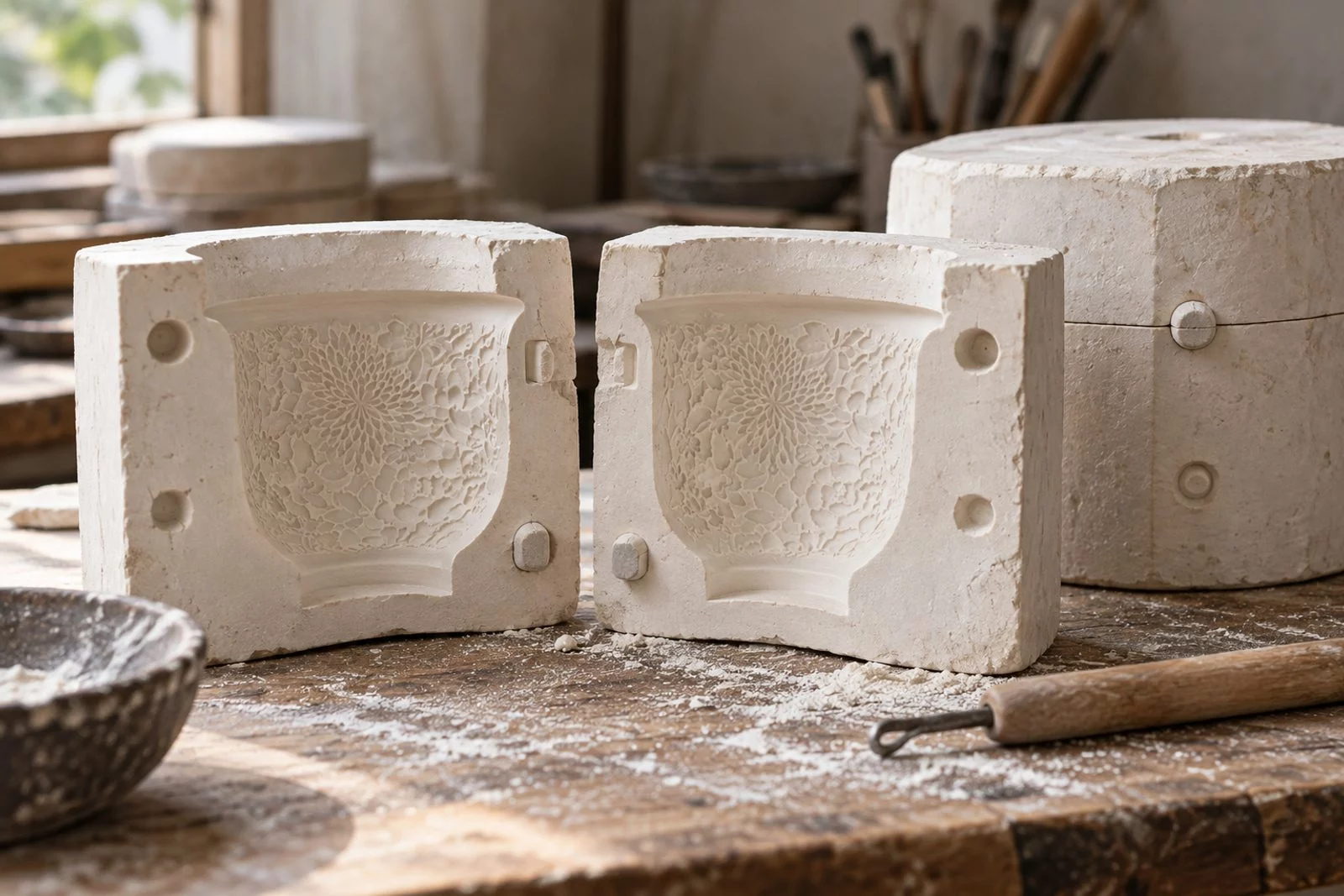
How a form is made matters as much as its size. Round forms such as cups, bowls and vases can be thrown on the wheel, which gives a lively, slightly individual surface and lets the potter thin or thicken the wall where the shape needs it. Angular, lobed or complex forms are usually cast in plaster molds from liquid clay, which repeats a shape very closely once the mold exists. Some pieces combine the two, with a thrown body and cast handles or knobs added by hand. None of these is better in general. They suit different products.
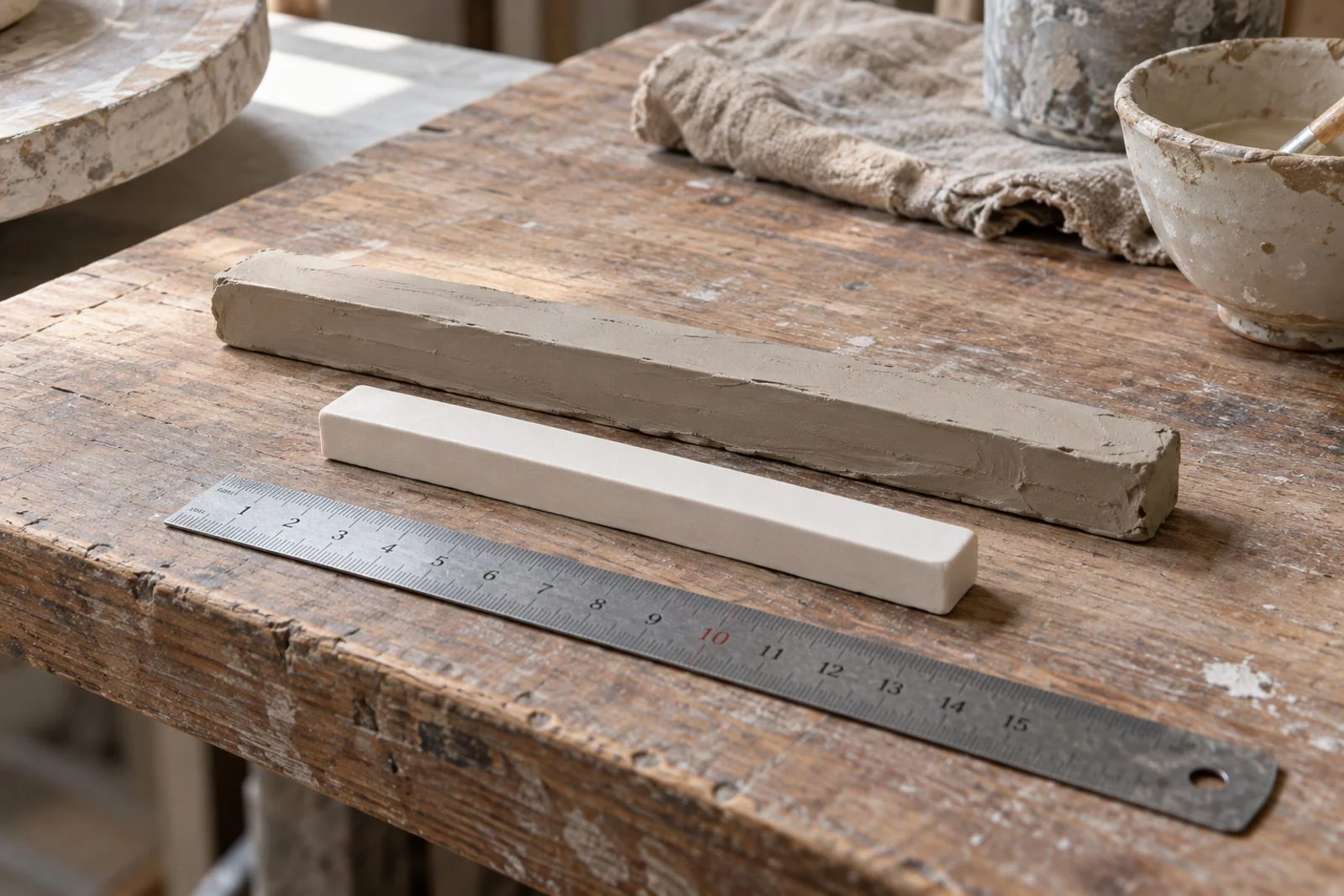
| Method | Consistency piece to piece | Set-up cost | Good for |
|---|---|---|---|
| Thrown on the wheel | Close, with the small variations of the hand | Low; no mold needed | Round forms, small runs, pieces where a handmade feel is the point |
| Pressed or jiggered in a mold | High | Mold needed | Plates, shallow bowls and repeated tableware |
| Slip-cast in a plaster mold | Very high | Mold needed, more for multi-part shapes | Angular, lobed or sculpted forms, lids and handles that must repeat closely |
The kiln then has its say. A porcelain body at full firing temperature softens enough that tall, thin or wide-flared shapes can slump, as the vase did. Walls that change thickness abruptly can crack as they dry. Wide, flat bases can warp. Lids are fired with their own bodies and stay paired with them through packing, because two pieces that shrank together fit each other better than any two pulled from a pile. A good maker will tell you early which parts of your drawing the kiln is likely to argue with, and offer a fix that keeps the look. I’d be cautious of one that accepts a fragile design without comment. Our Forming page shows how each of these steps works in our workshops.
What a new mold costs. At KKCN, a new mold for a simple symmetrical shape such as a cup, plate or straightforward vase costs $450–$800. Complex sculpted or multi-part forms cost $800–$1,600. That price covers the 3D CAD model, the master mold and one set of production working molds. Working molds wear with use, so a long run or several reorders will need more, and we quote each replacement set separately, generally $120–$300 depending on the shape. Once the buyer has paid the full mold fee, the physical molds belong to the buyer. We store them for their reorders and don’t use them for another brand. The source 3D files stay with us under our standard terms, and buyers who want them can negotiate them as a separate add-on. When you compare quotes from any maker, ask the same four questions: does the price include the model, the master and the working molds, how many working sets, what a replacement costs, and which of these become yours. A low quote that leaves out the master or the replacements can cost more by the third order. The economics are worth working through. A $600 mold spread over a first order of 500 pieces adds $1.20 to each one. Spread over 2,000 pieces it adds $0.30. Over 50 pieces it adds $12. That’s why, for a small first run, restyling or reshaping a form we already have is often the better choice, and why a new form usually makes most sense for a piece you expect to reorder.
Surface: why glaze color is a range, not a chip
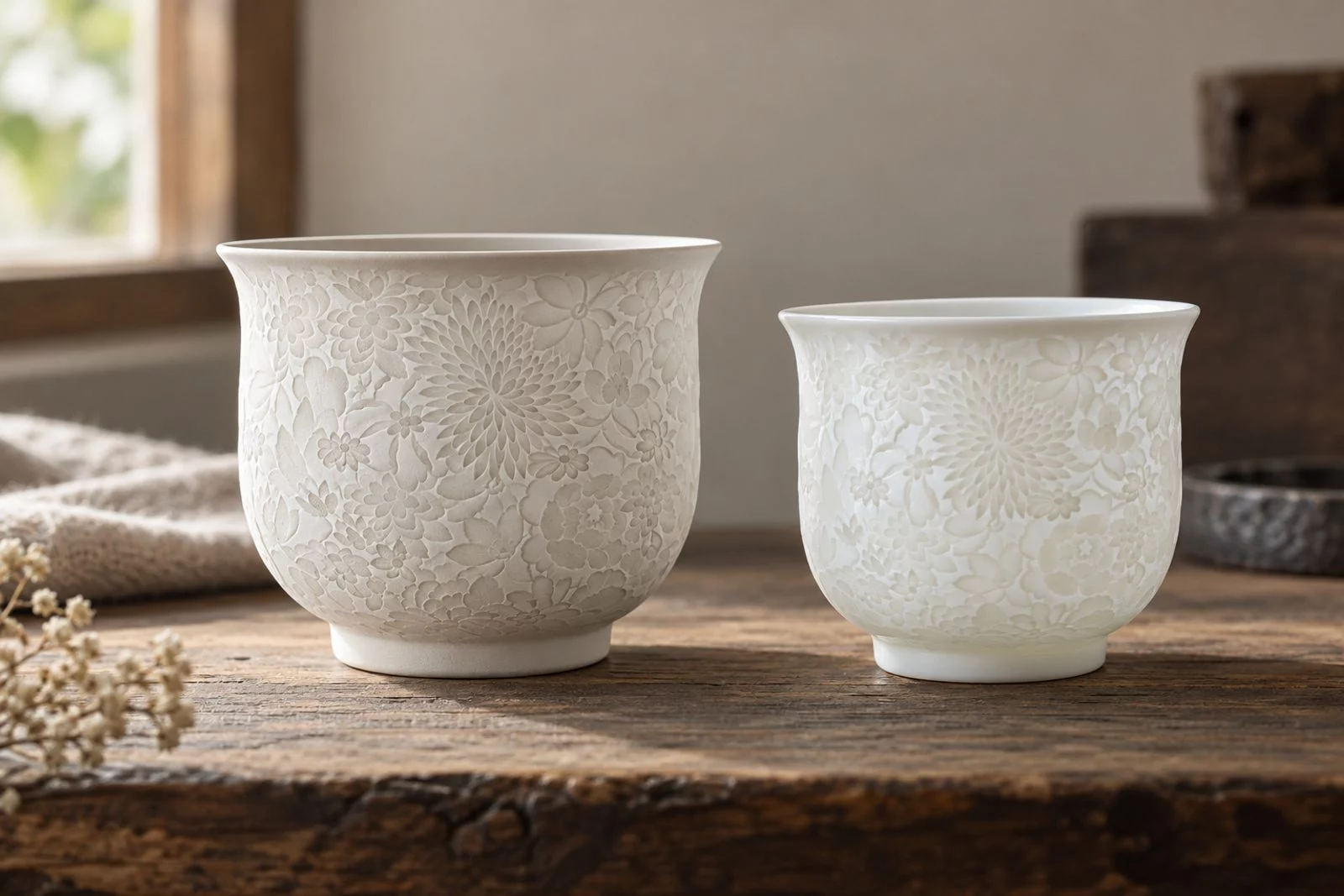
Decoration drives price more than size does. In our guide to sourcing porcelain from China I set out what the same 120 ml cup costs with a decal, with hand-painted underglaze blue, and with hand-painted enamel, and the spread runs from about $1.20 to $14 or more. For custom work, the method you choose also changes how many sample rounds you’ll need and how consistent the bulk run will be. A decal repeats a pattern very closely from piece to piece. Hand painting gives life and small variations. Enamel decoration needs a second firing at about 780–850 °C, which adds time and some losses. Carving and relief work sit between painting and molding in cost, and look best under celadon and other translucent glazes that pool in the cuts.
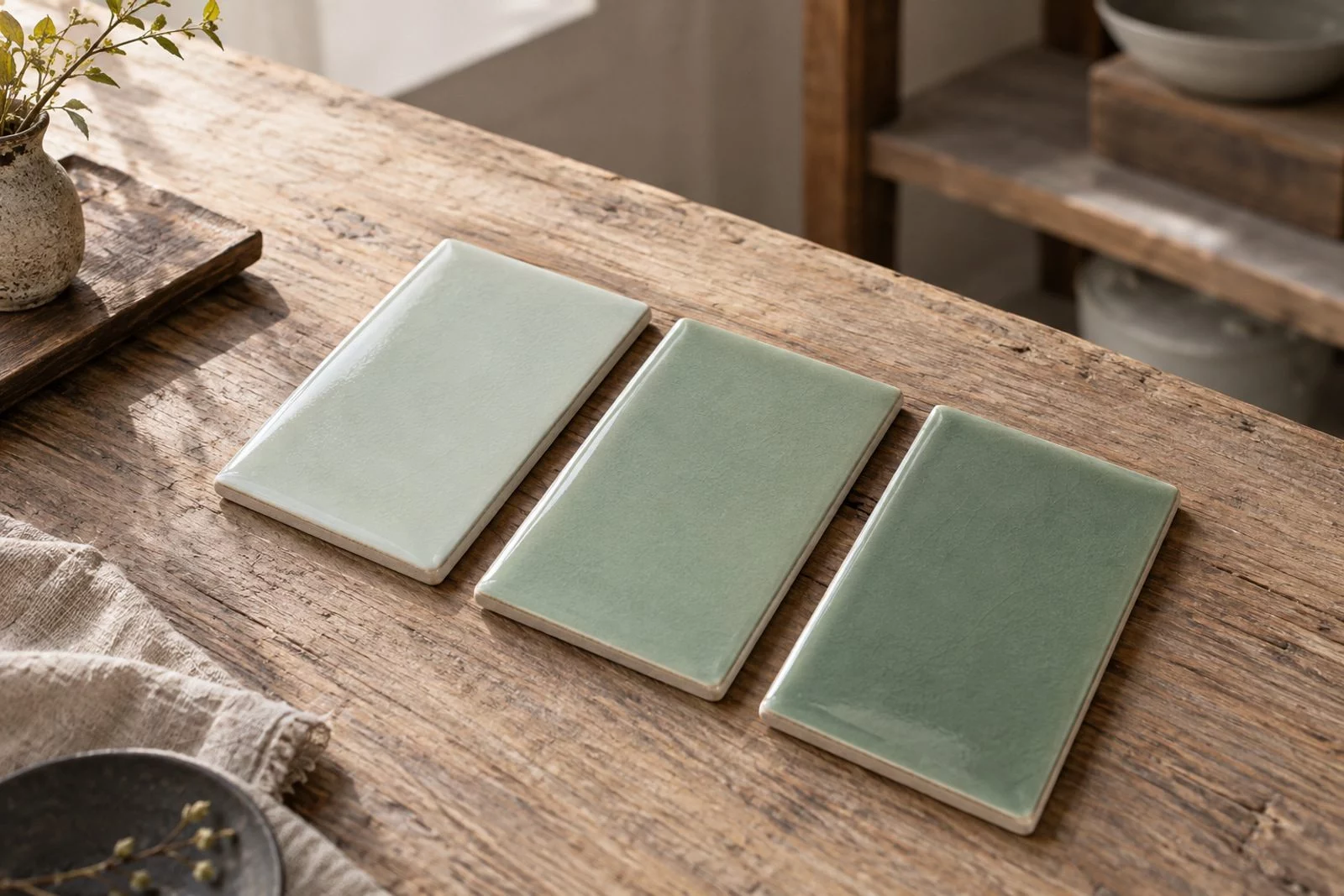
Glaze color is where most custom projects spend an extra round. A well-briefed project at our workshops usually settles in two sample rounds. When a third is needed, the reason is usually glaze color, because a fired glaze shifts with kiln temperature and atmosphere in a way that ink on paper never does. Reduction-fired glazes such as celadon shift more than oxidation-fired ones, and reactive or crystalline glazes are meant to vary.
So can a glaze match a brand color? For stable, non-reactive solid glazes, yes, closely. We regularly hold those to a color difference of Delta E 2.5 or less against the approved target tile. A Delta E figure only means something with its method attached, because the common formulas give different numbers for the same pair of tiles, and gloss changes the reading depending on how the instrument treats surface reflection. Ours is measured with the CIEDE2000 formula (ΔE₀₀) on a spectrophotometer, under a D65 illuminant with the 10° observer, in SCI mode, which includes the specular component so the glaze’s gloss doesn’t distort the color reading. We also compare the tiles side by side in a controlled light booth, because the eye and the instrument catch different things. Whoever quotes you a number, ask which formula, light source and measurement mode it uses, and write them on the approval record. Reactive, crystalline and high-fire art glazes vary more, and we say so before sampling rather than after. The approval method matters more than the number. We fire a strip of gradient test tiles, one lighter than the target, one on target and one darker, on the same clay body and the same kiln curve as production. You approve against real fired ceramic, and the light and dark tiles become the limits for the bulk run. A Pantone chip printed on paper can start the conversation, but it can’t be the standard, because a fired glaze can’t look exactly like ink. Our Glazing & Decoration page explains how each decoration method is applied.
Identity: the logo, the base mark and the box
OEM porcelain lives or dies on the details that carry your name. Where the logo goes matters as much as how it’s applied. A logo on the face of a cup is a design statement that has to suit the pattern. One on the base is a maker’s mark that buyers turn over to find. One on the box sells the piece before anyone touches it.
| Logo method | How it looks | How it lasts in use | Best for |
|---|---|---|---|
| Decal, fired on | Crisp, exact, any color | Durable when fired on properly; check it against your use | Detailed logos, short lead times, large runs |
| Hand-painted | Soft, slightly individual | Underglaze painting lasts as long as the glaze | Heritage brands, small runs, painted ranges |
| Carved or engraved | Subtle, tactile, glaze pools in the cut | Permanent | Minimal brands, monochrome glazes |
| Molded into the form | Raised or recessed, one color with the body | Permanent, but needs a mold change | Large repeat runs where the logo never changes |
Three of our long-standing clients show how differently this can work. Living Oriental, a German home brand, has us fine-tune forms and engrave its logo, and it reorders 800–1,500 pieces each year. Al Masa Grand Hotel’s design firm commissioned exclusive patterns and the hotel’s own logo, starting with 1,200 pieces. East Art Gallery, which supplies museum stores in the Washington, D.C. area, runs a private label with exclusive packaging in batches of about 2,000 pieces a quarter. Each of them chose the method that suited how its customers would meet the piece, on a shelf, in a hotel room or in a gift shop.
The box deserves the same attention as the mark, especially for retail and gifts. Ask for the box to be sampled with the piece, not after it, so the insert fits the fired size rather than the drawing. Finished examples of private label ceramics sit in our Custom Products collection.
How many sample rounds are normal, and how to stop the loop
Two rounds is a reasonable expectation for a well-briefed project. The first shows the form and surface as the maker understood them. The second corrects what the first got wrong. Not every extra round comes from the buyer, though. Some start on the factory side: a test firing shows a glaze running at the foot, a handle cracking where it joins the body, or a form that needs a different place in the kiln, and the fix takes another firing before it’s worth sending you. A good maker tells you when a round is theirs. Projects that run to four or five rounds often share one of three habits on the buyer’s side. The buyer changes several things at once, so nobody can tell which change caused the new problem. Changes are described in words (“a bit warmer, a little slimmer”) instead of being marked on the sample. Or nobody agreed at the start what “approved” would mean.
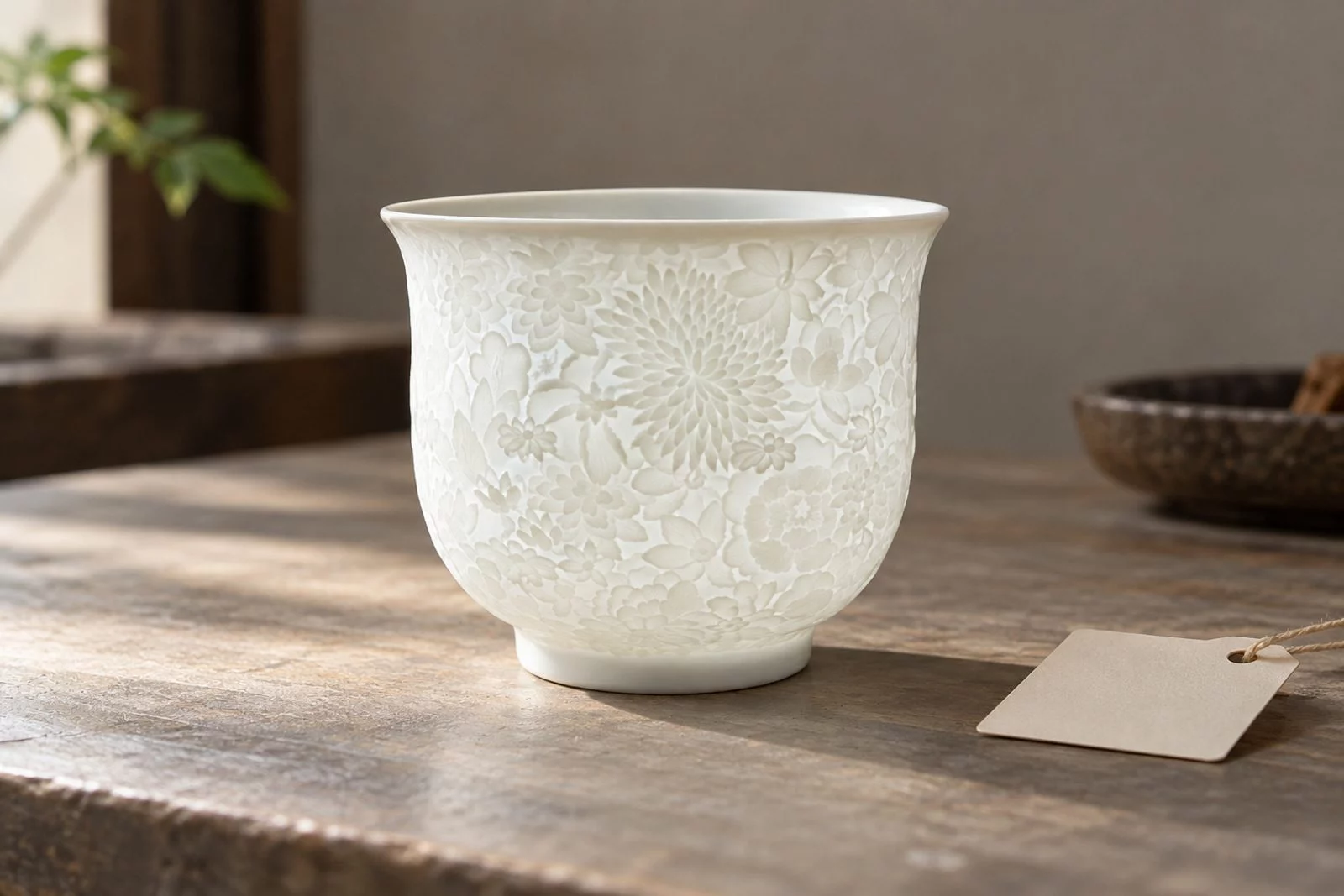
Breaking the loop is mostly discipline. Change one layer per round where you can: form first, then surface, then mark. Photograph the sample on a neutral background with a ruler, and draw your changes on the photo. Agree before the first sample what will be measured and what range is acceptable. At our workshops, Li Qiusheng’s team reviews each first piece against the standard before it ships to you, so you’re not the first person to discover a problem.
Sampling costs money, and it should. At KKCN a sample of a simple shape costs $80–$180 per revision round, which covers prototype labor, clay, glaze and kiln runs. Complex forms cost more. When the order that follows reaches the agreed minimum, we credit the sampling fee against the goods. Other makers handle sampling fees differently, so ask before the first round. The full terms are on our samples and quotations page.
Check that it works, not only that it looks right
Samples get approved on looks far more often than on use, yet the complaints that come back from a kitchen or a hotel dish room are usually about function. The mug in the example brief has to stack in fours. That’s easy to draw and easy to get wrong, because a foot or rim that fires a millimeter off can make a stack lean or lock. So test the sample the way the product will be used. Stack four fired pieces, check that they sit straight and lift apart cleanly, and write down the stack height. Fill the mug to the brim with water and measure what it holds, because a 300 ml drawing can fire to a different volume. Seat every lid on its body and check that it doesn’t rock. Set each piece on a flat surface to check it doesn’t wobble, and lift handled pieces both full and empty. If the piece is headed for a hotel, try it in the racks and carts it will live in.
Each check should end as a result on the sample record, either a pass or a number, rather than a comment. Those results also tell the maker what to change. When a stack locks, the fix is usually in the foot or rim profile of the mold, which is a factory adjustment rather than a new idea from the buyer. Lab tests your market requires, such as lead and cadmium release, should be run on pieces made the way bulk will be made, with the same body, glaze and firing.
Locking the standard for a product that’s yours
In the sourcing guide I explained why the signed sample works as the contract between buyer and maker. Custom products need a few extra things in that standard, because no catalog stands behind them.
The standard should name the mold, its version and where it’s stored. It should record the glaze by reference to its approved test tiles, not by a color name. Every color or decoration variant needs its own approved sample, because a design approved in sage is not approved in navy. Finished dimensions and capacity need their own tolerances, measured on fired pieces. The shrinkage allowance belongs in the maker’s mold, not in the margin you accept. The results of the function checks, such as stack height and lid fit, go in too. For hand-thrown or hand-painted pieces, the standard should say in writing which variations are the mark of the hand and therefore accepted. That last line prevents more disputes than any other, because it turns “this one looks different” into a question with an agreed answer. Our Quality & Approval page lists what our written standard locks before production, and every order then passes three inspections: one on the body, one on the glaze, and a full final check.
Who owns the design, and how to protect it
This is the question buyers ask most nervously, and with reason. My answer comes in two parts: what to expect from your maker, and what you should do yourself.
From the maker, expect three things in writing. The first is that molds you have paid for belong to you. The second is that your drawings, logo files, patterns and glaze formulas stay confidential and are never used for anyone else. The third is a clear statement of where your molds and records are stored and for how long. At KKCN, customer drawings, logo files and patterns are archived as confidential and are not disclosed without written authorization. Paid-for molds belong to the buyer and are never reused for other brands. Each client’s molds, 3D tooling files and glaze records are tagged and kept apart from everyone else’s.
What you do yourself matters more, because a contract with one maker doesn’t stop anyone else. China operates a first-to-file trademark system, so whoever registers a mark first generally owns it there, and a registration in your home country doesn’t protect you in mainland China, as China law firm Harris Sliwoski explains. Product designs can be registered too. Since June 1, 2021, Chinese design patents run for 15 years from filing, and partial designs, such as a distinctive handle or rim, can now be protected on their own, under the amended Patent Law. For the agreement with your maker, lawyers who work in China generally recommend an NNN agreement (non-disclosure, non-use and non-circumvention) over a generic NDA, because it also bars the maker from using your design itself or going around you to your customers. None of this is legal advice, and for a design you plan to build a business on, a short consultation with a China IP lawyer is money well spent. Our own terms are on the Custom Development page.
From the first run to the third reorder
Custom tableware development doesn’t end when the first container leaves. The real test is whether the third order, a year or two later, matches the first. That depends on three things staying put: the mold, the glaze record and the signed standard.
Ask your maker how long they keep them after your last order, and what happens after that. At KKCN we keep a buyer’s molds, 3D tooling files and glaze records for three years after their final order at no charge. Within that window production can restart with no new mold fee, though working molds that have worn out are replaced at the set price. After it, we can extend the storage or ship the molds to you. Other makers have different policies, and some quietly discard molds after a year, so get the answer in writing.
Plan the range so it grows cheaply. New styles that share an existing form, a glaze you’ve already approved or a firing schedule with your running pieces cost less to add and settle in fewer rounds. Our custom minimum is 50 pieces per style, and our workshops produce 3,000 to 5,000 handmade custom pieces a month. That capacity is shared across clients and tightens from August to December, so book reorders for peak season about three months ahead. Living Oriental’s annual repeats work because each new batch starts from the same molds and glaze references as the last.
Projects that don’t fit the usual route
One-off portrait pieces. Some custom work is made for one person. Hand-painted pet portrait plates, memorial urns and porcelain wedding portraits start at a single piece, because each is painted from the customer’s own photographs rather than repeated from a pattern. Our pet portrait plate, pet memorial urn and wedding portrait frame show how these work.
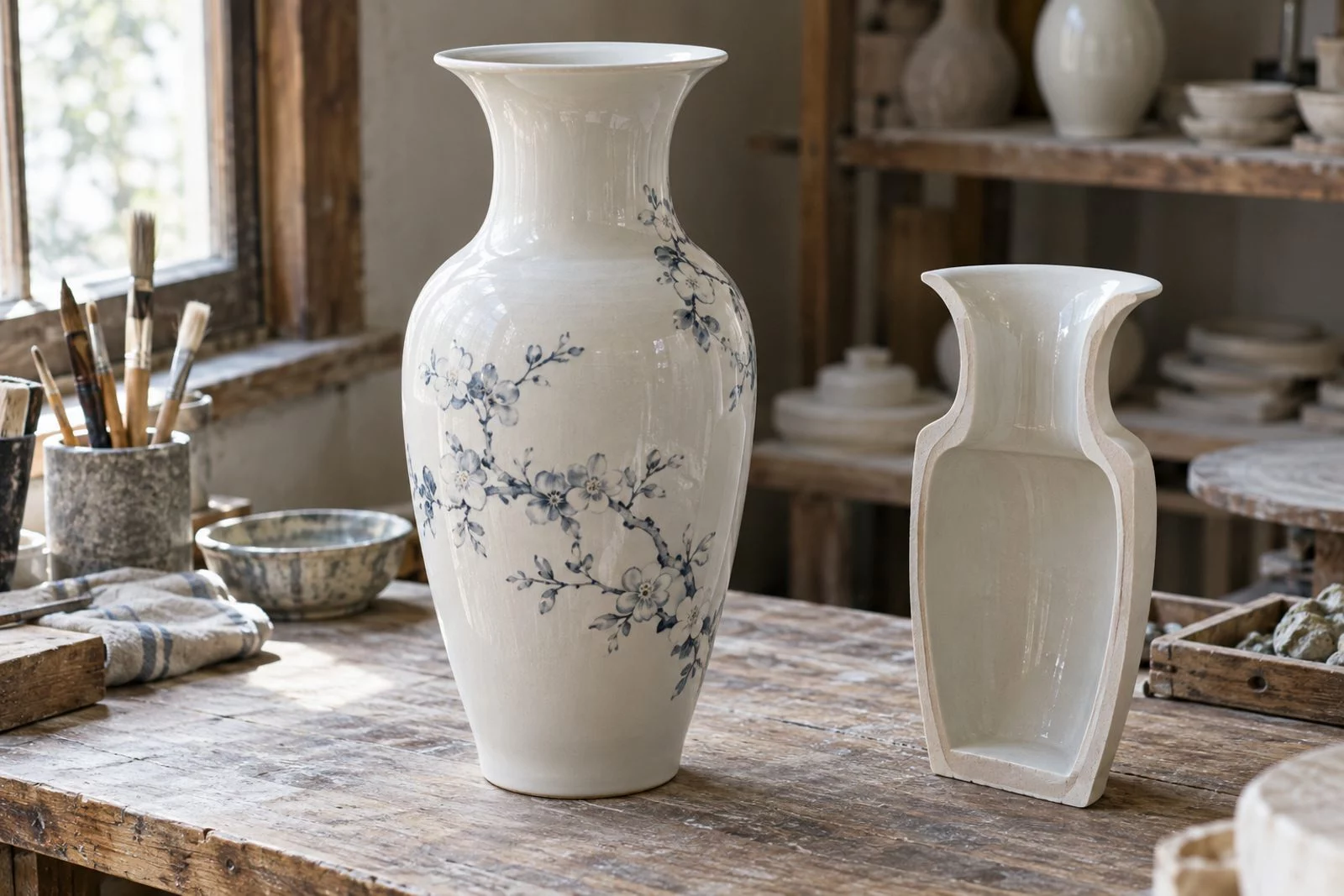
Art commissions. Large decorative pieces and sculpture are quoted per piece, take 45–60 days when fully handmade, and carry a risk of loss in the kiln that’s built into the price. Art Space Milano, an interior design studio, commissioned 30 one-of-a-kind pieces from us, each with an original form and a glaze developed for it.
Gifts with a fixed date. Corporate and event gifts have a date that can’t move, so plan backward from it. Allow for sample rounds, production, packing and freight, and choose a restyled stock form if the calendar is tight.
Very large pieces. We make pieces up to 130 cm tall. At that size, every step takes longer, from drying to firing to packing in a fitted wooden frame, and the first sample is a real commitment for both sides.
Quick answers
How long does custom porcelain take? It depends on how much of the piece is new. Restyling an existing form can take a few weeks from brief to bulk. A new form usually takes two to three months once sample rounds are included. At our workshops, new samples take 15–30 business days and custom production 30–45 days, with fully handmade art pieces at 45–60 days.
What’s the minimum order for custom porcelain? There’s no industry-wide number. Makers set minimums by what a new mold or pattern costs to set up and how their kilns load, so custom minimums range from a few dozen to several thousand pieces per style. At KKCN the custom minimum is 50 pieces per style, and one-off portrait pieces start at one.
How much does a custom porcelain mold cost? At KKCN, $450–$800 for a simple symmetrical shape and $800–$1,600 for a complex sculpted or multi-part form. That covers the 3D model, the master mold and one set of working molds, and the physical molds belong to the buyer once they’re paid for. Other makers’ prices vary with the shape and the mold type, so compare quotes on the same drawing.
Can a porcelain glaze match my brand color? For stable solid glazes, closely: we regularly hold them to Delta E 2.5 or less against the approved target tile, measured with CIEDE2000 under D65 light. Reactive and art glazes vary more. Approve on fired test tiles in light, target and dark versions, not on a printed chip.
Where to start
If you remember one thing from this guide, make it the order: decide how much of the form is new, then settle the surface, then the identity, and lock it all in a written standard before bulk. In our experience, projects that follow that order usually settle in about two sample rounds and reorder with few surprises. Projects that skip it tend to discover in the kiln the decisions they put off on paper.
When you’re ready, send your drawings and the brief to a custom porcelain manufacturer in China that keeps your molds for you, or start with our custom brief form. My team will reply within one to two business days with the route we’d suggest, what the sample will cost and how long it will take.
Lin Wan leads foreign trade at KKCN in Jingdezhen, coordinating buyers’ requirements, samples, orders and after-sales across Europe, North America, the Middle East and Southeast Asia. Ten years in ceramic export, working in English and Chinese.