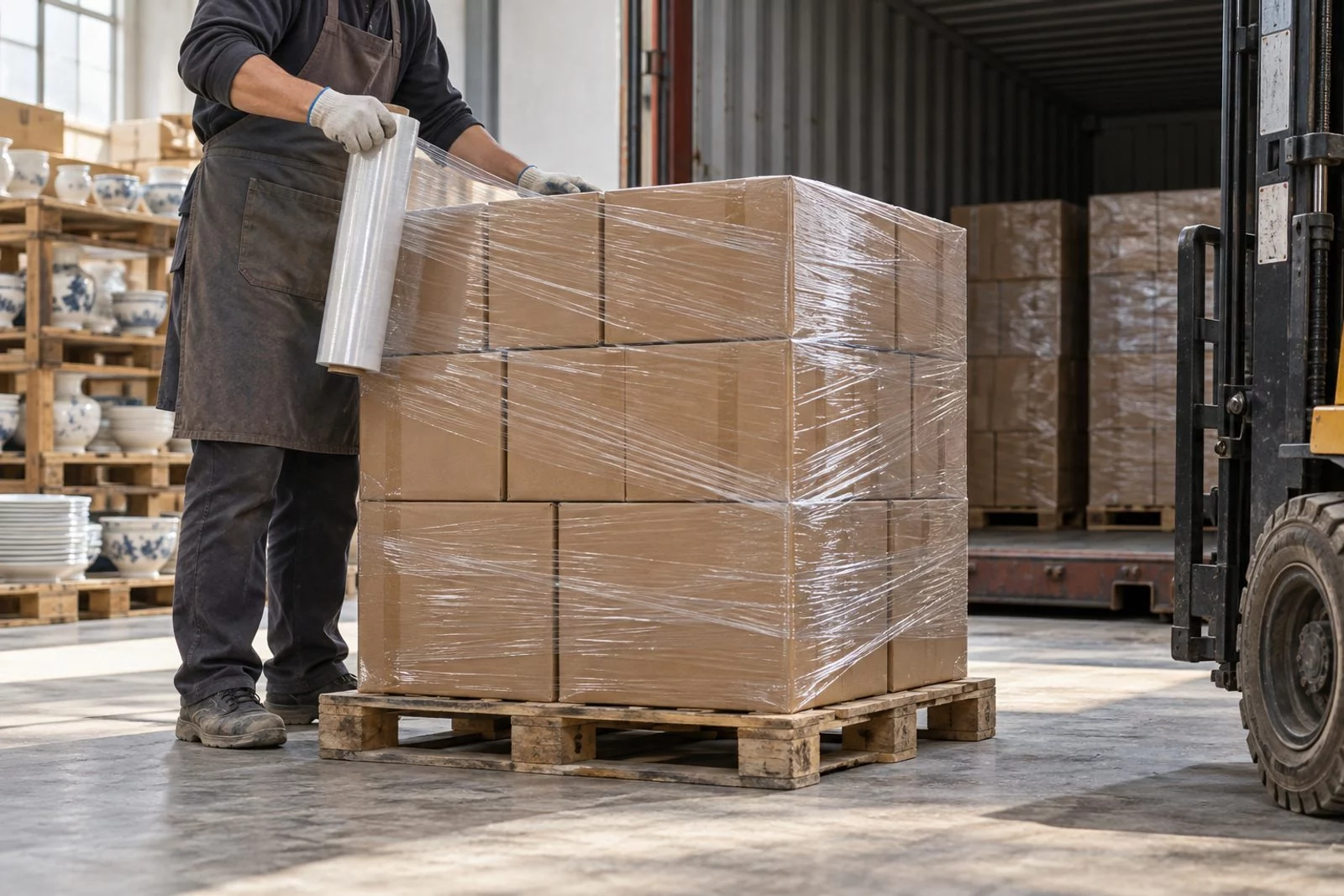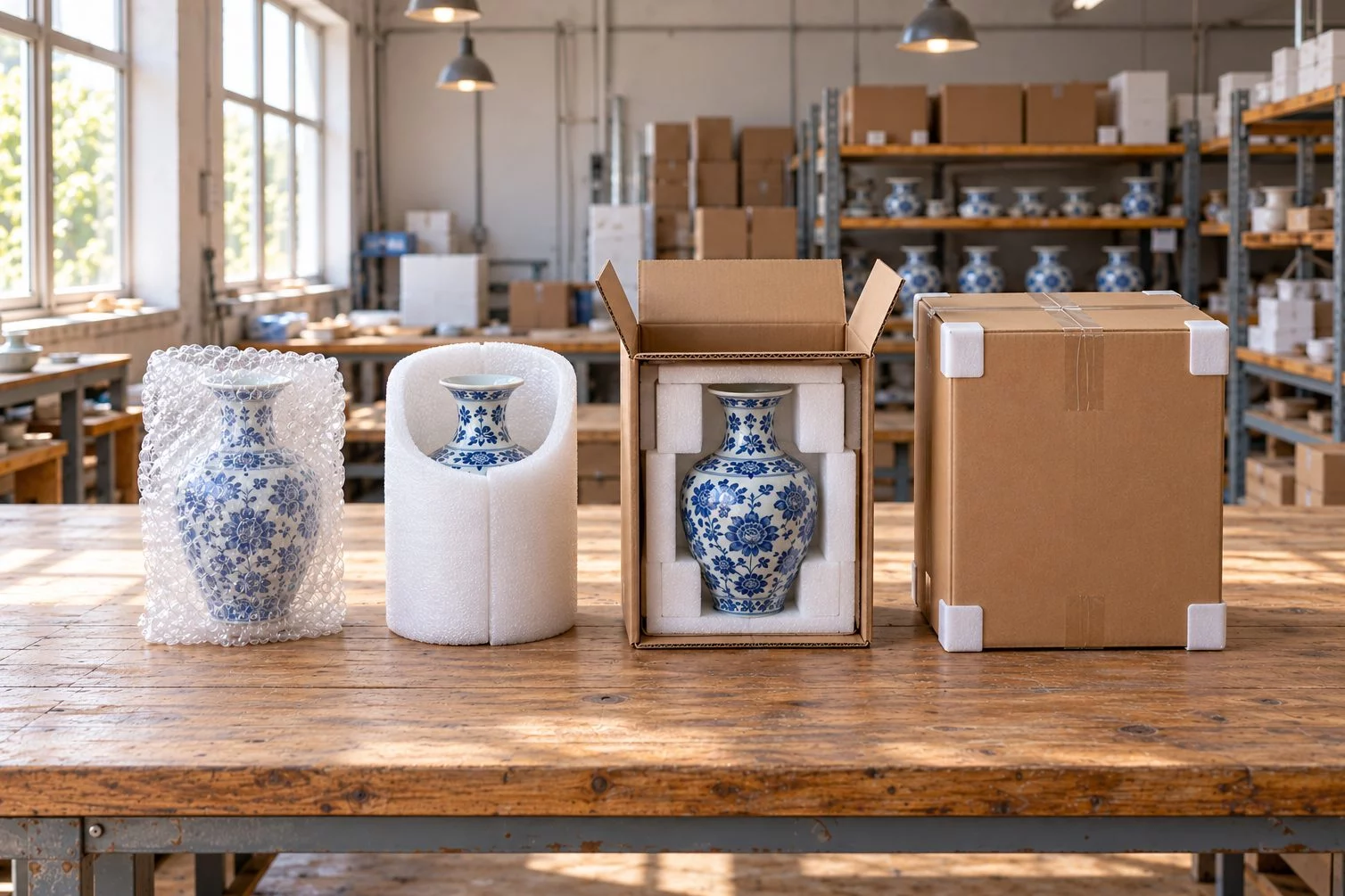

To import porcelain from China, you agree a sample, a trade term and a payment schedule with the factory or supplier, then a forwarder or the maker moves the cargo and a customs broker clears it in your country. With KKCN, a porcelain factory and exporter in Jingdezhen, in-stock pieces start at 1 piece, mixed orders at 10 pieces and custom designs at 50 pieces per style, and a first order takes anywhere from about two weeks for stock by express to three to five months for a new design by sea.
Most first-time importers worry about the wrong thing. The unit price is rarely what goes wrong; the sample that wasn’t specific enough, the trade term nobody explained and the duty nobody budgeted for are. This guide follows a first order from checking the maker to the cost of a piece on your shelf, and links to the pages where each step is set out in full.
Check the maker before the price
A quote is only as good as the company behind it, so the first question is who actually makes the porcelain. A trading company buys from factories and resells; a factory makes the pieces and, if it exports itself, also issues the contract and the customs papers. KKCN is both under one roof: we make the porcelain in our own Jingdezhen workshops and export it ourselves, so the company on your invoice is the one firing your order.
Ask any supplier for the documents that prove it. Our Jingdezhen headquarters is certified to ISO 9001:2015 (ISO-CER-20260218-044), and the site holds an amfori BSCI audit and a Sedex SMETA audit; the details are on Quality Control. A video call from the workshop floor, or a visit to the showroom by appointment, settles the rest. About KKCN.
Size the first order to what you can sell
Minimums decide the shape of a first order more than anything else. In-stock pieces start at 1 piece, mixed orders at 10 pieces, and custom designs at 50 pieces per style, so a new importer can test a market with a small mix of references before paying for anything made to order. Ceramic Home MY, an online seller in Malaysia, began exactly that way, with a 50-piece mixed trial from stock, and now reorders every month. Minimums, samples and the full case.
The larger decision is whether to start from stock or from your own design. Stock is faster and cheaper to test; your own design is what makes a range yours, and it can follow once the first pieces have sold.
Sample, sign, then pay
A sample is where an import is won or lost. An in-stock sample shows you the real piece in 3–7 business days; a new form or pattern takes 15–30 business days and is made in the real body and fired in the kilns that will make the run. Once you approve it, the dimensions, glaze, decoration, logo, packing and the range of natural variation are written into a signed standard, and the production order is checked against that, not against a photo. What the signed standard covers.
The contract and invoice come from Jingdezhen Kouci Ceramics Co., Ltd., and payment goes to company accounts only, usually as a deposit with the balance before shipment. Check that the company name on the contract, the invoice and the bank account is the same everywhere; with any supplier, a mismatch is the clearest warning sign there is. Payment terms and lead times.
Pick the trade term before the route
The trade term decides who pays for and carries the risk on each stretch of the route, so choose it before you compare freight prices. With EXW or FOB, your own forwarder takes over in China and you insure the cargo; with CIF we book the sea freight to your port; with DDP we deliver to your door with duties paid. CIF and DDP shipments are insured under KKCN’s PICC blanket cargo policy. The four terms, side by side.
The route follows the size of the order and the date. Express by DHL, FedEx or UPS takes 3–7 business days and suits samples and small restocks. Air takes 7–10 days. Sea freight, shared container or full, takes 25–45 days depending on the port, and is the only sensible choice once an order fills cartons by the pallet.
What happens at your border
Porcelain is cleared like any other goods: your customs broker classifies it, usually under HS heading 6911 for porcelain tableware and kitchenware or 6913 for ornamental pieces, and assesses duty and import tax on the declared value. Rates differ by country and change from year to year, so ask your broker for the current figure before you approve the quote, not after the ship sails.
The broker will need the commercial invoice, the packing list and the certificate of origin, and tableware for the EU or US often needs its test reports in the same file. We issue the export papers under our own customs qualification and include the reports that cover tested tableware. How to check a lead and cadmium report. Under DDP, all of this is handled for you up to delivery. For the importer’s side of the border market by market, our guide to importing ceramic tableware from China covers registration, filings and FDA checks.
A realistic calendar
The table below shows how long each step usually takes. Add five to ten days to production between August and December, our busiest season.
| Step | In-stock order | New design |
|---|---|---|
| Quote | 1–2 business days | 1–2 business days |
| Sample | 3–7 business days, plus courier | 15–30 business days, plus courier |
| Production | ships within 3–7 days of confirmation | 30–45 days, or 45–60 for fully handmade art |
| Transit | express 3–7 business days; sea 25–45 days | sea 25–45 days; air 7–10 days |
| Door to door | about 2 weeks by express | about 3–5 months by sea |
Two things shorten the calendar more than anything else: a brief complete enough to quote in one reply, and a sample approved without a second round. Exact lead times by order type.
Landed cost, not unit price
The number that matters is what one piece costs on your shelf. Start with the unit price and the packing, then add freight, cargo insurance where your term leaves it to you, the import duty and tax, the broker’s fee and the trip from the port to your door. On a large, heavy piece shipped by sea, freight can matter more than the price of the porcelain; on a small cup sent by express, it is the other way round. Ask for the quote on the term you will actually use, and compare suppliers on landed cost, not on the first line of the quote.
Send your market, your quantities and your date.
A list of pieces, the destination and when you need them are enough for a first quote. Lin Wan replies within 1–2 business days with a price on your trade term, sample options and a calendar to your door.