

A porcelain cup leaves our Jingdezhen headquarters the same way, whoever buys it: inspected, wrapped and boxed. What happens next depends on how you sell it. A cup bound for a store shelf is handled by a retailer and judged by a shopper. One sold online is picked, repacked and sent into a courier network on its own. One ordered for a hotel arrives with hundreds of others and has to reach the right floor.
Each route asks the packing to do something different, and the details that decide it sit with you. This guide lists them channel by channel, so you can send them before the sample is approved and the packing can be planned with the piece.
What every order gets before it leaves Jingdezhen
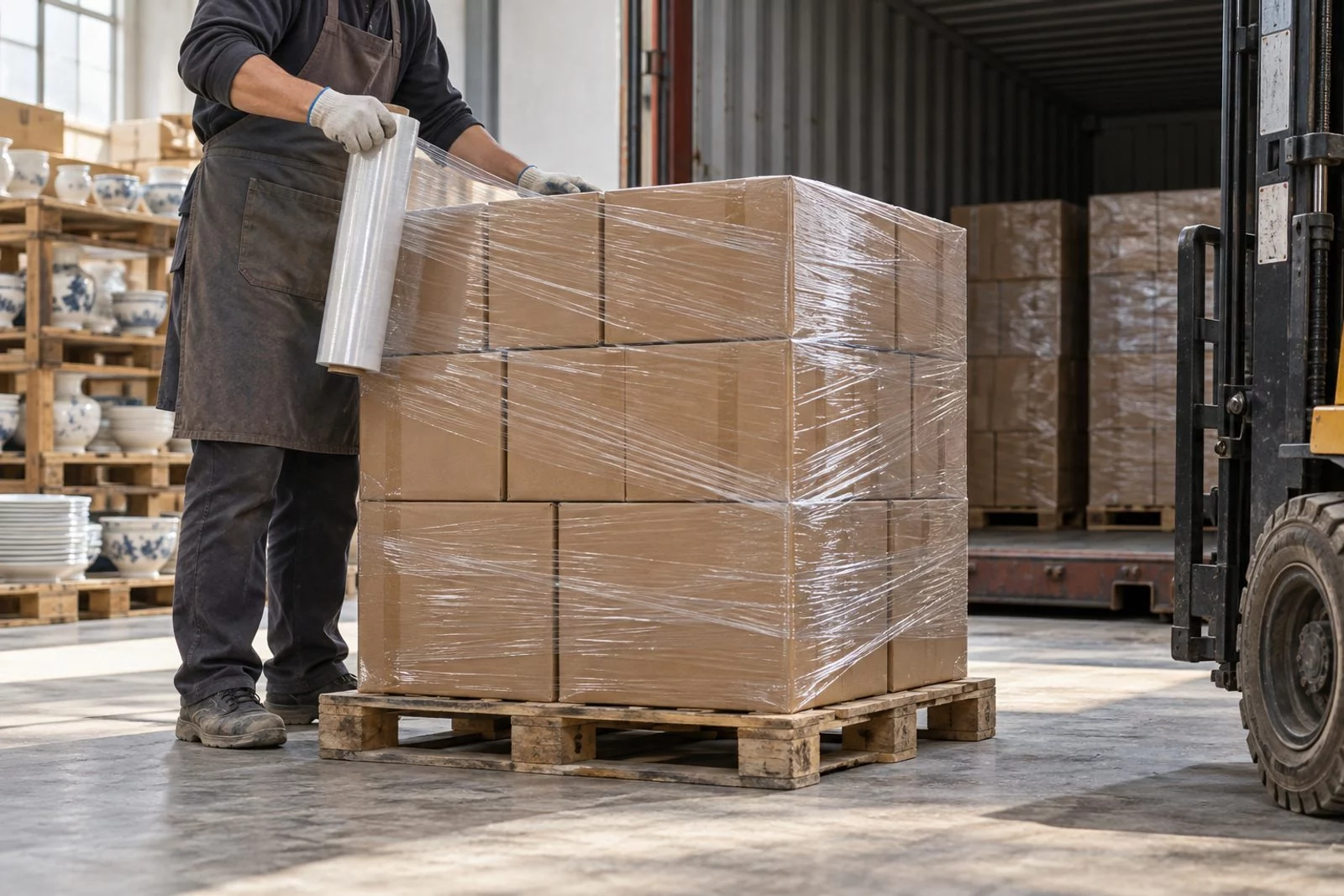
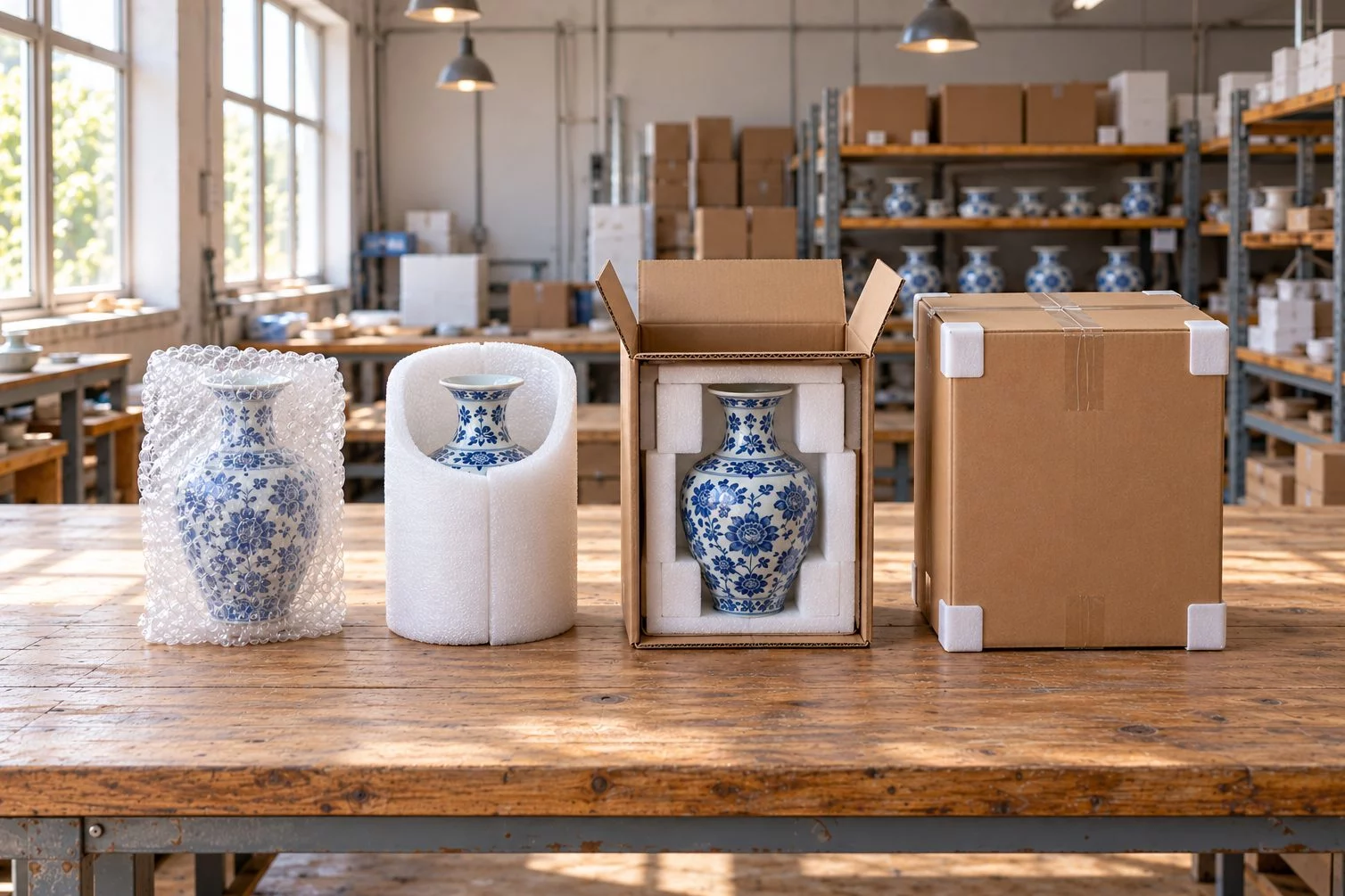
Every order, whether it comes from our own workshops or a partner kiln, is packed at our finished-product inspection and warehousing center in Jingdezhen. The standard build starts with a bubble bag on each piece and runs through EPE wrap and molded-pulp inserts to a five-layer export carton. Large pieces get solid-wood frames, and volume orders go out on stretch-wrapped pallets. Export packaging and branded boxes come from our partners in Chaozhou. The cartons carry your shipping marks with fragile and moisture labels. That standard protects the glaze in transit. Your channel decides everything around it: the box a customer sees, the label a warehouse scans and the way cartons are counted and marked.
On a retail shelf, the box is part of the product
In a store, the box is the first thing a shopper touches, so it deserves the same care as the piece inside. To plan it, send us:
- the box style you want: a printed color box or a rigid gift box;
- your print files, the item code and the barcode;
- the languages for any care or story card inside;
- how the box will sit on the shelf, upright or flat;
- how many units your stores want per master carton, which sets the outer carton size;
- your retailer’s carton-label rules, if it has its own.
Branded gift boxes and custom labels are part of our custom service. The box is sampled together with the piece, so you approve both at once.
Online orders: each piece travels alone after your warehouse
An online sale ends in a courier network that sorts by machine and hands each parcel on several times. If your warehouse will ship units one by one, say so in the brief. The protection then has to sit inside each unit’s own box rather than rely on the master carton around it. Tell us:
- how many pieces go in one customer parcel;
- whether your box also serves as the shipper;
- what your customer should see first on opening.
Small replenishment orders travel by DHL, FedEx or UPS in 3–7 business days, so a fast-selling line can be topped up between larger shipments. Ask your warehouse to photograph cartons as they arrive. Transit damage is reported to us within 48 hours with the shipping label and photos.
Hotel and project orders: cartons marked by floor and room
A hotel order is unpacked by people who did not place it, often on a site with no storeroom. We mark project cartons by room type, floor or zone, so the right cups reach the right lounge without every box being opened. To do that, we need:
- your room schedule or zone plan;
- the quantity for each area;
- the delivery address and the window when the site can receive goods;
- who signs for the delivery, and whether goods go to a warehouse first.
On DDP terms we deliver duty paid to the address you name. CIF and DDP shipments travel under our PICC blanket cargo policy. Project volumes move as sea freight, LCL or FCL, in 25–45 days depending on the destination port.
Statement pieces: one vase, one frame, one route
A floor vase or a one-of-a-kind piece ships as a consignment of its own. Pieces up to 130 cm travel in solid-wood frames built around their cushioning. Tell us the access at the destination: door widths, stairs, a lift or a loading dock, and whether a gallery team or a homeowner will do the unpacking. Choose air freight, 7–10 days, when the date matters most, or sea freight, 25–45 days, when it does not. Photos of the packed piece before the frame is closed are available on request, so you know exactly what your receiver will open.
Six details to send before the sample is approved
- The sales channel, or channels, for each piece.
- The destination address or port, and the trade term: EXW, FOB, CIF or DDP.
- The box style, print files, barcodes and the languages for printed inserts.
- Units per inner box and per master carton, plus any carton weight or pallet height limit at your warehouse.
- Shipping-mark and label rules from your retailer, forwarder or site.
- The date the goods must arrive.
With these in hand, the packing is planned before the price is final and approved alongside the sample. Before the cartons are sealed, Lin Wan confirms the counts, labels and marks with you in writing.
How to Import Ceramic Tableware from China: The Importer’s Route from Sample to Shelf
Import ceramic tableware from China step by step: importer setup, glaze tests, marks, trade terms, customs, FDA, cash and timing by market.
Shipping Porcelain from China: Packing, Freight, Customs and Landed Cost
How porcelain really ships from China: freight by volume, trade terms, where breakage happens, customs codes, duty, and landed cost per piece.
How to Import Porcelain from China: MOQ, Terms and Timing
How to import porcelain from China: check the maker, size a first order from 1, 10 or 50 pieces, sample and sign, choose EXW, FOB, CIF or DDP, and plan the calendar.