By Lin Wan, Foreign-Trade Lead at KKCN, Jingdezhen
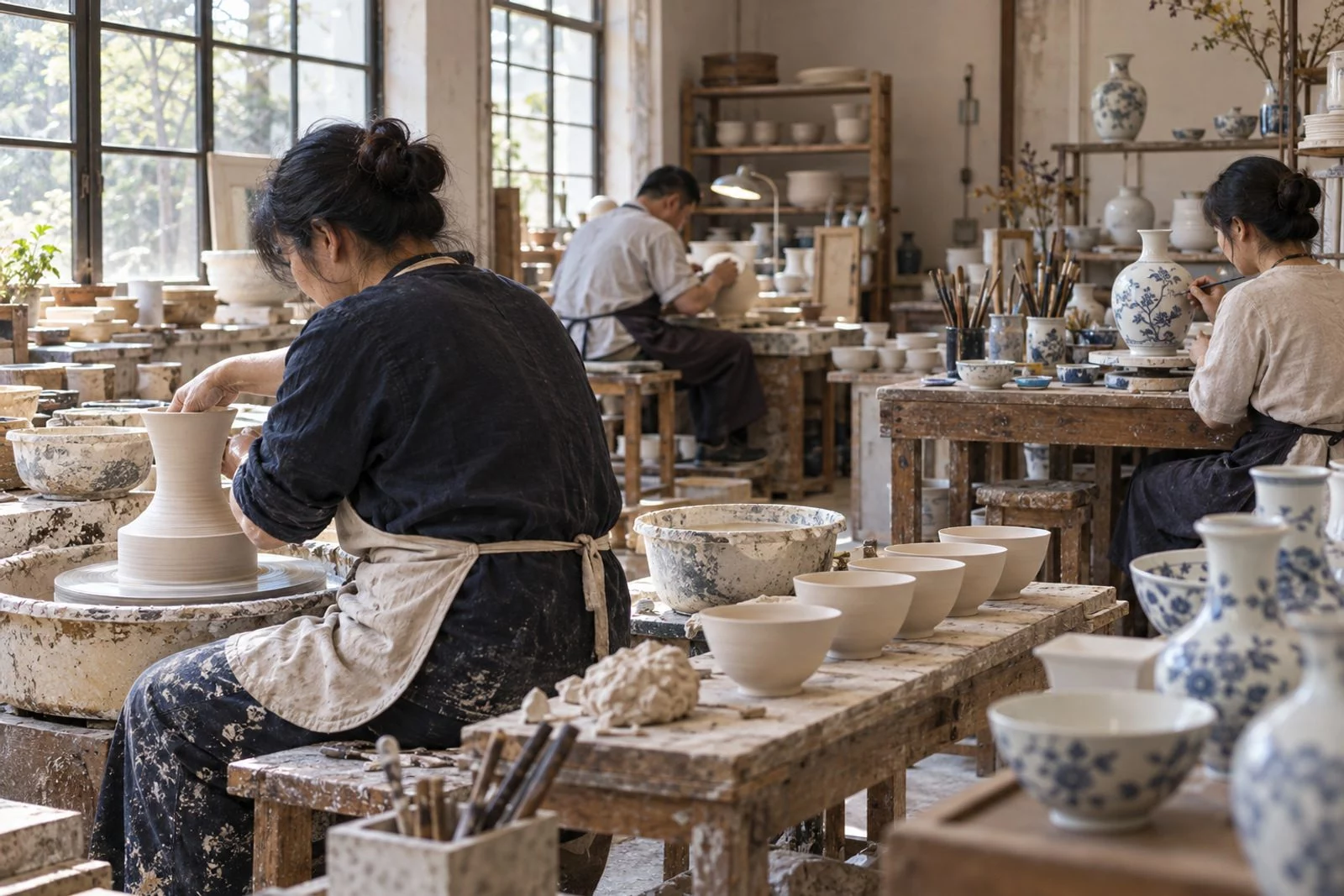
Search for Jingdezhen porcelain suppliers and you’ll find thousands of them, all using the same city name. Some are factories that take clay all the way to a packed export carton. Some are family workshops that do one step, like throwing or painting, for everyone else. Some are young artists with a wheel and a shared kiln, and some are offices that buy from all of the above. Any of them can be the right partner, but not for the same order. This guide explains the four kinds of maker you’ll meet in Jingdezhen, what each does well, and the questions that tell them apart before you pay for a sample.
Who wrote this. KKCN is a porcelain factory in Jingdezhen, so we’re one of the suppliers this page describes. We’ve tried to describe every kind of maker fairly, including the ones that compete with us.
Why Jingdezhen still matters to a buyer
Jingdezhen has made porcelain for more than a thousand years, and in July 2026 UNESCO added the Jingdezhen Handicraft Porcelain Industry Sites to the World Heritage List. What UNESCO recognized wasn’t a single kiln or museum. It was a whole production system that grew between the 10th and 19th centuries: 45 sites across 1,979 hectares, from clay pits and transport routes to workshops and the neighborhoods where potters lived, including the Guanyinge kiln site where porcelain made for European buyers has been excavated.
That system is the practical reason to buy here. The city still divides the work into specialist steps, and the people who do each step live and work within a short drive of each other: body makers, mold makers, throwers, trimmers, glaze mixers, painters in several distinct styles, and kilns of every size. The industry is large, too. Xinhua reported its output at more than 93 billion yuan in 2024. For a buyer, this means almost any porcelain technique is available somewhere in town. The hard part is finding who does it well and who will take responsibility for the whole piece.
Four kinds of Jingdezhen porcelain supplier
Integrated factories
An integrated factory takes a piece from clay or blank through forming, glazing, decoration, firing, inspection and export packing, with its own kilns and staff. Some are modern tableware plants making large volumes of standard shapes; others, like ours, combine their own workshops with a network of specialist artisans for particular techniques. Their value to a buyer is accountability: one contract, one sample approval, and one company responsible if the glaze or the packing goes wrong. Integrated factories are the natural choice for repeat orders, private-label ranges and anything that must match a sample across several production runs.
Family and specialist workshops
Much of Jingdezhen’s skill sits in small workshops that do one or two steps very well. A family may throw and trim large vases, another may paint only blue and white, another may run a wood kiln a few times a year. These workshops are where many of the city’s most refined hand techniques live. Buying directly from them can work for a single technique and a buyer who is in Jingdezhen often. For an overseas order that needs several steps, someone has to coordinate the workshops, check each stage and carry the risk, and that role usually falls to a factory or a trader.
Studio artists and young makers
Jingdezhen has drawn a new generation of artists and designers from across China and abroad, often called “jingpiao.” Many of them sell through markets and studios such as Taoxichuan, a former state porcelain factory that was renovated from 2013, opened in 2016 and now hosts a weekend creative market, artist residencies and millions of visitors a year. Studio makers are where you find original forms and small editions, and they can be ideal for a gallery, a concept store or a designer collaboration. The usual limits are capacity, export paperwork and the ability to repeat an edition exactly a year later, so ask about each before you plan a reorder.
Trading and sourcing offices
Trading companies and sourcing offices in Jingdezhen buy from factories, workshops and studios and sell on, often with English-speaking staff and export handling. A good one saves you weeks of coordination across several makers. The cost is margin and distance from the people actually making your goods, and some use the city’s name on pieces partly made elsewhere.
| Supplier type | Best for | Watch out for |
|---|---|---|
| Integrated factory | Repeat orders, private label, matched samples | Minimums for custom work; ask which steps are done in-house |
| Family or specialist workshop | One technique done exceptionally well | Coordination and quality checks across steps fall to you |
| Studio artist | Original designs and small editions | Capacity, export papers, repeating an edition |
| Trading or sourcing office | Mixed orders across many makers | Margin, and where each piece is really made |
Questions that tell them apart
You can learn more from five questions than from a website. Where is each step done? Ask the supplier to name who forms, glazes, decorates and fires your piece, and whether those steps happen in its own workshops. Whose kiln fires it, and at what temperature? A factory with its own kilns can tell you the firing range and cycle; a trader will have to ask. Who paints it? For hand-painted work, ask whether the same painters will do the reorder. Who keeps the molds and glaze records? A reorder two years from now depends on both. Can you see it? A video call that walks from the forming area to the kiln answers most of the above in ten minutes.
There’s also a fair question to ask about the city’s name. Jingdezhen workshops use bodies, decals and packaging from other Chinese ceramic centers, and that’s normal. What matters is that the supplier tells you which steps happen where, so the “made in Jingdezhen” on your product page is accurate.
Where KKCN fits
KKCN started in 1996 as a small handmade workshop on Doufunong old street and is now an integrated factory: three workshops and four natural-gas kilns firing up to 1,330 °C, where we fire every glaze we sell. Our 42 staff work with 86 partner artisans, including 15 with more than 30 years’ experience and two provincial intangible-heritage inheritors, which is how we cover techniques a single workshop can’t. Core forming, hand painting, glazing and firing happen in Jingdezhen; partners in Dehua supply high-white bodies and complex molds, partners in Chaozhou supply decals and export packaging, and every order comes back to Jingdezhen for final inspection. Custom work starts at 50 pieces per style and one-off commissions at one piece. We’re not a volume plant, and buyers who need tens of thousands of identical plates should look at the larger makers on our list of China’s top ceramic suppliers.
Buyers with a small first order should read low-MOQ ceramic suppliers. For how our own workshops make and fire porcelain, see our Jingdezhen porcelain manufacturer page.
Lin Wan leads foreign trade at KKCN in Jingdezhen, coordinating buyers’ requirements, samples, orders and after-sales across Europe, North America, the Middle East and Southeast Asia. Ten years in ceramic export, working in English and Chinese.